
By Paul Bond
Chief Correspondent, Culture
0
Share
Newsweek is a Trust Project member
See more of our trusted coverage when you search.Prefer Newsweek on Googleto see more of our trusted coverage when you search.
Michael Richards, best known for his role as Kramer on the iconic TV show Seinfeld, hasn't been seen on television much since his 2006 racial-slur laden meltdown at a Hollywood comedy club.
He also hasn't spoken too much about the event since a widely panned apology on The Late Show with David Letterman, an appearance he made three days after his rant, the day video emerged and made him one of the top stories nationwide.
While some point to Richards as an early example of cancel culture, he never claims to have been "canceled." He was still getting offers, a few of which he accepted. Most notably, in 2009 he reluctantly appeared on a Seinfeld reunion of sorts in episodes of Curb Your Enthusiasm, the HBO show created by Larry David, the co-creator of Seinfeld. Richards says it was his choice to largely shut down his career as an actor-comedian.
Read More on Entertainment
In his new autobiography, dubbed "Entrances and Exits," set for release on June 4, he finally lays bare the incident — while also offering plenty of behind-the-scenes anecdotes for Seinfeld aficionados to pore over.
Life after Kramer
Richards writes that he's always had a problem controlling his "rage" and that the genesis of his Laugh Factory rant might have been the failure of The Michael Richards Show, which was canceled after just two months in 2000.
Fast-forward six years, and he's in a parking lot when someone shouts to him, "Do you know who you are?" He figures it's a "kooky fan," though, in fact, it's George Carlin, and the legendary comedian invites him to see him perform at the Universal Amphitheater and the Comedy & Magic Club.
Richards hadn't done standup in 18 years, though watching Carlin on stage gives him the urge to have at it again, he writes. Soon, the then 57-year-old actor is doing two shows a week at The Comedy & Magic Club and he branches out to the Improv, The Comedy Store and The Laugh Factory.
Before his now-infamous set on November 17, 2006 at the Laugh Factory, he appears on a talk show hosted by a producer of the failed Michael Richards Show. It's awkward, but a chance to "button things up." Then he's stuck in traffic on his way to the Comedy Store and, after that, The Laugh Factory.
His set is 25 minutes late and he's informed the audience is "edgy, all drunk." It's a surprise appearance and the audience goes wild when they see "Kramer" on stage. He plays a physical bit — impersonating a dog on a leash — but can't hear laughter, only talking and commotion from the balcony.
He shouts, "Shut the f--- up!" and gets a laugh. He figures it's time to "go wild" and "be naughty," which is what standup comedy is all about, he writes. But the room goes quiet when someone in the balcony yells, "You're not funny."
It's his biggest fear — not being funny — and they are fighting words for a comic. He angrily hurls the N-word repeatedly toward the balcony. "He went low, and I went even lower ... shocked at my foul language and anger, I drop the mic and leave the stage," he writes.
After his set, he tries to find the man who called him unfunny and "make peace" with him, but his group had already been given a refund and left the club. In retrospect, he should have yelled back at the guy, "Okay, I'm not very funny tonight. Is there anything I can do? Wash your car, mow your lawn?" But he didn't think of that at the time.
Fallout from Richards' set
The Laugh Factory founder Jamie Masada tried consoling him with stories of other comedians who had a bad night, like when Sam Kinison fought with a man who was angry about Kinison mocking Jesus; or when Carlin threw a chair at someone who interrupted his act.
Richards reminds himself to never blame the audience for a bad show and resolves to power through the dark times, thus he's back on stage the following night. After his set, a reporter asks him how he plans to "make amends for my racism once the footage from my act is shown to the country."
He writes that no recording of shows is allowed — it's right there on the tickets – thus wonders how a woman has video and is backstage asking him about it.
"On Monday, I'm the biggest story on every news outlet in the country," he writes, and Larry King sends a handwritten letter to his home asking him to appear on CNN. Richards doesn't respond, but Jerry Seinfeld is scheduled on Letterman that night and asks Richards if he'll appear via satellite to apologize, and he agrees.
Stepping away from comedy
"I lost my temper onstage. I was at the comedy club trying to do my act, and I got heckled ... and went into a rage. Said some pretty nasty thing to some Afro Americans. A lot to trash talk," he tells Letterman that night.
When the audience chuckles nervously, Seinfeld admonishes them: "Stop laughing. It's not funny."
Richards ends his apology with, "I have to do personal work."
That work includes coming to grips with his childhood, born of a single mother who nearly aborted him before giving birth and allowing him to be adopted, only to change her mind two weeks later and reclaim him from his adoptive parents. And he still doesn't know who his father is.
He withdraws from the world and seeks help from a Jungian therapist and a Hindu monk, and he immerses himself in Vedanta philosophy and takes up photography.
He writes that celebrities he hasn't heard from in years reach out to console him, as do his Seinfeld costars: Seinfeld, Julia Louis-Dreyfus and Jason Alexander.
He reveals in his book that he was diagnosed with prostate cancer six years ago and thought he'd die. A successful surgery saved his life.
And he writes that his "personal work" paid off, as he's now at peace; he no longer seeks the limelight, nor does he miss the limelight.
How Richards became "Kramer"
But all of this comes at the tail end of his upcoming book because, first, he regales the reader with the backstage fun and drama of Seinfeld.
...
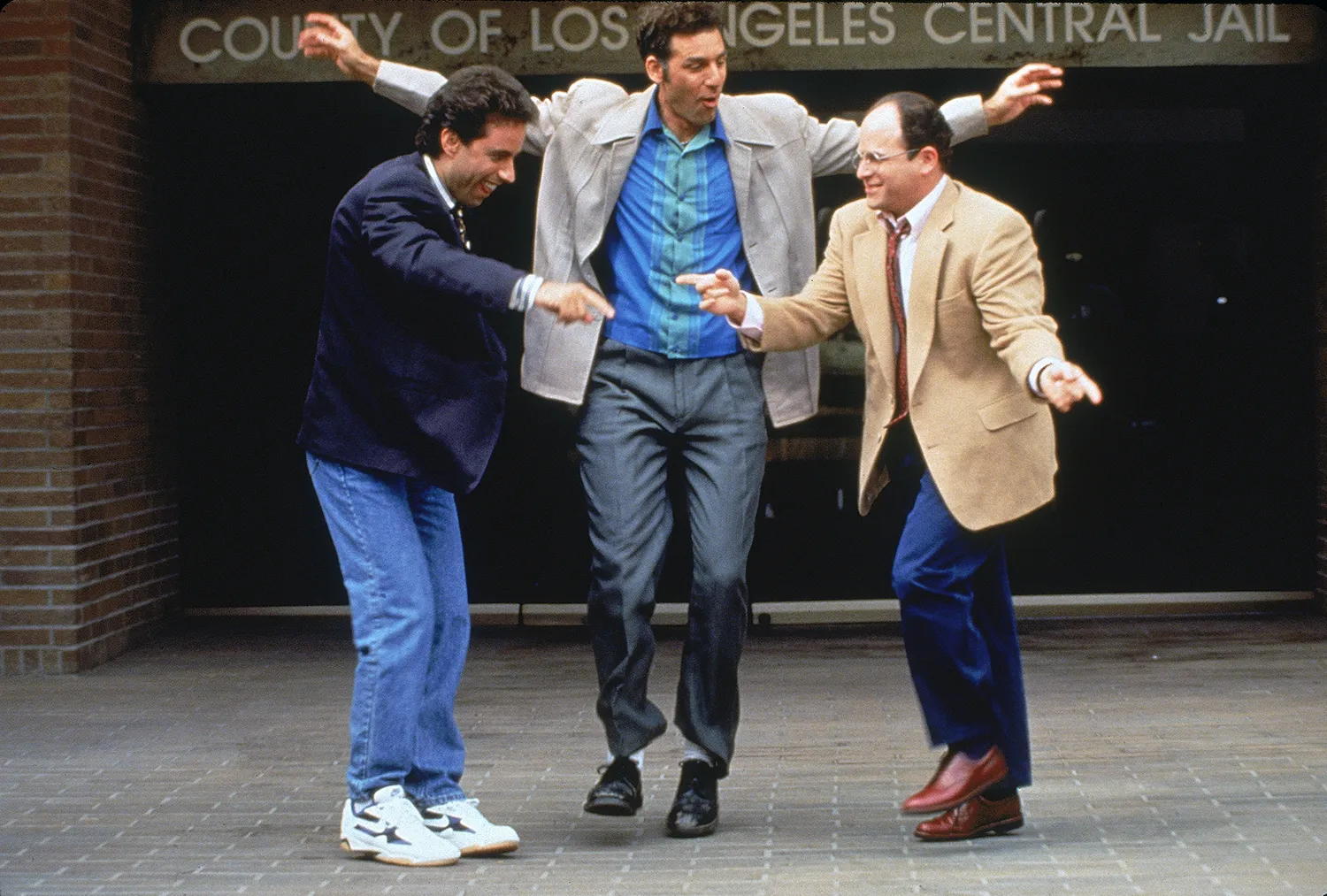
It was in 1989 when Seinfeld and his pal, Larry David, were creating a show to be dubbed, The Seinfeld Chronicles and they needed someone to play Jerry's neighbor, named Kessler at the time. Richards was set for a bit on The Tonight Show with Johnny Carson on a night when Jay Leno was subbing for Carson.
The skit had Richards playing a skinny, clumsy fitness guru to the stars, a character he called Dick Williams. Seinfeld, who wrote the forward to the book, writes that when he saw Richards on Leno, "I fell hopelessly, forever in love with him." The network required a multi-layered audition process but it was a charade, because "no one else stood a chance."
The Kessler character was based on a neighbor of Larry David, comic Kenny Kramer, and George Costanza, was based on David himself. That role went to Alexander, though others who were considered included Danny DeVito, Larry Miller, Nathan Lane and Steve Buscemi.
The pilot aired on July 5, 1989 and NBC approved four more episodes, but network suits wanted to replace both Richards and Alexander and add a girlfriend. They settled on keeping both actors and adding Elaine, an ex-girlfriend of Jerry's to be played by Louis-Dreyfus, and Kessler's name was changed to Kramer.
Behind the scenes on "Seinfeld"
Seinfeld writes that "no real-life rules would apply" to Kramer, a character he likened to Harpo Marx, Stan Laurel and Bugs Bunny. "Whatever's funny, that's what Kramer would be."
But Richards writes that he presumed he'd be gone after the initial four episodes, especially after NBC set up a promotional photo shoot with his three costars and did not include him.
He's also upset that his character doesn't appear at all in one of those four episodes, "The Chinese Restaurant," where Jerry, George and Elaine can't get a table. Later, when the show is a bonafide hit, George is left out of two episodes dubbed "The Pen" that take place at Jerry's parents' home in Florida, and Alexander threatens to quit over the snub.
"This business breeds both massive egos and incredible insecurity," writes Richards.
When the show adds a nemesis for Jerry, a neighbor named Newman, Seinfeld slumps to the floor laughing at Wayne Knight's portrayal of the mailman.
Richards writes that he didn't like an episode dubbed "The Bris" because the rabbi is "loud and mean and way over the top," and that among David's favorite episodes is "The Puffy Shirt." Among Richards' favorites is "The Jimmy," where Kramer is mistaken for someone with special needs.
For the episode "The Stand-In," Mickey, played by Danny Woodburn, flies into a rage when George calls him a midget instead of a little person. In reality, Woodburn tells Richards off-camera, "You can call me a f---ing martian. I don't give a doo-da."
The character Izzy Mendelbaum, an elderly fitness fanatic who takes offense when Jerry jokes about his advanced age, was supposed to be played by legendary comic Jerry Lewis, but the network balked at his $50,000 salary demand so the part went to Lloyd Bridges, according to Richards.
Ironically, the last episode before the show's finale in 1998, called "The Puerto Rican Day," has Kramer doing something so politically incorrect that it was "canceled" for a time—removed from the rotation of reruns. The scene that caused NBC to ban the episode, according to entertainment trade papers, has Kramer accidentally lighting a Puerto Rican flag on fire and stomping on it to put out the flames.
"It's an ultra-comedy of errors, certainly not real politics," Richards writes.
The episode has since been added back to the rotation, and can be seen both on broadcast TV and on Netflix.
Finding "Meaningful Purpose"
Richards also tells anecdotes away from the show, like when Bruce Willis tells him to "be careful" with a woman flirting with him, advice that proved prescient. And when Mel Gibson invites him to join a weekly card game at his home, he declines, writing that, "I can't sit around with Braveheart," given that Richards is typically shy and awkward around other celebrities.
There's even an OJ Simpson sighting in the book.
In 1995, Richards is with Ed Begley Jr. at a party hosted by Gavin de Becker, a well-known security expert for celebrities. Other guests include Peter Falk and Jeff Goldblum, and all are talking about the so-called "trial of the century" when prosecutors Marcia Clark and Chris Darden walk through the door.
"You've got Columbo, Dr. Ehrlich from St. Elsewhere, the scientist from Jurassic Park, and Kramer huddling with the legal team trying football great OJ Simpson for murder," writes Richards.
"It's surreal, especially when Peter says he has to go but steps back into the living room a moment later with just one more question, as he usually does through his character Columbo, another question that usually leads him to solve the case."
At the gathering, Clark and Darden express concern about their chances of convicting Simpson, who was found not guilty a few weeks after de Becker's party.
In the final chapter, it is 2022 and he's preparing to write his autobiography by doing something he has never done before: watching every episode of Seinfeld, and he's doing so with his son, Antonio. Richards is impressed with his co-stars and guest-stars and is recalling the hard work they all put into the show, and his son is laughing.
"I'm reliving Seinfeld through my son, grateful to have put my interest in acting to a meaningful purpose," he writes.
View 0 Comments
Submit Correction
View Editorial & AI Guidelines