
...

By Gabe Whisnant
News Editor
0
Share
Newsweek is a Trust Project member
See more of our trusted coverage when you search.Prefer Newsweek on Googleto see more of our trusted coverage when you search.
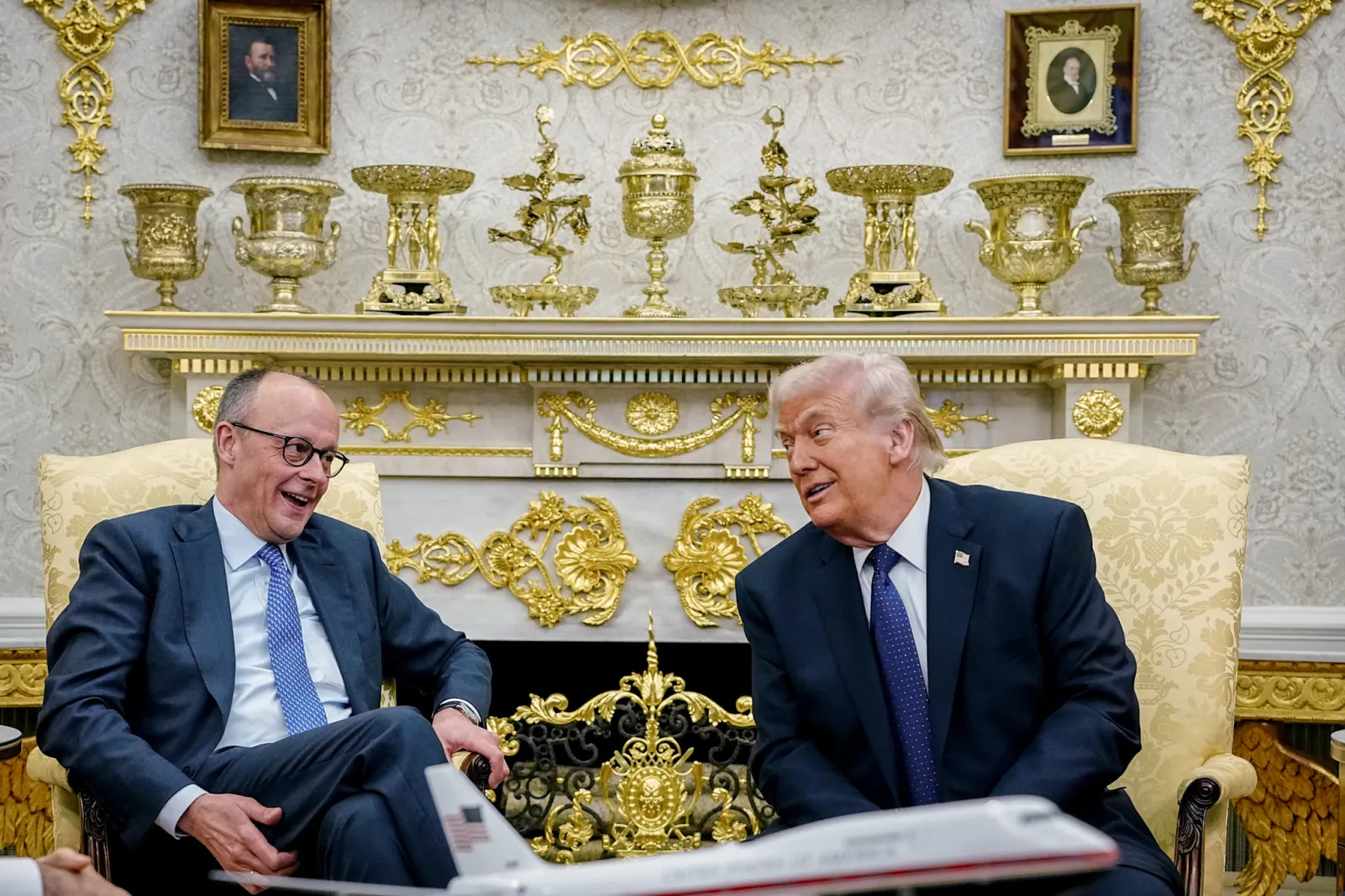
German Chancellor Friedrich Merz said on Friday he would not advise his children to study or work in the United States, citing concerns about the country's "social climate."
The remarks underscore growing unease among European leaders about shifting economic prospects and social conditions in the United States, challenging its long-standing appeal to global talent. The comments also come amid Merz's disputes with U.S. President Donald Trump over the Iran war and Washington's decision to reduce its troop levels in Germany.
Speaking at a Catholic Congress panel in Wuerzburg, Merz said admiration for the U.S. was "not growing," adding that highly educated workers now faced difficulty finding jobs compared with a year ago.
Read More on World
"I am a great admirer of America. My admiration isn't growing at the moment," he said. "So, I wouldn't recommend to my children today that they go to the U.S., get an education there, and work there. Simply because of a social climate that has suddenly developed there."
"By the way, the question of what well-educated young people can achieve used to be answered very differently in America up until a year ago than it is today," he continued. "Today, the best-educated in America have great difficulty finding a job."
Newsweek reached out to the White House via email for comment.
...
U.S. Job Market: Mixed Signals for Highly Educated Workers
Recent data suggests Merz’s remarks reflect a real but more limited trend affecting young, highly educated workers entering the U.S. job market. The unemployment rate for recent college graduates has risen above the overall rate, with many also working in roles that do not require a degree, pointing to a more difficult transition from education to employment than in previous years.
Data from the Federal Reserve Bank of New York show that unemployment among recent college graduates was about 5.7 percent in early 2026, with more than 40 percent underemployed in roles that typically do not require a degree.
“Young people are bearing the brunt of a lot of economic uncertainty…The people that you often are most hesitant in hiring… are entry-level positions,” Brad Hersbein, a senior economist at the Upjohn Institute, told the Associated Press.
At the same time, economists say the broader labor market remains relatively strong for skilled workers overall, who still tend to have lower unemployment and better long-term prospects than less-educated groups. Analysts describe the shift as a softening in entry-level hiring and changing workforce dynamics rather than a collapse in opportunity, suggesting a more nuanced picture than Merz’s comments imply.
“By many measures, the labor market is still relatively strong,” Cory Stahle, a senior economist at Indeed Hiring Lab, recently told CNBC, adding that the slowdown has been concentrated in entry-level hiring.
Merz Says He's Aligned With Trump on Iran, Strait of Hormuz
Merz also said on Friday, following a phone call, that he and Trump agreed that Iran must return to negotiations, reopen the Strait of Hormuz and not be allowed to acquire nuclear weapons.
Merz said he spoke with Trump as the U.S. president returned from China, signaling an easing of recent tensions between Washington and Berlin.
On X, Merz wrote that the two leaders also discussed a peaceful solution to the Russia-Ukraine war and coordinated positions ahead of a NATO summit in Ankara, Turkey, adding that the United States and Germany remained "strong partners in a strong NATO."
Last month, Merz said the leadership in Tehran is humiliating the Trump administration, the strongest criticism yet by the country at the heart of the European Union, G7 and NATO of the United States' approach to the war in Iran.
"The Iranians are clearly stronger than expected, and the Americans clearly have no truly convincing strategy in the negotiations either," Merz said during a school visit in Marsberg, a town in his home region of Sauerland.
He added, "A whole nation is being humiliated by the Iranian leadership."
Trump then sharply criticized Merz, saying that the German leader is willing to tolerate a nuclear‑armed Iran. In a post on Truth Social, Trump said Merz “thinks it’s OK for Iran to have a Nuclear Weapon,” adding that the chancellor “doesn’t know what he’s talking about.”
Trump Vows Deeper Troop Cuts in Germany as NATO Tensions Rise
Trump’s pledge to scale back U.S. troop levels in Germany has renewed focus on America’s military role in Europe.
The United States typically maintains between 80,000 and 100,000 troops across the continent, including more than 36,000 stationed in Germany. The Pentagon announced earlier this month it would withdraw about 5,000 troops, and Trump said the following day he planned to go “a lot further.”The U.S. has also stopped a planned rotation of more than 4,000 American troops en route to Poland.
Members of the 2nd Armored Brigade Combat Team, 1st Cavalry Division, had already left their Texas home base for Poland when the order came to halt the scheduled rotation, an official familiar with the matter told Newsweek on Friday.
A temporary deployment of troops to Europe had been "paused" so the U.S. could re-evaluate where its soldiers and military equipment were dotted around Europe, Lithuanian Defense Minister Robertas Kaunas told the Baltic country's LRT state broadcaster on Thursday.
The U.S. presence dates to World War II and the Cold War, when American forces helped stabilize Europe and deter Soviet expansion. More recently, those deployments have supported operations in the Arctic, Africa and the Middle East, including ongoing tensions involving Iran.
Trump, however, has broken with longstanding bipartisan policy by criticizing NATO allies and moving to reduce the U.S. security footprint in Europe.
View 0 Comments
Submit Correction
View Editorial & AI Guidelines