...

By Jasmine Laws
Reporter
0
Share
Newsweek is a Trust Project member
See more of our trusted coverage when you search.Prefer Newsweek on Googleto see more of our trusted coverage when you search.
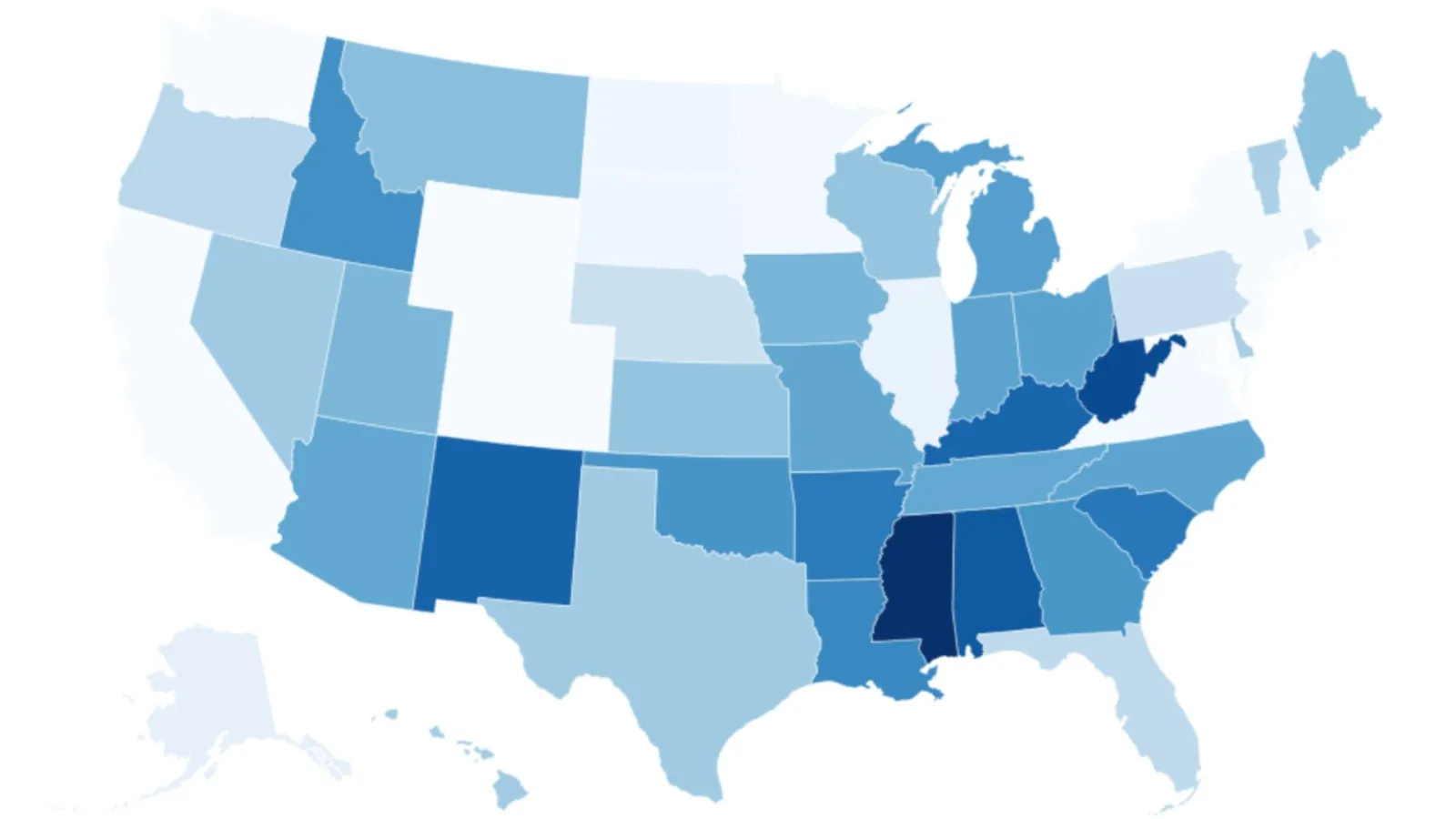
Mississippi and West Virginia are the states that receive the most federal assistance for Medicaid, as shown by data from the health policy research center Kaiser Family Foundation (KFF).
Newsweek has contacted the Centers for Medicare and Medicaid via email for comment.
Why It Matters
Concerns for potential cuts to Medicaid ramped up when the GOP budget passed through the House, as now the House Energy and Commerce Committee, which oversees Medicaid, is looking to cut $880 billion in spending over the next decade.
Read More on Politics
Critics of the budget warned it would result in the "gutting" of Medicaid, a program used by some 80 million Americans, many of whom are President Donald Trump's supporters.
What To Know
The majority of Medicaid spending comes from the federal government—as much as 67 percent of the program is federal government funded, according to the National Association of State Budget Officers.
Many states are therefore worrying about the impact the federal government spending cuts will have on Medicaid, especially for those that rely heavily on government funding to run the program.
Mississippi is the state that receives the most support from the federal government to run Medicaid, as the federal medical assistance percentage (FMAP) in the state is 77 percent.
FMAP is calculated by taking into account the average per capita income for each state relative to the national average. No state currently receives a FMAP lower than 50 percent.
West Virginia also received a significant amount of assistance from the government, having a FMAP of 74 percent.
Kentucky, Alabama, South Carolina, Arkansas, and New Mexico are other states receiving a higher proportion of federal government support in running Medicaid services, with percentages of 71, 73, 70, 69 and 72 respectively.
Out of these seven states that receive the most government support for Medicaid, six of them voted for Trump in the 2024 Presidential Election.
New Mexico was the only state that voted for his Democratic opponent, former Vice President Kamala Harris.
The states which received the minimum amount of support from the government, with a FMAP of 50 percent, were Washington, California, Colorado, Connecticut, Wyoming, New Jersey, Maryland, Massachusetts, New Hampshire, and New York.
Of the states receiving the smallest proportion of support from the government for Medicaid, the only state that voted for Trump in the November election was Wyoming— the others were all supporters of Harris.
While it does not receive as much federal support as other states, KFF data also shows that Oregon is expected to see the largest decline in Medicaid enrollment.
What People Are Saying
Michael Sparer, chair of the Department of Health Policy and Management at the Mailman School of Public Health at Columbia University, told Newsweek: "Unless individual states made up for the lost federal funding, millions of Americans would lose their insurance coverage. This impact would be felt particularly strongly in states such as Mississippi and Arkansas that can least afford to make up the difference. The newly uninsured persons would likely end up either forgoing needed care or receiving uncompensated care in safety net hospitals and community health centers, leading many of those institutions to teeter near bankruptcy.
"Governors in many states would need to cut other parts of their budgets to meet balanced budget requirements. These political dynamics leave President Trump and the Republican Party in a difficult position. The only path to renewing the tax cuts for the wealthy could be by cutting Medicaid coverage for the low-and-middle income."
@TheDemocrats, an account on X with more than 2.3 million followers on the platform, wrote in a post on X on Wednesday: "41 percent of all births in the United States are covered by Medicaid—which House Republicans voted to cut."
Texas Representative Al Green said when explaining why he interrupted Trump during his address in Congress: "I wanted him to know that he didn't have a mandate to cut Medicaid. I did this because Medicaid is the only insurance many people have in this country. I am blessed as I stand here now, there's a physician waiting if something should happen."
"I have the best health care in the world. There are other people who have less than I have. I would have them have what I have. But I surely would not stand by and see them lose what little they do have," he added.
What's Next
It is still not clear where the House Energy and Commerce Committee will find its savings; however, analysis by the nonpartisan Congressional Budget Office released this week showed that the GOP's budget goals could not be reached without reducing spending on Medicaid.
Update 03/10/25, 04:05 a.m. ET: This article has been updated with comment from Michael Sparer.
View 0 Comments
Submit Correction
View Editorial & AI Guidelines