10
Loading video...

By Amanda Greenwood
Associate News Editor
0
Share
Newsweek is a Trust Project member
See more of our trusted coverage when you search.Prefer Newsweek on Googleto see more of our trusted coverage when you search.
McDonald's is facing a nationwide class-action lawsuit that accuses the fast-food giant of using an AI-powered pricing system to coordinate menu prices across its U.S. restaurants, days after the company publicly insisted that "AI does not set the price of a Big Mac or any other menu item."
The lawsuit, filed in federal court in Chicago on October 2, alleges that McDonald's violated U.S. antitrust law by conspiring with independent franchisees to fix prices using algorithms trained on nonpublic pricing data.
The plaintiff, Michael Thomas, is seeking to represent potentially millions of McDonald's customers nationwide.
Read More on News
In a statement emailed to Newsweek on Tuesday, McDonald's USA said: “These speculative and uninformed claims attempt to recast a standard business practice as something controversial. AI does not set the price of a Big Mac or any other menu item."
"The use of pricing recommendation tools and analytics is widespread across industries. McDonald’s franchisees make their own pricing decisions. The pricing portal is a tool, not a mandate, designed to provide restaurant-specific recommendations to help franchisees deliver value for customers and make informed business decisions.”
...
What Preceded the McDonald's Lawsuit?
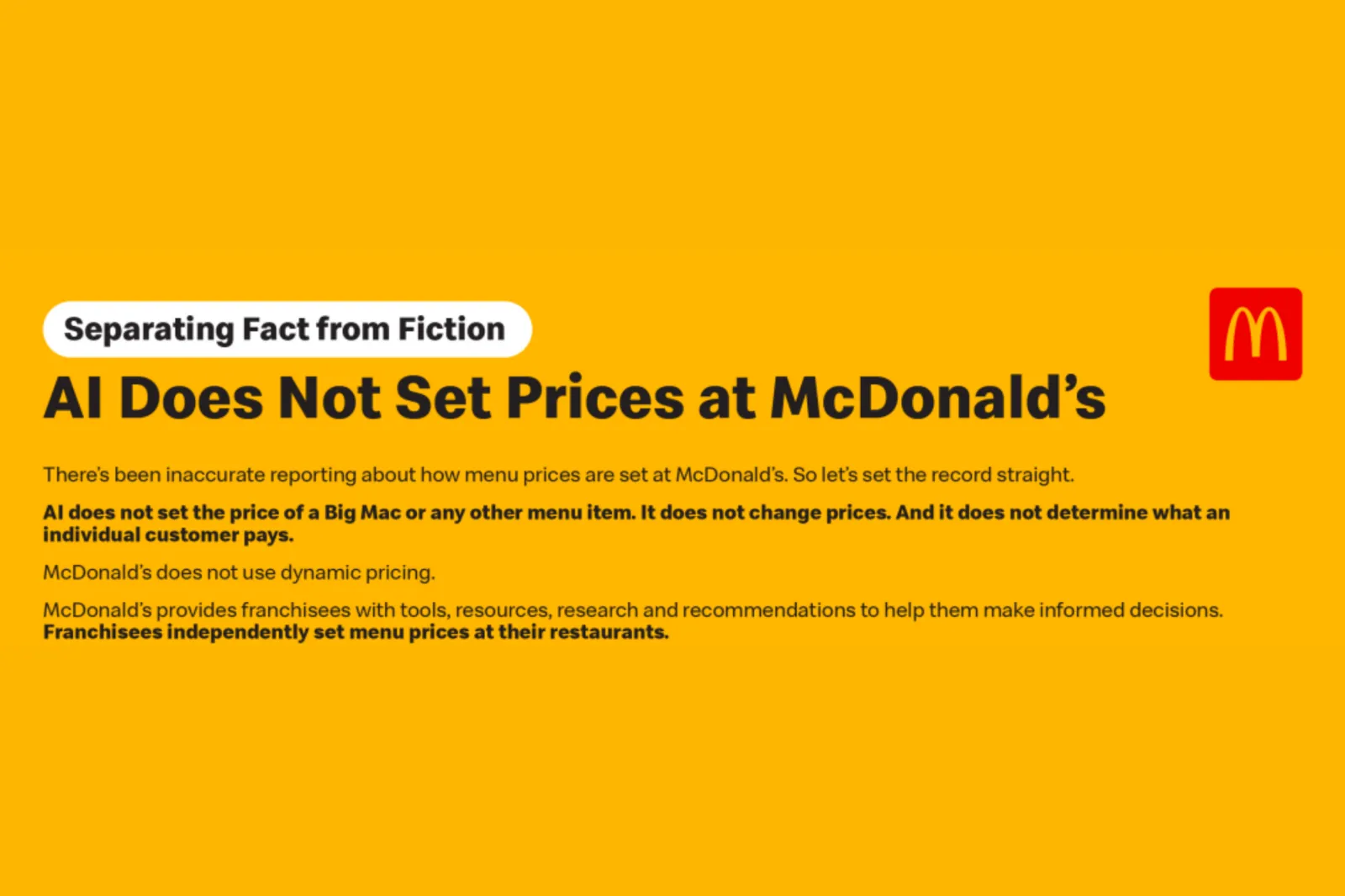
On October 1, McDonald's published a fact-checking statement titled "Separating Fact from Fiction: AI Does Not Set Prices at McDonald's," arguing that media outlets had misrepresented its practices.
"There's been inaccurate reporting about how menu prices are set at McDonald's. So let's set the record straight," the release said.
The company said franchisees independently decide menu prices, and that its pricing tools merely provide recommendations based on local market conditions. It also denied using dynamic pricing or charging different amounts based on what individual customers are willing to pay.
Related Story

McDonald’s Is Spending $8.5 Billion. 7 Changes Customers Could See
However, a Reuters investigation published a few days earlier, which the lawsuit cites, reported that McDonald's pricing engine uses machine-learning algorithms to analyze millions of daily transactions across almost 14,000 U.S. restaurants and generate what the company calls the "optimal price" for menu items at individual locations.
Reuters reported that the system incorporates factors such as local demand, competitor pricing and estimates of customer willingness to pay.
The lawsuit argues that the system suppressed competition because independently operated franchise restaurants should set prices independently, but instead allegedly used pricing recommendations generated by a common algorithm trained on pooled, nonpublic competitor data.
What Is AI Pricing?
AI pricing, sometimes called algorithmic pricing, uses machine learning and large datasets to recommend prices based on factors such as local demand, historical sales, operating costs, competitors' prices and consumer behavior.
Companies say such systems help businesses respond more effectively to local economic conditions. Critics, however, argue that when many businesses rely on the same algorithm or shared datasets, prices can become more closely aligned, potentially reducing competition. This concern has already triggered lawsuits involving apartment rents, hotel pricing and other industries.
For consumers, the controversy centers on the possibility that AI could recommend higher prices based on what customers in a specific area appear willing to pay. Reuters reported that McDonald's system includes estimates of customer willingness to pay in local markets, although the company says restaurant operators make the final pricing decisions.

...
What McDonald's Said About the Lawsuit
McDonald's has strongly rejected the lawsuit's allegations. It maintains that franchisees decide whether to accept pricing recommendations and that analytics tools are widely used throughout the business world.
McDonald's told Newsweek that it does not use dynamic pricing and that its pricing tools do not tailor prices to individual customers or change prices in real time. The company said local restaurant owners consider factors such as costs, demand, competition and economic conditions when setting prices, and that franchisees ultimately make their own pricing decisions.
The company added that pricing analytics tools have long been used across industries to help operators deliver value to customers, while accounting for differences in local market conditions among its nearly 14,000 U.S. restaurants.
Growing Scrutiny of AI-Powered Pricing
The lawsuit comes amid a broader push by lawmakers and regulators to scrutinize the use of artificial intelligence and algorithms in pricing decisions.
Several states have recently moved to restrict certain forms of algorithmic pricing.
In California, a law that took effect in January amended the state's antitrust rules to prohibit the use of a "common pricing algorithm" that relies on competitors' data to recommend, align or influence prices as part of an anticompetitive agreement.
Other states have focused on so-called "surveillance pricing," in which companies use personal information, browsing habits, location data or other consumer characteristics to determine how much an individual customer is likely to pay. Maryland, Connecticut and New Jersey have enacted restrictions targeting such practices, while lawmakers in other states have proposed similar measures.
The growing legislative activity reflects concerns that increasingly sophisticated algorithms could allow businesses to coordinate prices more closely or charge consumers higher prices based on data-driven predictions of their willingness to pay. Critics argue that such systems can undermine competition and transparency, while businesses contend that pricing analytics are simply modern tools for responding to local market conditions.
The lawsuit against McDonald's touches on the first of those concerns. According to the complaint, the company used machine-learning algorithms trained on nonpublic restaurant data to generate pricing recommendations across its U.S. network. The plaintiff argues that the practice violates antitrust law because independently owned franchisees are expected to make pricing decisions independently rather than relying on recommendations derived from shared data. McDonald's denies the allegations and says franchisees retain full authority over menu prices.
This legal battle could become an early test of how courts apply long-standing antitrust rules to AI-powered pricing systems, an issue that lawmakers and regulators across the country are increasingly examining.
Newsweek's reporters and editors used Martyn, our AI assistant, to produce this story. Learn more about Martyn here.
Contact Newsweek editors on this story: Ben Kelly and Shakeema Edwards.
View 0 Comments
Submit Correction
View Editorial & AI Guidelines