...

By Melissa Fleur Afshar
Reporter
0
Share
Newsweek is a Trust Project member
See more of our trusted coverage when you search.Prefer Newsweek on Googleto see more of our trusted coverage when you search.
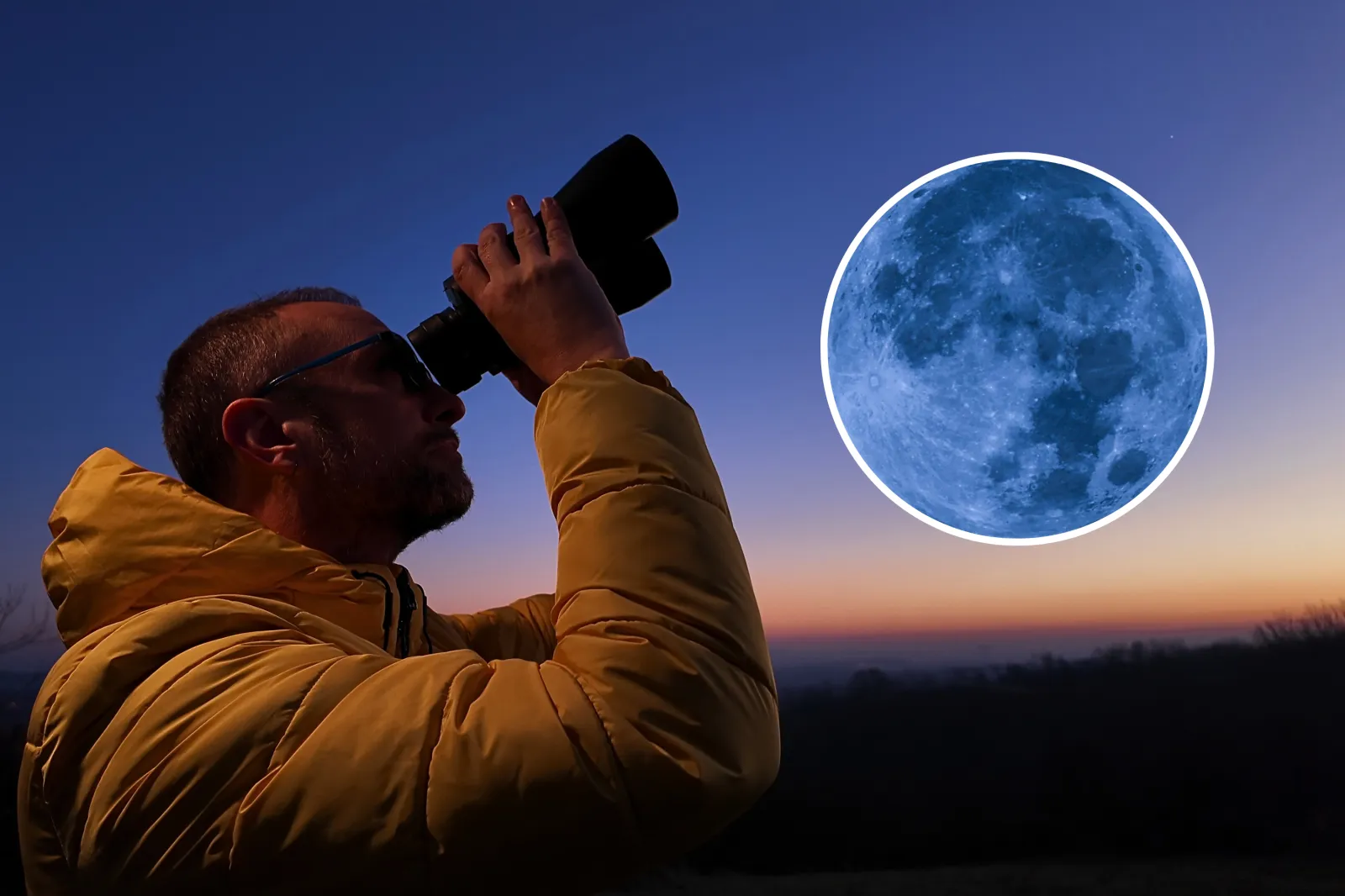
A rare celestial event is set to light up the night sky this weekend, as what is known as a blue moon rises on May 31. But despite its famous name, stargazers should not expect to see anything blue.
The full moon will be the second to fall within the same calendar month, making it what astronomers call a "monthly Blue Moon." The phenomenon is driven by the mismatch between the moon's 29.5-day cycle and the 12-month calendar year.
It is the kind of event that only comes around once every two to three years, and this weekend's rising offers one of the best opportunities to catch it.
Read More on Science
When Is the Blue Moon and How to See It?
The blue moon will be full on Sunday, May 31, at 4:45 a.m. ET, but the best time to watch it is actually the evening before.
On Saturday, May 30, the moon will rise in the east at dusk, appearing large and glowing orange, instead of blue, against the horizon.
The phrase "once in a blue moon" implies something exceedingly rare, but the reality is actually a little more frequent than the idiom suggests. What makes this moon more unique is the fact it will be a "micromoon." This happens when the moon is at its farthest point from Earth during the month.
No telescope is required by skywatchers eager to see the spectacle. The naked eye will do the job, though binoculars will sharpen the view considerably. The key is finding a clear, unobstructed view of the southeastern horizon at moonrise. After a few minutes, a large, warm-colored full moon will appear in the sky.
The orange color is not unique to blue moons—it is the same effect seen at sunset.
When the moon sits low on the horizon, its light must pass through a much thicker section of Earth's atmosphere than when it is high in the sky.
Shorter blue wavelengths scatter off air molecules before reaching the eye, while longer red and orange wavelengths travel through more directly. This process, known as Rayleigh scattering, produces the familiar warm glow of both moonrises and sunsets.
What Does a Blue Moon Mean?
The term blue moon has nothing to do with color—it describes an extra full moon appearing within a set period of time.
There are two accepted definitions. One is the monthly blue moon, when there are two full moons in one month. The other traditional definition calls a blue moon the third full moon in an astronomical season that has four rather than the usual three.
Both arise from the same underlying cause: a slight but persistent mismatch between the lunar cycle and the calendar.
Our modern calendar is built on astronomical principles.
A day reflects one rotation of Earth on its axis, a year marks one orbit around the sun, and a month is broadly based on the moon's revolution around Earth.
But the two systems do not align perfectly. A calendar year contains roughly 11 more days than 12 complete lunar cycles, and over time that difference accumulates—producing an extra full moon.
...
How Often Do Blue Moons Occur?
Blue moons occur roughly every two to three years.
After this weekend, the next seasonal blue moon is expected on May 20, 2027. The next monthly blue moon is expected on December 31, 2028.
View 0 Comments
Submit Correction
View Editorial & AI Guidelines