
...

By Hollie Silverman
News Editor
0
Share
Newsweek is a Trust Project member
See more of our trusted coverage when you search.Prefer Newsweek on Googleto see more of our trusted coverage when you search.
Republican Representative Thomas Massie praised GOP Representatives Nancy Mace and Lauren Boebert—as well as former congresswoman Marjorie Taylor Greene—for helping force the release of the Jeffrey Epstein files, saying they “paid an enormous price” for backing his discharge petition even as most Republicans ultimately voted for disclosure.
The praise comes as all four have face political blowback from within their own party. Massie, who represents Kentucky’s 4th Congressional District since 2012, lost his seat earlier this month to a Trump-backed challenger in the Republican primary, a defeat that underscored how sharply the party’s internal dynamics have shifted. The race came to a head as the most expensive House primary in U.S. history. Following his defeat, Massie remarked on NBC News' Meet the Press that his "biggest crime" against the political establishment was working across the aisle to force transparency.
Mace is battling a Trump‑endorsed primary challenger in South Carolina, Boebert has drawn the ire of MAGA hardliners and President Donald Trump himself, and Greene, who resigned from Congress earlier this year, continues to clash with GOP leadership.
Read More on Politics
Massie, who led the procedural effort to force a vote on releasing the documents, alongside the bill’s Democrat co-author, Representative Ro Khanna of California, said that while “virtually all Republicans eventually admitted by their votes that it was right to release the Epstein files,” only three GOP members were willing to sign his discharge petition.
“Boebert, Greene, and Mace have paid an enormous price for doing the right thing,” the congressman wrote in a post on X Friday, framing their signatures as acts of political courage that came with real consequences.
Massie’s comments underscore how a transparency vote has become a loyalty test inside the Republican Party. The petition compelled House leadership to bring the measure to the floor—a step many Republicans initially resisted.
Nancy Mace
Mace of South Carolina has become one of the most polarizing figures inside the Republican Party, frequently clashing with MAGA‑aligned conservatives and traditional GOP leadership. Her vote to oust then-Speaker Kevin McCarthy angered establishment Republicans, while her criticism of Trump—followed by later attempts to realign with him—has frustrated the party’s right flank.
Trump’s endorsement of her primary challenger has intensified those tensions, with some conservatives accusing her of political inconsistency and opportunism. Mace has defended her record as independent and principled, but the internal friction has left her increasingly isolated within her own conference. She has faced criticism from MAGA activists and traditional conservatives, making Massie’s praise a rare boost from within the party’s libertarian wing.

...
Lauren Boebert
Boebert has faced her own turbulence within the party, including criticism from colleagues over her high‑profile feuds, her district switch in Colorado, and her willingness to break with Trump‑aligned hardliners on select issues — including her support for Massie’s discharge petition on the Epstein files. Boebert’s alignment with Massie has drawn backlash from MAGA influencers and even from Trump himself, who has publicly criticized her in recent months.
Some conservatives have labeled her a “RINO,” a Republican in Name Only, while others argue she has become unpredictable in her alliances. Boebert has dismissed the criticism as politically motivated and insists she remains committed to conservative principles.
Earlier this week, the Colorado lawmaker acknowledged Trump’s sharp rhetoric—he called her "dumb" and "weak-minded"—but framed it as a normal part of political life, during an interview with Denver news channel 9NEWS.
When asked why she and other Republicans are "willing to take so much abuse" from Trump, she answered: "Interesting. I don't see it as abuse. I think it's part of the D.C. nature. Nothing happens in D.C. without force." She added that her "support for the president has not changed."

...
Marjorie Taylor Greene
Greene repeatedly collided with GOP leadership over spending, aid to Ukraine, and what she described as the party’s failure to deliver on conservative priorities. Her public attacks on GOP Speaker Mike Johnson and earlier confrontations with McCarthy had deepened divisions, leading some Republicans to strip her of committee assignments in the previous Congress and to distance themselves from her hardline tactics. Greene framed her clashes as a fight against what she calls “weak Republican leadership,” while critics inside the party argued she had become a destabilizing force who undermines GOP unity.
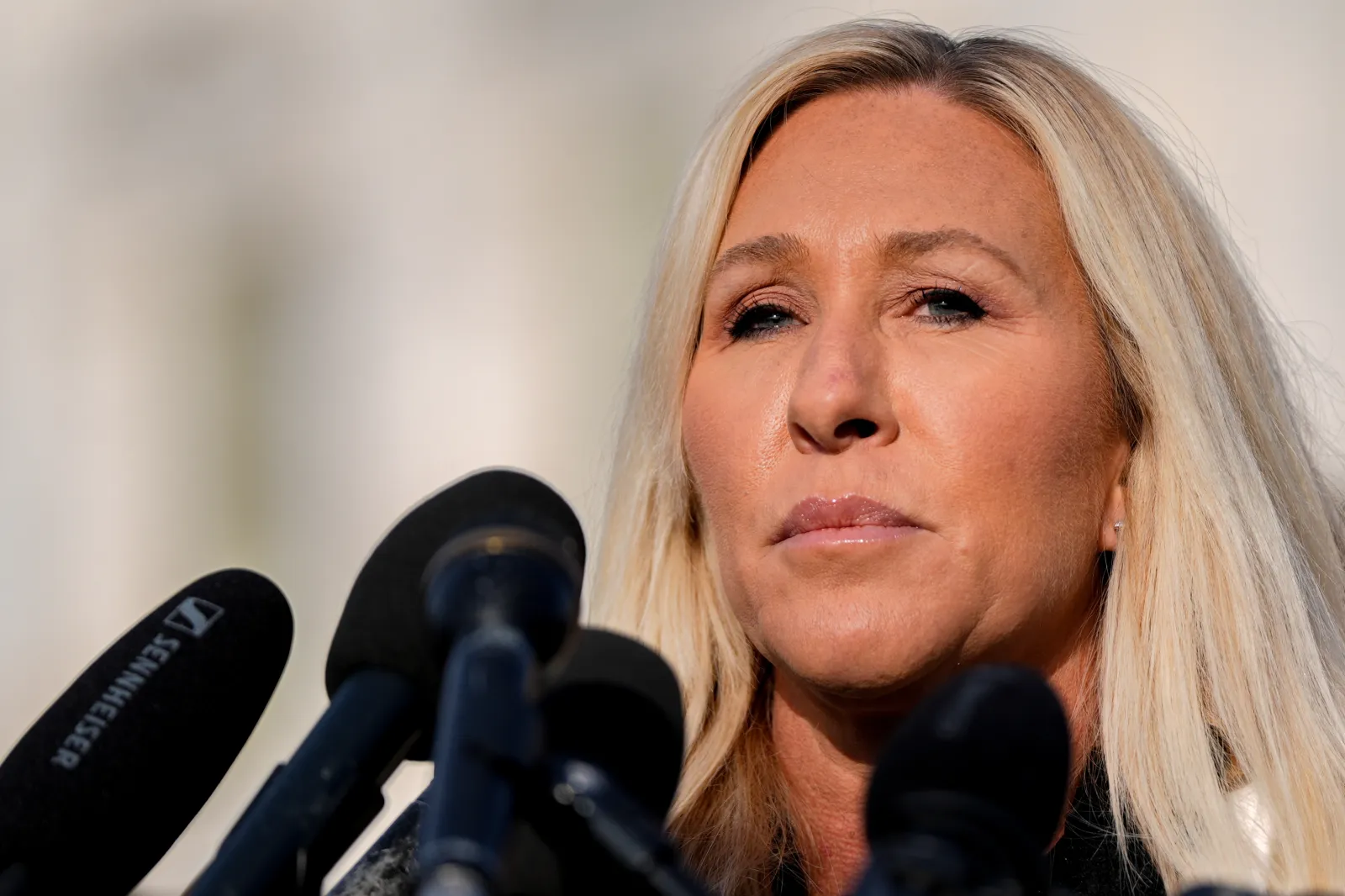
Trump had grown increasingly critical of Greene in recent months, publicly rebuking her for her clashes with GOP leadership, formally un-endorsing her, and publicly labeling her a "low IQ traitor" and a "rotten apple" for aligning against leadership on the Epstein files. The public vitriol marked a volatile rupture for a lawmaker who once counted herself among Trump’s most loyal defenders, ultimately leading Greene to resign her House seat effective January 5, stating she refused to be a "battered wife" politically.
...
What the Epstein Files Revealed
The U.S. House of Representatives voted overwhelmingly to release the files on November 18, 2025, by a final 427-1 vote, with GOP Representative Clay Higgins being the only dissent. The documents contain thousands of pages of investigative material, including references to Epstein’s associates, flight records, correspondence, and law‑enforcement files compiled over decades. The vote was forced by Massie’s discharge petition, a rarely used procedural maneuver that compelled House leadership to bring the measure to the floor after initially stalling action.
To reach the mandatory 218-signature majority required to bypass Johnson, Massie and Khanna relied on a broad coalition consisting of virtually the entire House Democratic caucus, joined by four Republicans: Massie, Boebert, Greene, and Mace.
The Epstein files offered the most expansive public look yet at the network of high‑profile figures who crossed paths with Epstein, a convicted sex offender who died by suicide in prison in 2019 while awaiting trial on sex trafficking charges, over several decades. The documents— a mix of court records, depositions, correspondence, and investigative material—did not accuse every named individual of criminal conduct, but they did detail the extent of Epstein’s social, financial, and political connections.
- Prince Andrew: His relationship with Epstein has been the subject of years of scrutiny.
- Former President Bill Clinton: The documents included references to Clinton, noting his flights on Epstein’s private jet and appearances in Epstein’s social calendar. Clinton has long said he was unaware of Epstein’s crimes and has denied any wrongdoing.
- Trump: The files reflected his social interactions with Epstein in the 1990s and early 2000s before the two men reportedly fell out. Trump has denied any involvement in Epstein’s criminal activity.
- Other Prominent Figures: Names appearing in the documents included lawyer Alan Dershowitz, who has repeatedly and vigorously denied allegations made against him, and billionaire Glenn Dubin, whose family has also denied wrongdoing and has not been charged with any crime.
While the release did not produce new criminal allegations against these figures, it did provide additional context about how Epstein operated: cultivating access to powerful individuals, leveraging social connections, and maintaining a network that spanned politics, finance, academia, and royalty. The disclosures have also renewed public interest in how Epstein avoided serious legal consequences for so long.
...
View 0 Comments
Submit Correction
View Editorial & AI Guidelines