10
Loading video...

By Andrew Stanton
Reporter
0
Share
Newsweek is a Trust Project member
See more of our trusted coverage when you search.Prefer Newsweek on Googleto see more of our trusted coverage when you search.
Alaska voters are set to cast their ballots in their Senate primary on Tuesday, as the race between Republican Senator Dan Sullivan and Democratic former Representative Mary Peltola emerges as a critical election in November.
The race is expected to be one of the most competitive of the midterm elections, despite Alaska’s historical status as a red state that backed President Donald Trump by 13 points in the 2024 election.
Alaska’s Senate election has major national implications. It could be the race that determines whether Democrats or Republicans control the upper chamber of Congress next year. Although the current map favors Republicans, Democrats believe Trump’s declining national approval rating amid cost-of-living and inflation concerns could allow them to expand the electoral battleground in November to flip seats in more conservative areas.
Read More on Politics
In Alaska, which has a notable independent streak, Peltola is viewed as a top recruit for Democrats to take on Sullivan, who has served in the Senate since 2015. Peltola represented the state’s at-large congressional district from 2022 to 2025 and overperformed former Vice President Kamala Harris in the state in 2024.
Joseph Warren, professor of political science at the University of Alaska Anchorage, told Newsweek on Monday the race is "definitely competitive," but that Alaska is a tough state to poll.
"It’s notable that Alaska is a geographically vast, diverse state, and so polling is difficult. There was a polling error in 2020 when Senator Sullivan was reelected," he said. "But certainly both political parties are spending money on the state."
Peltola, he said, is a strong candidate who only narrowly lost in a good year for Republicans and could "absolutely" win in a better year for Democrats. He said she has worked to distance herself from the Democratic Party’s national brand, particularly on issues of energy.
Trump’s approval rating will certainly matter for the race, but local issues are going to be important as well, Warren said. Particularly, Alaska’s fisheries have been struggling as salmon runs decline, and that is a major issue for the state.
"In Alaska, people are talking a lot about fish, and in particular about trawling in the Bering Sea. It’s highly controversial. It’s not an issue that’s really a left-right issue. It doesn’t map onto conventional ideological categories of the two major parties or what you might get in the lower 48," he said. "Exactly how that plays out is going to have a big impact on the race."
A Peltola spokesperson told Newsweek on Monday: "Alaskans know that Mary will stand up to anyone to fix the rigged system in D.C., lower costs and put Alaska first. With more than 10,000 Alaskans signed up to help Mary’s campaign from every corner of the state, and Dan Sullivan’s approvals plummeting with Alaskans after he spiked the cost of gas, groceries and healthcare, Mary is in a strong position to retire self-serving Dan Sullivan this November."
Newsweek reached out to the Sullivan campaign via email for comment.

...
Alaska Jungle Primary: What To Know
Alaska uses a unique electoral system unlike other states. It uses both a nonpartisan top-four primary system and ranked choice voting for the general election.
In the primary, all candidates will appear on a single ballot regardless of political party, and the four who receive the greatest number of votes will advance to the general election. That means there could be multiple Republicans or multiple Democrats on the ballot in November.
In the general election, voters will rank the four candidates according to their preference. If no candidate reaches an outright majority, the candidate with the lowest number of votes is eliminated, and their voters are redistributed based on their second choice. If again no candidate wins 50 percent plus one, the process is repeated between the final two candidates.
That is different from most states, which separate candidates based on party in the primaries and have a first-past-the-post system in the general election. The new electoral system was implemented in the 2022 election cycle, and this will be the second Senate race using it.
The jungle primary could benefit political moderates, Warren said.
Related Story
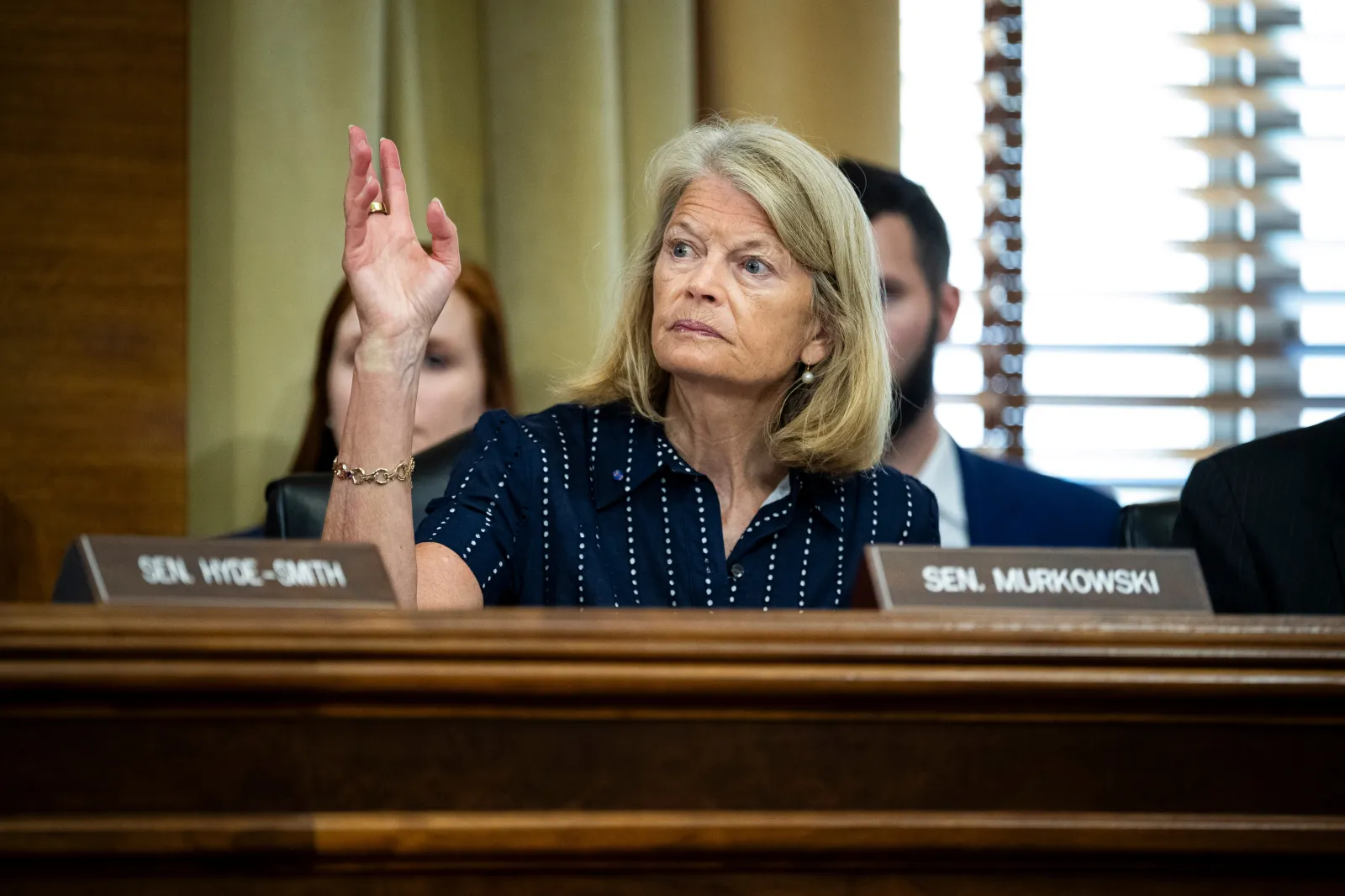
Murkowski: SAVE Act Could Require $1,000 Trips to Register to Vote
What Polls Show About Alaska Senate Race
A new poll of the Alaska Senate race released ahead of the primary showed a competitive race ahead of the primary.
On the first round of voting, no candidate received an outright majority in the poll, with 47 percent saying they would vote for Peltola compared to 41 percent for Sullivan. Another 4 percent said they would vote for a separate individual named Dan Sullivan, who has no relation to Senator Sullivan.
His candidacy has sparked outcry from Republicans, including Trump who called him an "imposter" in a Tuesday post to Truth Social. Three percent said they would vote for Gerald Heikes, another Republican candidate, while 5 percent were undecided.
In the final round of ranked choice voting, Peltola had a 6-point lead over Sullivan, 53 percent to 47 percent, according to the poll. It surveyed 605 likely voters in Alaska from July 28 to August 4, 2026 and had a margin of error of plus or minus 4 percentage points.
The poll did not include numbers on the primary specifically; polls so far have largely focused on the matchup between Peltola and Sullivan, as other candidates are viewed as long shots to win the race.
The latest survey from Alaska Survey Research polled only the final round of ranked choice and found Peltola with a narrow lead over Sullivan, 50.8 percent to 49.2 percent. It surveyed 1,371 likely voters August 2-5, with a margin of error of plus or minus 3 percentage points.
For comparison, a March poll from Alaska Survey Research of the final round of ranked choice voting showed Peltola up by more than 4 points, 52.4 percent to 47.6 percent. An April release from the pollster showed her winning with 50.2 percent, to Sullivan’s 43.6 percent and Republican James Ryan’s 6.2 percent.
However, Sullivan had a 2-point lead over Peltola in a recent poll from The New York Times and Siena University in the initial round of ranked choice voting. The incumbent received support from 47 percent of respondents to Peltola’s 45 percent. Five percent were undecided, while 2 percent said they would vote for other candidates.
It surveyed 593 likely voters June 15-29. The margin of error among the likely electorate was plus or minus 4.9 percentage points, and plus or minus 5.4 points "for the sample of completed interviews."
Kamala Harris Endorsement Rattles Alaska Senate Race
On Wednesday, an email was sent out from Harris’ super PAC supporting Peltola, according to The New York Times. Harris urged her supporters to "stand behind" the Democratic candidate in the key race.
The National Republican Senatorial Committee quickly called attention to the statement, with its regional press secretary, Nick Puglia, writing in a statement: "Mary Peltola is an ineffective radical leftist who worked hand in hand with Kamala Harris to put Alaska last, so it’s no surprise that Harris is backing Peltola."
Peltola responded to Harris’ support in a statement reported by the Times: "Mary isn’t seeking endorsements from anyone from the Lower 48—her focus is and always will be Alaska," the statement said, adding that the campaign had not approved the email from Harris.
Harris received just over 41 percent of the vote in Alaska in 2024, a weaker showing than former President Joe Biden four years earlier. On the same ballot, Peltola lost by fewer than 3 points to Republican Nick Begich, 51.2 percent to 48.8 percent.
What Prediction Markets Show About Alaska Senate Race
Prediction markets on Tuesday favored Peltola, with Kalshi giving her a 54 percent chance of flipping the seat. Polymarket, meanwhile, gave her a 57 percent chance of winning.
That marks a shift from just 24 hours earlier, when Peltola had only a 52 percent chance of winning on Kalshi and Sullivan had a 51 percent chance on Polymarket.
Peltola had a 99 percent chance of advancing to the general election on Kalshi as of Tuesday, while Sullivan had a 94 percent chance.
Republican Dustin Darden had a 53 percent chance of advancing to the general, while the other Dan Sullivan had a 50 percent chance. Richard Grayson of the Green Party had a 28 percent chance, while Libertarian Scott Kohlhaas also had a 28 percent chance.
Prediction markets allow traders to buy and sell contracts tied to political outcomes and current events, aggregating real‑money wagers into probability estimates.
Prices fluctuate as traders react to polling, fundraising, candidate developments and broader political trends. They measure trader sentiment at a given moment but do not always accurately predict the future.
Forecasters See Alaska as Toss-Up
Forecasters view it as one of the most competitive races. The Cook Political Report and Sabato’s Crystal Ball classify it as a pure toss-up in which neither party has a clear advantage.
In June, Sabato’s Crystal Ball analysts Kyle Kondik and J. Miles Coleman pointed to Peltola’s close race in 2024, when she lost by fewer than 3 points as Trump won the state by 13 points, as to why it is a toss-up.
They wrote that it seems "plausible" she would have a reasonable chance to win in a better environment for Democrats, given such an overperformance two years earlier.
Democrats Narrow Margin in Alaska, But State Still Leans Red
Over the past few decades, Republicans’ margins in Alaska have narrowed as leftward shifts in places like Anchorage give Democrats hope that the state could become more competitive. For much of the early 2000s, the state was solidly Republican, but elections have been closer in the Trump era.
Trump carried Alaska by 13 points in 2024, 10 points in 2020 and 15 points in 2016. Republicans also won Alaska by 14 points in 2012, nearly 22 points in 2008, 26 points in 2004 and 31 points in 2000.
As of August 3, there were 141,995 registered Republicans and 69,889 registered Democrats in Alaska. However, there were 81,801 nonpartisan and 298,273 unaffiliated voters in the state, making them the largest voting bloc, according to the Alaska Division of Elections.
Alaska also has an independent streak. Its state Senate has a majority coalition made up of Democrats and moderate Republicans, and it has elected Democrats statewide before, with Peltola being the most recent. Alaska’s other Republican senator, Lisa Murkowski, is also known as one of the most centrist in the chamber who has been willing to break with her party on key issues.
Even as the state voted Republican on the presidential level in 2008, it backed Democrat Mark Begich in the Senate race, though he went on to lose to Sullivan six years later. That was the last time Alaska elected a Democratic senator.
Alaska Could Be Tipping-Point State
Alaska has the potential to be the tipping-point state, meaning it could determine which party wins a Senate majority.
Republicans currently hold a 53-47 majority, so Democrats must flip four seats to take control. A lot must go right for Democrats to win a majority—they must hold all of their current seats, flip races in competitive states and win on more conservative turf.
Democrats are defending seats in two states Trump won in 2024—Georgia, where Democratic Senator Jon Ossoff has led polls against Republican Representative Mike Collins, and Michigan, where progressive Democrat Abdul El-Sayed and Republican former Representative Mike Rogers recently won their primaries.
They are also viewing Maine and North Carolina as top targets. In Maine, which Harris won by about 7 points, longtime GOP Senator Susan Collins is up for reelection in a state that leans Democratic, but she has won in the past because of her moderate image and personal popularity. She faces Democrat Troy Jackson, the former Maine Senate president.
In North Carolina, which Trump won by about 3 points, former Governor Roy Cooper, a Democrat, has built a polling lead against Michael Whatley, the former chair of the Republican National Committee. Republican Senator Thom Tillis is retiring.
There are no other GOP-held seats up for grabs in states Trump won by single digits or lost in 2024. So even if Democrats win all of these seats, Republicans will still have a 51-49 majority next year.
This is where states like Alaska come into play. Democrats must win two double-digit Trump states to win a majority, as the vice president serves as the tiebreaker in votes. Democrats view Alaska, Iowa, Ohio and Texas as potential flip opportunities. If Democrats flip Alaska, they will need only one of those states to win a majority.
Contact Newsweek editors on this story: Jason Lemon, Dave Siminoff, Sam Wilson, James Debens.
View 0 Comments
Submit Correction
View Editorial & AI Guidelines