...

By Jasmine Laws
Reporter
0
Share
Newsweek is a Trust Project member
See more of our trusted coverage when you search.Prefer Newsweek on Googleto see more of our trusted coverage when you search.
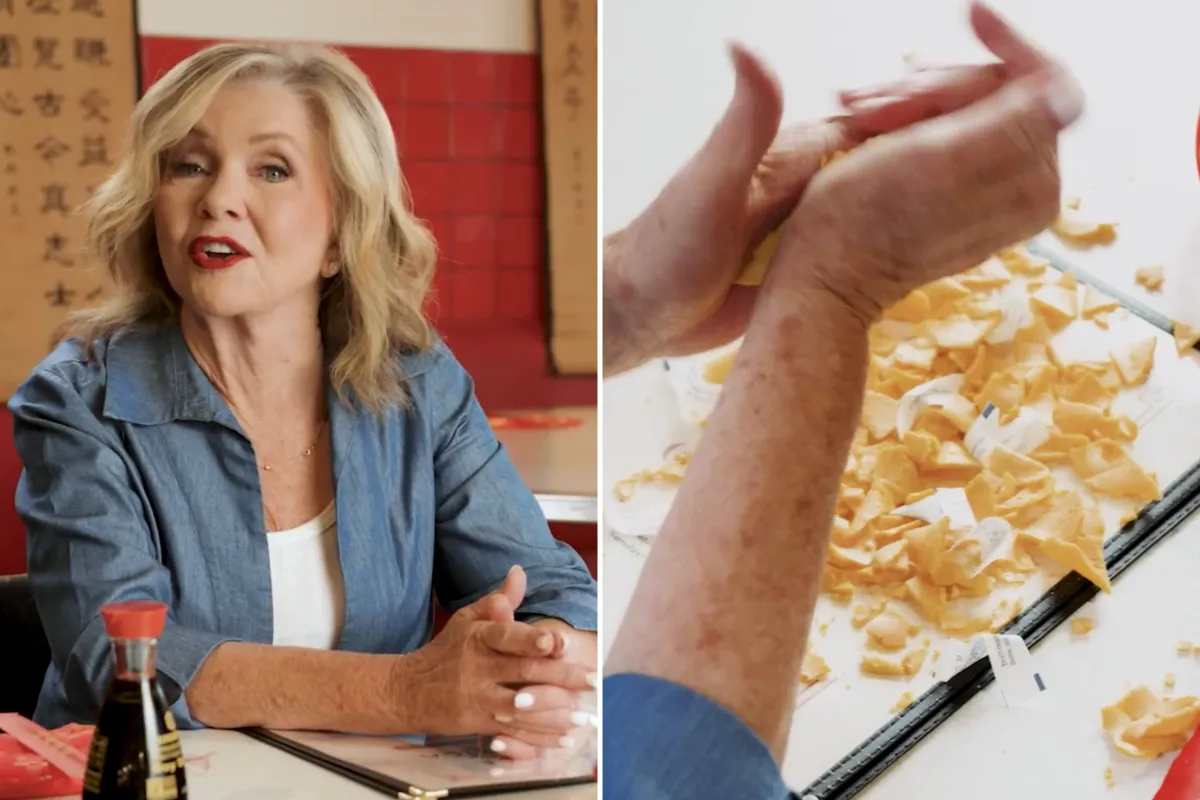
Senator Marsha Blackburn has posted an anti-China campaign ad on social media, where she destroys fortune cookies and vows to "stop communist China and protect Tennessee land."
Seated in what appears to be a Chinese restaurant, Blackburn, a Republican running for governor in Tennessee, says to the camera: "How hard am I going to crack down on China? Well, here's a clue." She then proceeds to crush fortune cookies in her hands, leaving the broken pieces in a pile on the table.
In one shot, a piece of paper can be seen poking out from a broken cookie, reading: "Marsha Blackburn will fight to protect Tennessee land from China." Another shot shows a slip of paper that reads: "Marsha Blackburn will close loopholes and hunt down communists."
Read More on Politics
"It doesn't take a fortune cookie to figure it out," she says at the end. "Here in Tennessee, we're going to stop communist China and protect Tennessee land."
The video was posted on Wednesday morning and less than 24 hours later had accumulated more than 1.3 million views.
...
Blackburn said in a statement to Newsweek: “Tennessee’s largest and most important industry is agriculture–which means that our agricultural heritage is part of the foundation and values of our state and must always be protected. I share Tennesseans’ concerns about our foreign adversaries getting a foothold in our country.
"The Chinese Communist Party doesn’t represent our values. Allowing them to purchase land is the first step in the spread of their communist values in America—if you don’t believe me, just look at the Democratic Socialist Party of America that is getting a foothold in New York and other places. When I’m governor, the Chinese Communist Party won't be able to get their hands on one blade of grass in Tennessee."
Blackburn's Ad Sparks Backlash
Since posting the video, Blackburn has been met with widespread backlash online. American journalist and podcast host Chuck Todd, who has more than 2 million followers on X, wrote: "Some TV ads are subtle and some… well."
Some determined that the ad was "racist." Show host Gabe Sanchez, who has more than 69,000 followers on X, wrote: "Woof, no one said racists were smart." The Tennessee Holler also called the ad "racist."
Others were quick to point out fortune cookies do not originate from China, including Aaron Reichlin-Melnick, a senior fellow at the American Immigration Council, a non-partisan immigration research and advocacy organization, said: "Fortune cookies were invented in America and basically do not exist in China."
Journalist and political economist Ben Norton, who is the editor of the left-leaning publication Geopolitical Economy Report, wrote on X: "The US really is an idiocracy. This Republican Congress member boasts of how much she hates China by crushing fortune cookies with her hands. By the way, fortune cookies were invented by Japanese immigrants in the US. They don't eat them in China."
Who Is Marsha Blackburn?
Blackburn has served in the Senate since 2019. She previously represented Tennessee’s 7th Congressional District in the U.S. House for more than 15 years and became known for her conservative positions on issues including trade, technology and national security.
Blackburn is running to succeed Republican Governor Bill Lee, who is barred from seeking a third term. Her campaign has focused on issues including economic growth, public safety and limiting foreign influence in the state.
US-China Tensions Shape Land Ownership Debate
The ad lands at a time when U.S.-China relations remain defined by strategic competition over trade, technology, supply chains and national security.
While Washington and Beijing have sought to prevent tensions from spiraling, China policy has become a central theme in Republican politics, with lawmakers increasingly framing Chinese investment, technology access and economic ties as security risks rather than ordinary commercial activity.
Concerns about Chinese purchases of U.S. land have become part of that wider debate. According to U.S. Department of Agriculture (USDA) data, foreign ownership of U.S. agricultural land doubled between 2009 and 2019, sparking concerns about the security of America's food supply.
In 2019, foreign investors owned at least 35.2 million acres of U.S. agricultural land, which equates to 2.7 percent of U.S. farmland, an area almost the size of Iowa, according to the Center for Strategic and International Studies, a bipartisan, nonprofit research organization.
While Chinese entities own only a small share of foreign-held U.S. agricultural land—about 277,000 acres, according to the most recent USDA data—the country's purchases of U.S. land have also been found to be near important U.S. defense sites, such as Grand Forks Air Force Base in North Dakota, Laughlin Air Force Base in Texas, Barksdale Air Force Base in Louisiana and Francis E. Warren National Nuclear Base in Wyoming, according to the outlet Modern Diplomacy. That has heightened concern as some of these bases house American nuclear ballistic missiles.
As concern amplifies over the foreign ownership of U.S. land, Blackburn has become vocal about the issue. In recent years, she has proposed various security measures—some with bipartisan support—that seek to bar certain foreign individuals and businesses from purchasing U.S. farmland.
Are They Chinese?
Fortune cookies, which are thin, crispy wafers that typically contain a slip of paper inside with a fortune message, are not actually from China. They originate from Japan, despite being served in many Chinese restaurants in the U.S. and elsewhere at the end of a meal. They are rarely found in China, according to the South China Morning Post.
In the early 1900s, Japanese immigrants brought the cookies to America, but after World War II, when thousands of Japanese Americans were detained, Chinese Americans began to take over the business of baking the cookies.
The video also features a waving cat at the end, known as a "maneki-neko" or "beckoning cat," which also originates from Japan, not China, even though they are often seen in Chinese businesses as well. The soy sauce seen in the ad—Kikkoman—is a Japanese brand.
Contact Newsweek editors on this story: Daniel Orton and Cristina Diciu.
View 0 Comments
Submit Correction
View Editorial & AI Guidelines