...

By Jess Thomson
Science Reporter
0
Share
Newsweek is a Trust Project member
See more of our trusted coverage when you search.Prefer Newsweek on Googleto see more of our trusted coverage when you search.
Researchers have found bizarre, enormous structures hidden deep beneath the remains of an ancient Martian ocean.
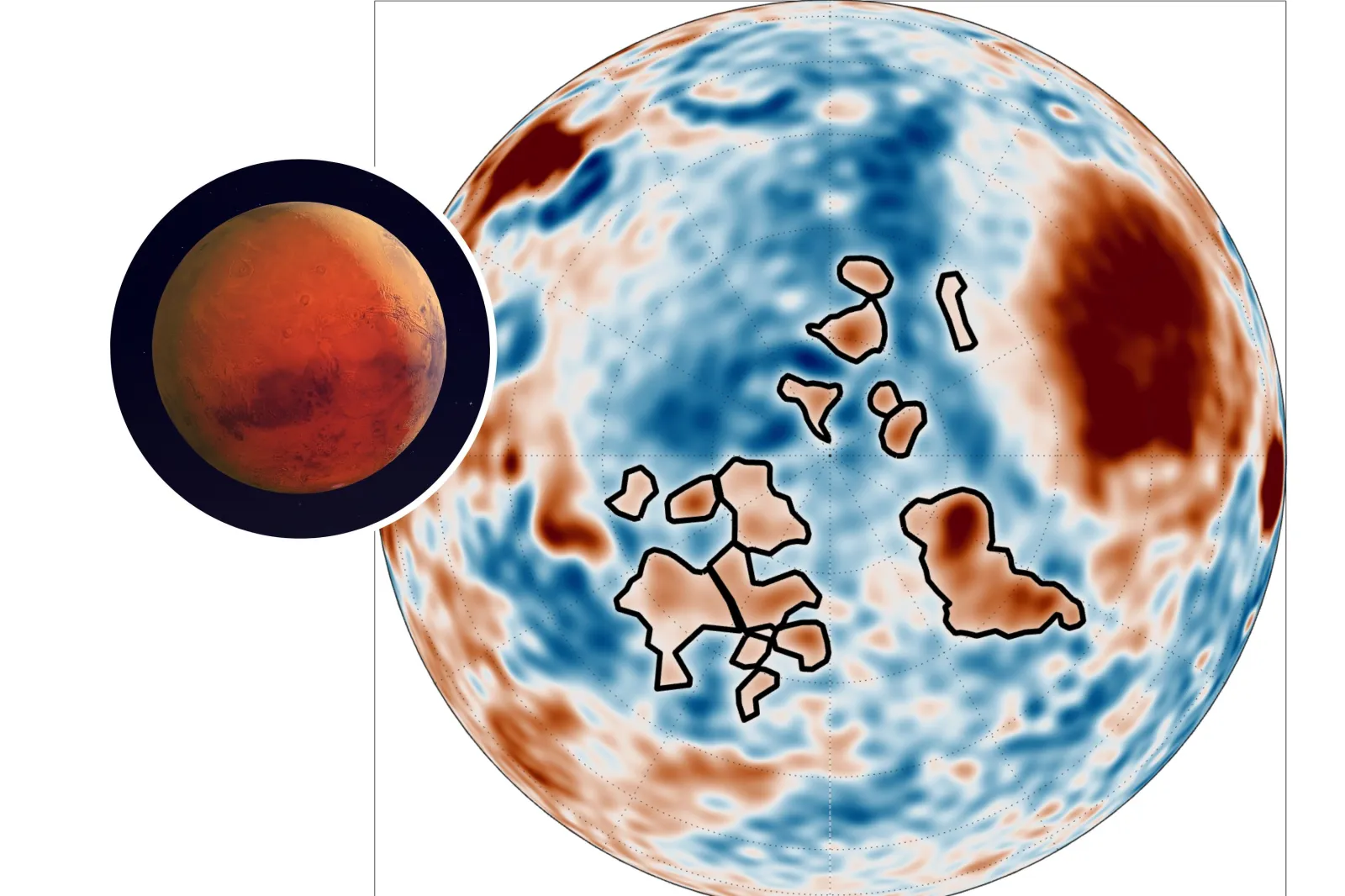
These dense structures may have been formed by ancient volcanic activity, or by space rock impacts, according to new research being presented this week at the Europlanet Science Congress (EPSC) in Berlin.
The discovery was made on the Red Planet's northern polar plains thanks to observations of Mars' gravity by NASA's Insight mission and other satellites in orbit.
Read More on Science
...
"These dense structures could be volcanic in origin or could be compacted material due to ancient impacts. There are around 20 features of varying sizes that we have identified dotted around the area surrounding the north polar cap—one of which resembles the shape of a dog," study co-author Bart Root, a researcher at Delft University of Technology (TU Delft), said in a statement.
"There seems to be no trace of them at the surface. However, through gravity data, we have a tantalizing glimpse into the older history of the northern hemisphere of Mars."
The researchers created a global density map of Mars using data regarding the crust of Mars and the dynamics of the mantle below. Thanks to the map, the researchers found about 20 of these weird massive structures, which varied in size, but were about 300-400 kg/m3 more dense than the surrounding rock.
"Some preliminary study expects these structures to be in the shallow subsurface. We think in the crust, but covered under a large layer of sediments; remnants of the paleo ocean that seems to cover the northern regions of Mars. How deep exactly is difficult to find out, this would need to be explored by new seismic missions to Mars, but we are now also looking at ground-penetrating radar data, but I think this will not penetrate deep enough," Root told Newsweek.
"How the might have formed is still a mystery. They could be remnants from the huge Borealis Impact, or they could be covered smaller impact craters or volcanoes," Root said.
The density map also revealed that a plume of lava within the mantle of Mars may be boosting the Tharsis Rise upward, which is home to the largest volcano in the solar system, Olympus Mons, as well as Arsia Mons, Pavonis Mons and Ascraeus Mons.

...
"The NASA InSight mission has given us vital new information about the hard outer layer of Mars. This means we need to rethink how we understand the support for the Olympus Mons volcano and its surroundings," Root said. "It shows that Mars might still have active movements happening inside it, affecting and possibly making new volcanic features on the surface."
Do you have a tip on a science story that Newsweek should be covering? Do you have a question about Mars? Let us know via science@newsweek.com.
References
Root, B., Alkahal, R., Qin, W., & Thieulot, C. (2024, September 8–13). Exploration of high mass subsurface structures in the northern hemisphere with joint flexure and mantle convection modelling of the Martian gravity field. EPSC2024, Berlin, Germany. https://doi.org/10.5194/epsc2024-730
Woerner, L. (2024, September 8–13). Quantum Technologies for Planetary Geodesy. EPSC2024, Berlin, Germany. https://doi.org/10.5194/epsc2024-632
Update 09/17/24, 12:27 p.m. ET: This article was updated to include comment from Bart Root.
View 0 Comments
Submit Correction
View Editorial & AI Guidelines