...

By Tom Howarth
Science Reporter (Nature)
0
Share
Newsweek is a Trust Project member
See more of our trusted coverage when you search.Prefer Newsweek on Googleto see more of our trusted coverage when you search.
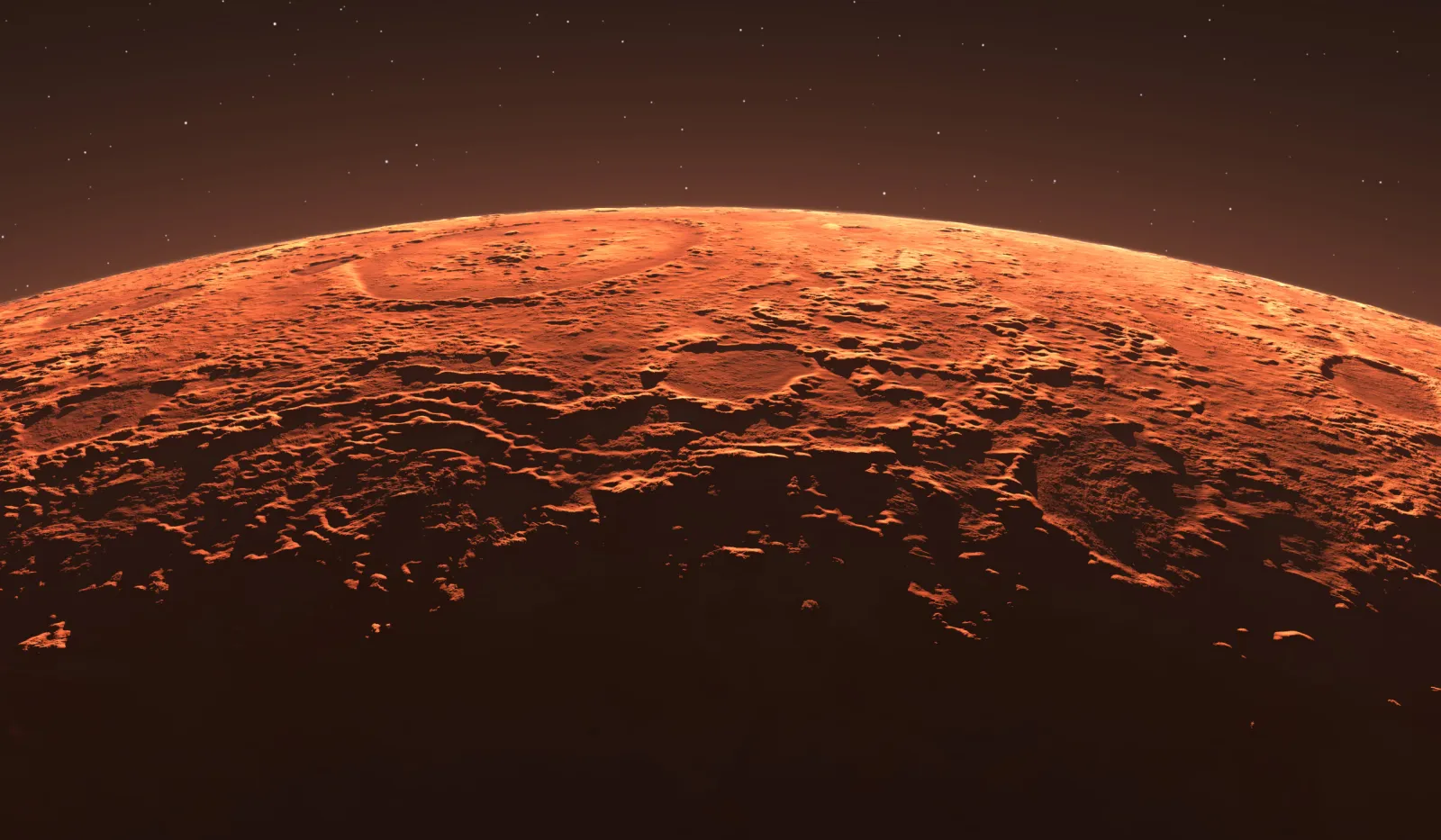
Mars' missing atmosphere may be locked up in the planet's clay-rich surface, a new study by MIT geologists has suggested.
According to the researchers, ancient water trickling through Mars' rocks could have triggered a series of chemical reactions, converting CO2 into methane and trapping the carbon in clay minerals for billions of years.
Billions of years ago, Mars was a very different place—likely wet, with rivers flowing across its surface and a thick atmosphere of carbon dioxide (CO2) insulating the planet. However, around 3.5 billion years ago, the red planet's atmosphere thinned and its water dried up, leaving behind the cold desert we see today.
Read More on Science
A central mystery in planetary science has been: where did all that carbon dioxide go?
...
The dominant explanation relies on an interaction between the sun's rays and gases in the atmosphere. Mars lost its protective magnetic field billions of years ago, likely allowing high-energy solar particles to strike the upper atmosphere, kicking molecules off into space, according to NASA.
"Current rates of loss to space can explain less than 1 percent of the early atmosphere when extrapolated back into the past," lead author Joshua Murray told Newsweek. "However, these rates could have been higher in the past due to solar flares and a magnetic field."
But this might not be the whole story. The researchers focused on a type of clay mineral called smectite, known for its ability to trap carbon. These minerals, abundant on Mars, contain tiny folds that can store carbon molecules for aeons.
The study was published in the journal Science Advances.
"There is plenty of evidence for a thick clay layer on the Martian surface. Almost 80 percent of satellite spectra detect these high-surface-area clay minerals on the Martian surface. Clay has been detected in craters as deep as 17 kilometers [10.5 miles]," Murray said.
On Earth, smectite forms through tectonic activity, drawing down CO2 from the atmosphere and cooling the planet over time. But Mars, unlike Earth, does not have active tectonic plates. This led the researchers to explore alternative pathways for the formation of smectite on Mars.
Using a model based on Earth's rock chemistry, they theorized that early Martian water interacted with ultramafic rocks, a type of igneous rock rich in the mineral olivine. As water trickled through these rocks, chemical reactions would have produced methane by drawing CO2 out of the atmosphere, eventually locking it in the planet's surface.
Their model suggested that Mars' surface could contain up to 1.7 bar of CO2—roughly 80 percent of its early atmospheric volume—sequestered as methane within clay deposits. This methane could still be present today, lying beneath the planet's dry and barren crust.
"We know this process happens, and it is well-documented on Earth. And these rocks and clays exist on Mars," Oliver Jagoutz, the study's author, said in a statement. "So, we wanted to try and connect the dots."

...
The discovery that Mars' ancient atmosphere could be hidden within its surface clays offers a new perspective on the planet's history and raises intriguing possibilities for future exploration.
For example, if the sequestered carbon could be recovered and converted, it could serve as a propellant for future space missions between Earth, Mars and beyond.
The study also opened new avenues for understanding Mars' climate history. If large amounts of CO2 were indeed trapped in the planet's clays, this could explain the drastic shift in Mars' climate billions of years ago, when its atmosphere thinned and the planet dried up.
This research added another piece to the puzzle of Mars' ancient climate and its transition from a warm, wet planet to the dry and cold world we see today.
With further exploration, scientists may soon confirm whether the Martian atmosphere really is trapped in the planet's clay—a discovery that could have profound implications for both planetary science and human exploration of the red planet.
"We find that estimates of global clay volumes on Mars are consistent with a significant fraction of Mars' initial CO2 being sequestered as organic compounds within the clay-rich crust," Murray said in a statement. "In some ways, Mars' missing atmosphere could be hiding in plain sight."
Do you have a tip on a science story that Newsweek should be covering? Do you have a question about Mars? Let us know via science@newsweek.com.
Update 09/26/24, 4:45 a.m. ET: This article was updated to include comment from lead author Joshua Murray.
View 0 Comments
Submit Correction
View Editorial & AI Guidelines