...

By Kate Plummer
Senior US News Reporter
0
Share
Newsweek is a Trust Project member
See more of our trusted coverage when you search.Prefer Newsweek on Googleto see more of our trusted coverage when you search.
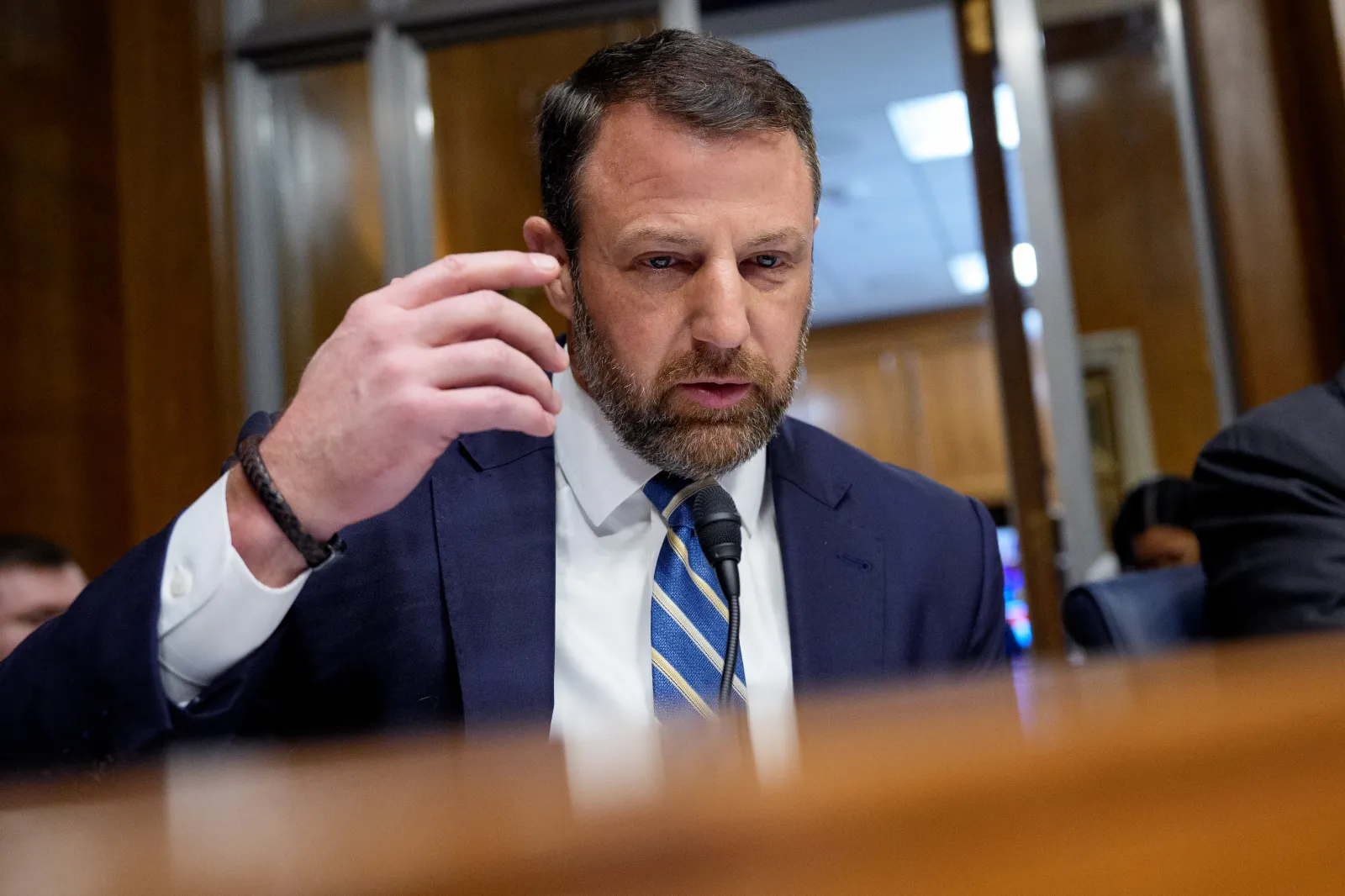
Senator Markwayne Mullin from Oklahoma has been encouraged to divest from certain stocks in his portfolio over conflict of interest concerns that could arise because of the Republican's new role as secretary of the Department of Homeland Security (DHS).
Last week, President Donald Trump nominated Mullin, who has been a senator from Oklahoma since 2023, to replace Kristi Noem, after she became the first Cabinet secretary to be fired from Trump's second administration. Mullin is expected to assume the post on March 31, pending Senate confirmation.
Under 18 U.S. Code § 208, a federal conflict of interest statute, members of the executive branch of the U.S. cannot participate in matters including stock holdings where they have a direct financial interest. There is no suggestion Mullin is in breach of this statute.
Read More on Politics
Ahead of Mullin's confirmation, ethics experts have raised concerns after a Newsweek analysis found Mullin has purchased at least $305,009 worth of stock in companies that could intersect with his role at DHS.
Richard Painter, a chief ethics lawyer under former President George W. Bush, told Newsweek: "He should probably divest from all of these stocks as there is too great a risk that they will be impacted by his work at DHS."
A White House spokesperson told Newsweek: “As DHS Secretary, Senator Mullin will, of course, comply with all ethics and conflict of interest rules, just as every cabinet secretary does. Senator Mullin currently uses an independent, third-party operator firm that manages all stock portfolio investments on his behalf. He does not conduct or inform trades.”
Congressional stock trading is permitted but the practice has attracted bipartisan criticism because of concerns it may facilitate insider trading, if lawmakers are privy to information about assets that could move markets. There are also concerns that those with stock holdings can influence the assets they hold to inflate their share value.
...
Newsweek reached out to DHS, Mullin, the U.S. Office of Government Ethics and the companies Mullin bought stock in by email for comment.
Mullin's Stock Portfolio
Under the 2012 STOCK Act (Stop Trading on Congressional Knowledge Act), members must provide a broad numerical range of the value of their stock transactions in periodic transaction reports (PTRs). Using this data, Newsweek analyzed holdings that could intersect with DHS and other government agencies.
While Mullin has been in the U.S. Senate since 2023, Newsweek has only analyzed trades reported in 2026 until March 2 to gather the most recent data about his stock holdings, bearing in mind the 45-day lead-in time mandated for members of Congress to report their trades publicly. This means this analysis is also not an exhaustive reflection of his stock portfolio and he could have trades with other companies that intersect with DHS or other government agencies. These trades were also conducted before Mullin was tapped for his upcoming role at DHS. Meanwhile, given the time lag in which politicians must disclose trades, it is possible that Mullin may have sold these stocks since reporting he purchased them.
The purchases, made between December 29, 2025 and February 4, 2026 were for stock in:
- Nvdia a chipmaker which has been subject to U.S. export-license conditions tied to AI chip sales to China.
- Aerospace and defense company RTX, formerly known as Raytheon, a federal contractor
- APi Group, a services provider of safety, security and specialty services.
- Adobe, which provides software services to DHS.
- Caterpillar, a manufacturer of construction and mining equipment with DHS contracts.
- Deere & Company, an agricultural machinery company and DHS contractor.
- Microsoft, a technology company used by multiple government departments.
Seven were made as joint purchases, two purchases were made individually. At their minimum reported value, the stocks total to $305,009. At their maximum, they tally to $850,000. Mullin's spouse also made two purchases of stock from two of the aforementioned companies.
Some of the companies have been in receipt of federal contracts with DHS and other government agencies. For instance, in June 2025, RTX corporation was awarded $347,381 to repair the auxiliary power unit in an aircraft operated by the U.S Coast Guard, a DHS subsidiary. The company also has contracts with the Pentagon.
In September 2025, Caterpillar was awarded $246,420 to provide power and hand pumps to the department.
Speaking to Newsweek, Veljko Fotak, a finance professor at the University at Buffalo in New York, said that "these trades are not direct proof of anything nefarious."
But, he added, "the conflicts of interest are glaring and, of course, they are problematic." "It is not just the lack of conflicts of interest that matters—perceptions matter as well," he added. "When citizens start questioning the motives behind the decisions made by government officials, when doubt creeps in, trust in our institutions weakens, with the predictable negative consequences for both our democracy and our markets."
"One of the problems in addressing these perceived conflicts of interest is that a department with a broad mandate as the DHS tends to impact life on the ground in all sorts of ways," he added. "There are very few listed firms whose operations are not, in some way or another, affected by the operations of the DHS—which, by the way, is also a peculiar equilibrium we find ourselves in. So, I would take this a step further and say that anyone in charge of the DHS should not be trading stocks, period."
Mullin's Previous Trades
Mullin's congressional activity has drawn previous scrutiny. In December 2024, Newsweek reported that Mullin had bought shares in an education company while sitting on the Senate Health, Education, Labor, and Pensions Committee, raising concerns about possible intersections with his legislative committee work.
In February 2024, Newsweek revealed that he had purchased six municipal bonds in Oklahoma, raising conflict of interest concerns because the bonds were in the state he represents. Local governments rely on bonds to finance infrastructure projects. Often, interest received by holders of bonds is exempt from taxation.
Bills to Stop Stock Trading
Amid this and other scrutiny, there have been bipartisan calls to limit the ability to trade stocks of politicians in positions of power. Earlier this month, a group of House Democrats, led by Michigan Representative Haley Stevens, California Representative Derek Tran and Illinois Representative Eric Sorensen introduced the No Getting Rich in Congress Act—a bill that would ban the president, vice president, members of Congress, candidates for federal office as well as their spouses and dependents from buying and selling stocks.
In January, the House Administration Committee advanced a bill by Wisconsin Republican Bryan Steil that would allow members of Congress and their spouses and dependent children to retain stocks they already own but prevent them from buying new ones.
During his State of the Union speech, Trump called on Congress to pass legislation to stop congressional stock trading over concerns of use of insider information.
In a polarized era, the center is dismissed as bland. At Newsweek, ours is different: The Courageous Center—it's not "both sides," it's sharp, challenging and alive with ideas. We follow facts, not factions. If that sounds like the kind of journalism you want to see thrive, we need you.
When you become a Newsweek Member, you support a mission to keep the center strong and vibrant. Members enjoy: Ad-free browsing, exclusive content and editor conversations. Help keep the center courageous. Join today.


View 0 Comments
Submit Correction
View Editorial & AI Guidelines