10
Loading video...

By Rachael O'Connor
Reporter
0
Share
Newsweek is a Trust Project member
See more of our trusted coverage when you search.Prefer Newsweek on Googleto see more of our trusted coverage when you search.
A new study has suggested a species of marine animal may communicate with each other by waving.
Researchers from École Normale Supérieure in France have found evidence of cuttlefish possibly communicating with each other, by waving one of their ten limbs—eight arms and two tentacles—at one another.
Coauthor of the study, Sophie Cohen-Bodénès, told Newsweek: "Our study gives a first insight on how cuttlefish may use the four arm waves to communicate visually and through mechanoreception with other conspecifics and also certainly to lure preys and predators."
Read More on Science
Despite the name, cuttlefish are not fish: they are invertebrates related to octopus and squid, and are known to be intelligent, particularly when it comes to evading predators.
The mollusks can change their skin color on demand, and can even create a body double from a cloud of ink.
Now new research has suggested this intelligence extends to how cuttlefish communicate with each other.
The team examined how the Sepia officinalis, also known as the common cuttlefish, and Sepia bandensis, the dwarf cuttlefish, move their arms.
They observed the sea creatures in a tank together, and found four waving patterns that appeared to be consistent: up, side, roll and crown.
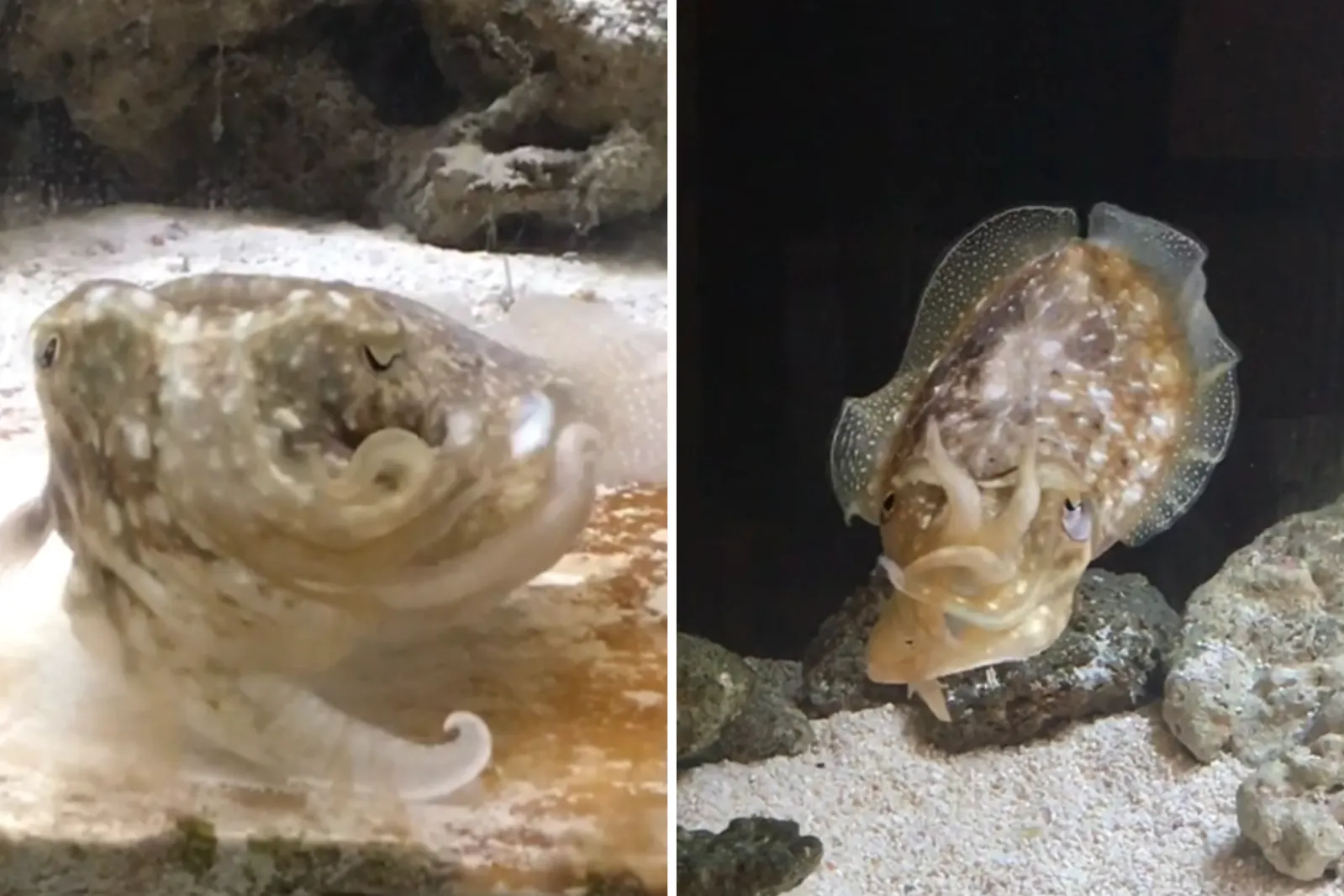
...
When they recorded this movement and played it back to the cuttlefish, scientists found that the cuttlefish waved back to the video.
Moreover, the cuttlefish were found more likely to wave back to the screen when the video was played the right side up, rather than flipped upside down.
The scientists noted that along with the visual display, their waving produces waves in the water which may be perceived via mechanoreception: detecting and responding to stimuli such as touch and vibration, even when the cuttlefish are not visible to one another.
Testing this theory, they recorded vibrational waves using a hydrophone, an underwater device which detects and records ocean sounds from all directions.
They then played the waves back to the marine animals in a scrambled or reversed order—and found the cuttlefish would not respond to the scrambled version, only the original.
The study has not yet been peer-reviewed, and the scientists involved suggested more work is involved to prove conclusively that the cuttlefish are communicating messages with their waving.
However, the researchers hope it will open up new possibilities when it comes to understanding communication in cephalopod species, as an example of convergent evolution with vertebrate species.
Cohen-Bodénès told Newsweek: "Currently, we are investigating quantitatively if cuttlefish also use the signs to interact with prey.
"We believe the signs may be intra- and interspecific, and we are developing artificial intelligence tools to decipher more in-depth their meaning.
"Especially, we will attempt to correlate skin pattern coloration and arm wave sign displays," Cohen-Bodénès said.
Do you have a tip on a science story that Newsweek should be covering? Do you have a question about evolution? Let us know via science@newsweek.com.
Update, 05/07/25, 09:59 a.m. ET: This article has been updated to include comment, video and images from Sophie Cohen-Bodénès.
Reference
Bodenes, S. C., & Neri, P. (2025). Cuttlefish interact with multimodal "arm wave sign" displays. bioRxiv. https://doi.org/10.1101/2025.04.13.648584
View 0 Comments
Submit Correction
View Editorial & AI Guidelines