...

By Jenna Sundel
News Reporter
0
Share
Newsweek is a Trust Project member
See more of our trusted coverage when you search.Prefer Newsweek on Googleto see more of our trusted coverage when you search.
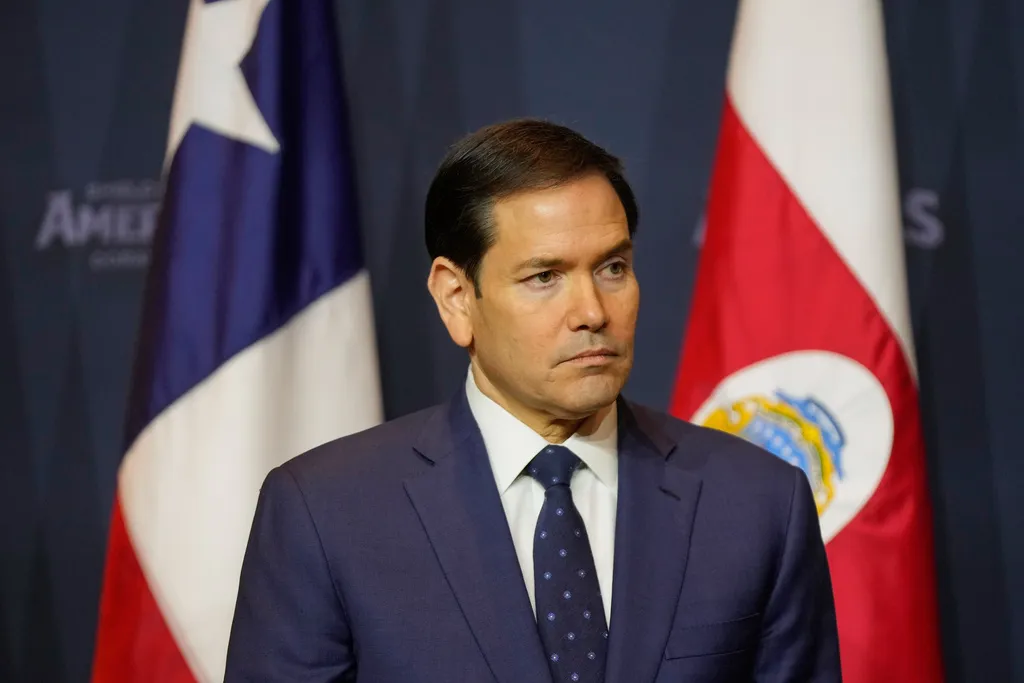
Secretary of State Marco Rubio took the stand on Tuesday in the trial of a former congressman accused of lobbying on behalf of the Venezuelan government, making Rubio the first sitting member of the president's Cabinet to testify in a criminal trial in 43 years.
Why It Matters
The last sitting Cabinet member to deliver testimony in a criminal trial was Labor Secretary Raymond Donovan, who testified at an organized crime trial in 1983.
Read More on News
Rubio was asked about interactions dating back nearly a decade with former Representative David Rivera, who served as a Florida Republican. Rubio was previously a Republican senator representing Florida.
Rivera and an associate were charged in 2022 with money laundering and failing to register as a foreign agent after being awarded a $50 million lobbying contract from the government of Nicolás Maduro, who was president of Venezuela at the time. Rivera has denied any wrongdoing.
Rubio said during his testimony that he had no knowledge of the alleged lobbying.
“I would’ve been shocked" had he known, he said.
...
What To Know
Rubio appeared in a federal courtroom for three hours of testimony in Miami with heightened security. Rubio testified that he became "very close” with Rivera when they both were serving as members of the Florida Legislature in the early 2000s.
Rubio and Rivera, both Cuban-American Republicans, co-owned a house in Tallahassee.
They remained close after being elected to Congress and shared friends and family gatherings.
Rubio said he received a text in July 2017 from Rivera saying he needed to see him urgently to discuss Venezuela. Rivera said he was working with Raul Gorrín, a media magnate in Venezuela, on a plan to convince Maduro to step down as president, according to Rubio's testimony.
“I was skeptical,” Rubio said in court.
The secretary of state added that the Maduro government was full of “double-dealers” who were constantly promoting plans to betray Maduro.
“But if there was a 1 percent chance it was real, and I had a role to play alerting the White House, I was open to doing that,” he said.
Rubio said he had no knowledge Rivera was working for Maduro, as prosecutors later alleged.
Rubio said he did not think Gorrín would betray Maduro, despite Rivera showing him a bank account with millions of dollars in it that he was told were payments from the businessman to Venezuela’s opposition.
“It was an impressive amount,” Rubio said. “He didn’t tell me whose account it was. He said it was to support the opposition.”
In the days after learning of Rivera's alleged dealings with Gorrín, Rubio wrote and delivered a speech on the Senate floor indicating that the U.S. would not retaliate against Venezuelan government insiders who worked to get Maduro out of his position as president. Rubio said he received talking points from Rivera.
"He provided me with insight into some of the key phrases that regime insiders would’ve wanted to hear to know this was serious,” Rubio said. “No vengeance, no retribution.”
Rubio said he told Trump there may be something “brewing” with Venezuela during his first term.
In the indictment against Rivera, there is no indication that Rubio acted improperly as a senator at the time.
At a meeting at a Washington hotel, Gorrín failed to produce a promised letter from Maduro to Trump that he wanted Rubio to hand-deliver to the president.
“It was a total waste of my time,” Rubio said.
Rivera and his co-defendant are accused of trying to arrange meetings for then-Foreign Minister Delcy Rodríguez, who is now serving as Venezuela's acting president after Maduro was ousted, in Dallas, New York, Washington and Caracas with White House officials, members of Congress and the chief executive officer of Exxon Mobil.
Prosecutors say the purpose of the $50 million lobbying contract Rivera was awarded was to persuade President Donald Trump's administration during his first term to normalize relations with Maduro’s government.
Rivera has argued that his firm, Interamerican Consulting, was hired by an American subsidiary of Venezuela’s state-owned oil company, and therefore did not need to register as a foreign agent. His attorney, Ed Shohat, said the contact was only focused on luring Exxon back to Venezuela, making it commercial work that is generally exempt from the Foreign Agents Registration Act.
The defense said Rivera's efforts with the Venezuelan opposition to establish a plan for Maduro’s exit were separate from his consulting work. Shohat said Rivera is a “freedom fighter” and “ardent opponent of communism wherever it rears its ugly head.”
What People Are Saying
Prosecutor Roger Cruz, in his opening statement on Monday: "This case is about two things: greed and betrayal. The evidence will show that for $50 million these two defendants made a pact to secretly lobby for Nicolás Maduro.”
Defense attorney Ed Shohat, in his opening statement on Monday: "The government’s theory is utterly preposterous."
This article includes reporting by The Associated Press.
Do you have a story that Newsweek should be covering? Do you have any questions about this story? Contact LiveNews@newsweek.com.
In a polarized era, the center is dismissed as bland. At Newsweek, ours is different: The Courageous Center—it's not "both sides," it's sharp, challenging and alive with ideas. We follow facts, not factions. If that sounds like the kind of journalism you want to see thrive, we need you.
When you become a Newsweek Member, you support a mission to keep the center strong and vibrant. Members enjoy: Ad-free browsing, exclusive content and editor conversations. Help keep the center courageous. Join today.


View 0 Comments
Submit Correction
View Editorial & AI Guidelines