
Justin Sullivan/Getty Images

By Joe Edwards
Reporter
0
Share
Newsweek is a Trust Project member
See more of our trusted coverage when you search.Prefer Newsweek on Googleto see more of our trusted coverage when you search.
A new U.S. Drought Monitor map shows large swaths of the country facing “extreme” to “exceptional” drought, with the most severe conditions stretching across parts of the West, Plains, South and Southeast.
The latest data highlights the scale and spread of drought across multiple regions, with some areas reaching the highest category on the monitor’s five-level scale. The findings come as unusually warm conditions have gripped the country, with the last year (May 2025-April 2026) marking the warmest 12-month period on record for the contiguous U.S.
The Drought Monitor’s map shows where drought is occurring nationwide and how severe it is, using five categories:
Read More on News
- D0—Abnormally Dry
- D1—Moderate Drought
- D2—Severe Drought
- D3—Extreme Drought
- D4—Exceptional Drought

...
Its latest release, issued Thursday, shows that parts of the West, High Plains, South and Southeast have been experiencing “exceptional” drought—the most severe level (D4).
In the West, the affected areas include southwestern Idaho, adjoining parts of Nevada, and northeastern Utah. In the High Plains, sections of Colorado and Nebraska were identified as experiencing “exceptional” drought, while in the South, the same designation applied to parts of Texas, Arkansas, Oklahoma and Mississippi. Across the Southeast, Florida, Georgia and the Carolinas also contained areas classified at the “exceptional” level.
Meanwhile, areas classified as experiencing “extreme” drought (D3) included parts of Oregon, Idaho, Montana, Wyoming, Utah, Colorado, Arizona, New Mexico, South Dakota, Nebraska, Kansas, Oklahoma, Texas, Louisiana, Arkansas, Kentucky, Tennessee, Mississippi, Florida, Georgia, the Carolinas and Virginia.
Third-Warmest April on Record
In a report earlier this month, the National Oceanic and Atmospheric Administration’s National Centers for Environmental Information said the contiguous U.S. witnessed its third-warmest April on record, with more than 700 counties recording record-high average temperatures, impacting more than 50 million people.
Severe to exceptional drought affected more than 40 percent of the lower 48 states, with the Southeast seeing its largest extent on record, it said.
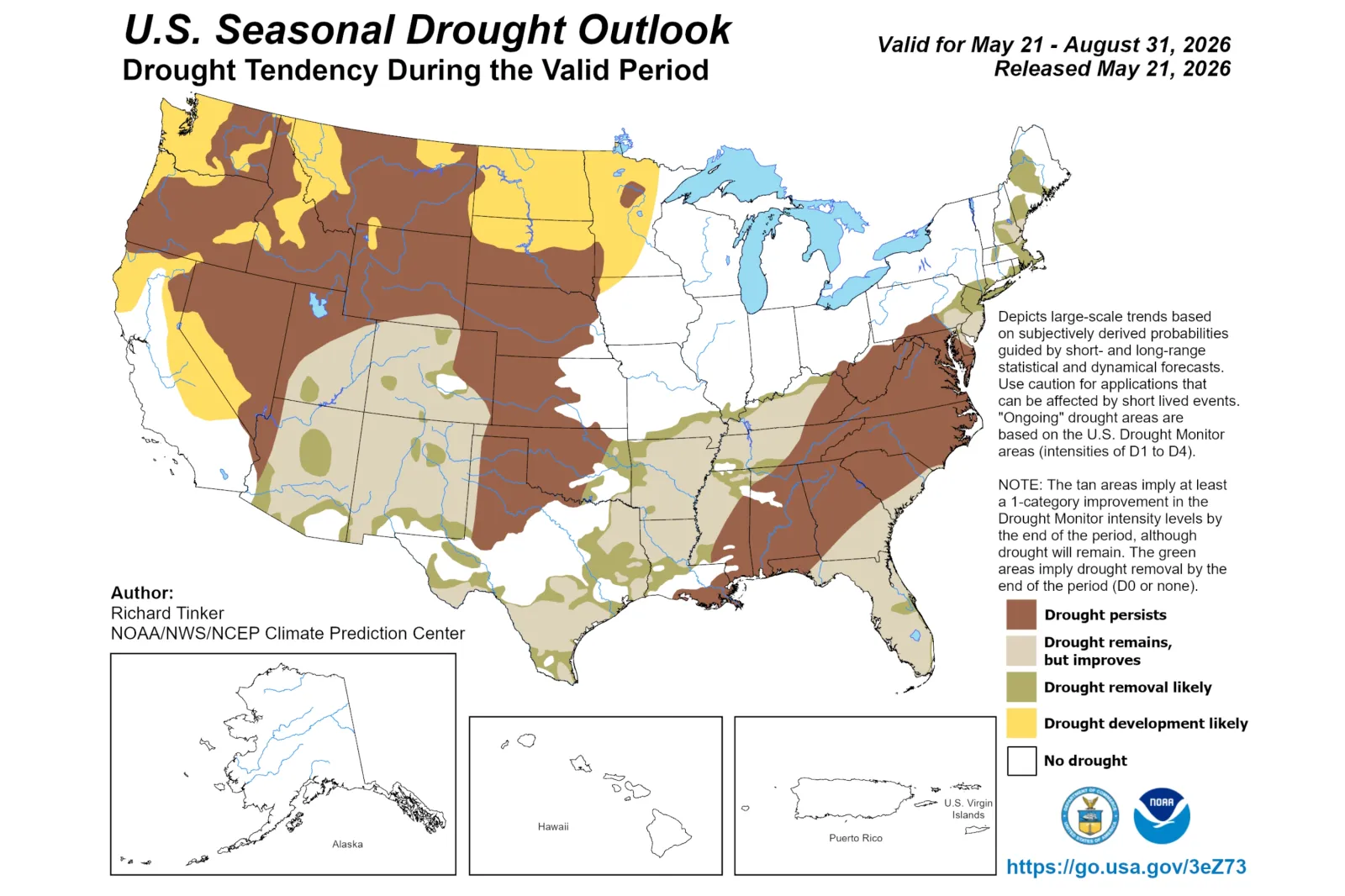
Looking ahead, the Climate Prediction Center’s (CPC) most recent seasonal drought outlook, issued Thursday and valid for late May through August, said that drought is expected to persist and expand across much of the northern and western parts of the West, driven in part by unusually low winter snowfall limiting water supply.
...
Some improvement is likely farther south, particularly in the Four Corners region, where enhanced monsoon activity and above-normal early summer rainfall could ease conditions, though relief may be limited in typically drier northern areas, it said.
Across the central and eastern U.S., conditions could be more mixed. Drought improvement or removal is expected by the CPC in parts of Texas, the Lower Mississippi Valley, Florida, the coastal Southeast and the Northeast, largely a result of periods of heavy or increased rainfall.
However, it said drought is likely to persist in the interior Southeast and parts of the south-central Plains, while drought development is anticipated in the northern Plains and Upper Midwest amid warmer and drier-than-normal conditions.
Outside the mainland, only minor dryness is present in Alaska, Hawaii, Puerto Rico and the U.S. Virgin Islands, with no widespread drought development expected by the end of summer, it said.
Expansive Drought Threatens Rural Communities
Meanwhile, the Union of Concerned Scientists (UCS) non-profit has warned that drought conditions are posing risks to rural communities that depend on farming and ranching. Dry conditions are reducing water availability, damaging crops, and straining groundwater supplies essential for agriculture, it said.
According to UCS, these impacts could lower crop yields and force ranchers to scale back livestock, threatening incomes—particularly for small and midsize operations. The group also highlights that prolonged drought, intensified by climate change, is increasing uncertainty for rural livelihoods and could contribute to higher food prices.
View 0 Comments
Submit Correction
View Editorial & AI Guidelines