...

By Giulia Carbonaro
Senior Reporter
0
Share
Newsweek is a Trust Project member
See more of our trusted coverage when you search.Prefer Newsweek on Googleto see more of our trusted coverage when you search.
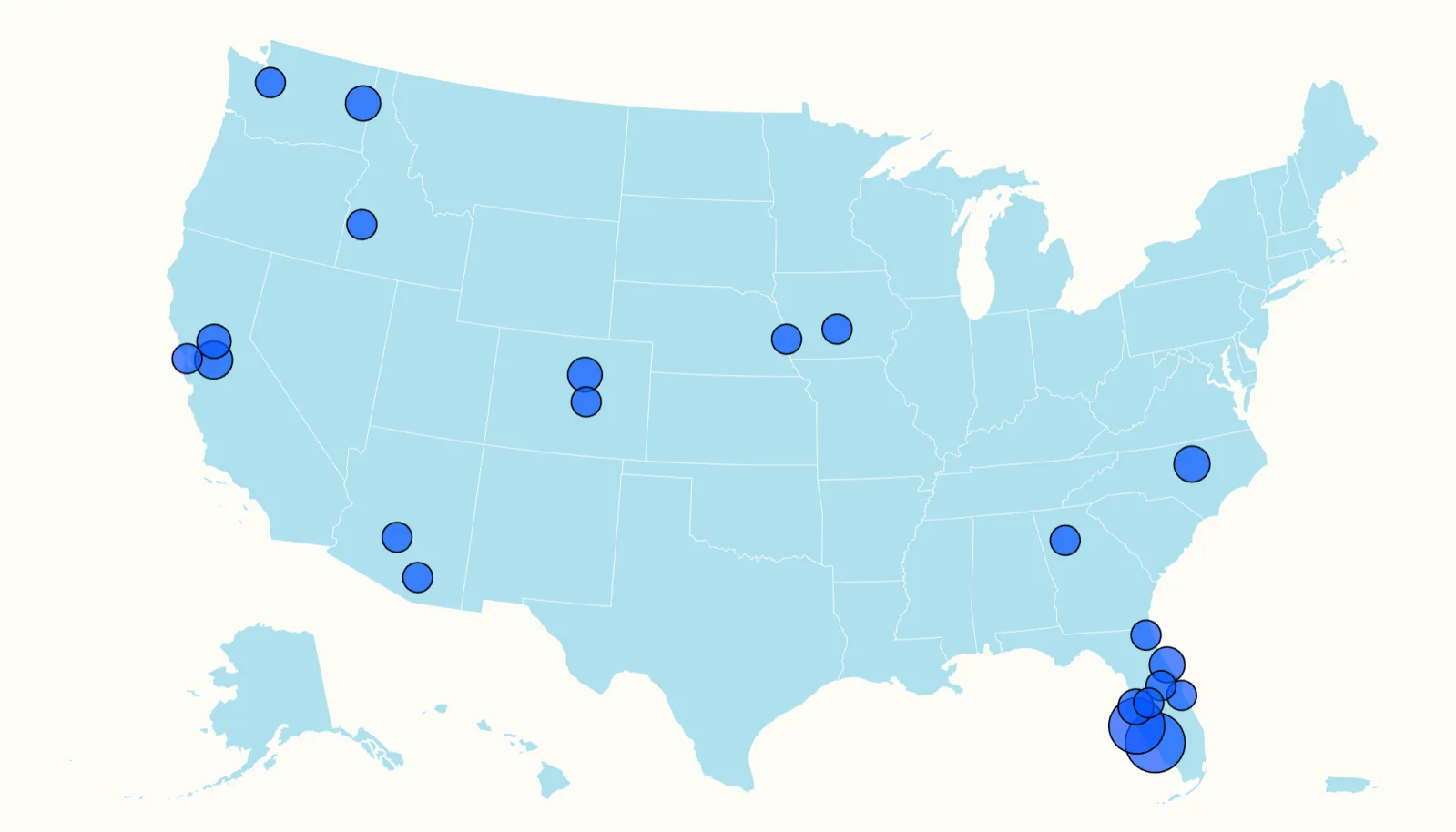
Home prices are expected to fall in only 22 of the largest 100 cities across the country next year, according to predictions made by Realtor.com in a new report, as affordability will remain an issue for many Americans despite slight improvements.
A majority of these cities are in the South and West, with a cluster being concentrated in Florida alone—showing that the stark correction that has taken hold of these regions after the pandemic homebuying frenzy will continue in the coming months.
Why It Matters
Despite the recent slowdown in the rapid home price growth that characterized the pandemic years, buying a home is still much more expensive than it was before the health emergency.
Read More on U.S.
In October 2019, the median sale price of the typical U.S. home was $313,200, according to Redfin. This October, despite weak sales and dwindling demand in the spring and the summer, it was $439,869, up 1.3 percent from a year earlier.
High home prices, alongside historically elevated mortgage rates and other rising housing costs, such as property taxes and homeowners' insurance premiums, have caused the homeownership rate in the U.S. to flatline this year. According to Census data, the homeownership rate in the country was 65 percent in the second quarter of 2025—the lowest since 2019.
What To Know
Realtor.com experts expect home prices nationwide to surge by 2.2 percent in 2026, a modest increase compared to the growth recorded during the pandemic. This slight improvement will boost sales, which they expect to increase by 1.7 percent for existing homes.
But in parts of the country, buyers will see even better improvements. In these 22 U.S. metropolitan areas, Realtor.com experts expect home prices to fall next year, to different degrees:
- Atlanta-Sandy Springs-Roswell, Georgia (-0.1 percent)
- Boise City, Idaho (-0.8 percent)
- Cape Coral-Fort Myers, Florida (-10.2 percent)
- Colorado Springs, Colorado (-0.4 percent)
- Deltona-Daytona Beach-Ormond Beach, Florida (-3.6 percent)
- Denver-Aurora-Lakewood, Colorado (-3.4 percent)
- Des Moines-West Des Moines, Iowa (-0.9 percent)
- Jacksonville, Florida (-1.4 percent)
- Lakeland-Winter Haven, Florida (-0.2 percent)
- North Port-Sarasota-Bradenton, Florida (-8.9 percent)
- Omaha-Council Bluffs, Nebraska-Iowa (-0.4 percent)
- Orlando-Kissimmee-Sanford, Florida (-1.6 percent)
- Palm Bay-Melbourne-Titusville, Florida (-1.0 percent)
- Phoenix-Mesa-Scottsdale, Arizona (-2.3 percent)
- Raleigh, North Carolina (-3.7 percent)
- Sacramento–Roseville–Arden-Arcade, California (-3.3 percent)
- San Francisco-Oakland-Hayward, California (-2.5 percent)
- Seattle-Tacoma-Bellevue, Washington (-0.3 percent)
- Spokane-Spokane Valley, Washington (-3.5 percent)
- Stockton-Lodi, California (-4.1 percent)
- Tampa-St. Petersburg-Clearwater, Florida (-3.6 percent)
- Tucson, Arizona (-0.5 percent)
The steepest price drops are expected in Florida, with the Cape Coral-Fort Myers metro area facing an estimated -10.2 percent change in home prices, followed by North Port-Sarasota-Bradenton at -8.9 percent, and Tampa-St. Petersburg-Clearwater and Deltona-Daytona Beach-Ormond Beach each with -3.6 percent.
These are all markets that became overheated during the pandemic, facing a surge in demand that waned after prices shot through the roof and domestic migration to Florida slowed. A construction boom in the state has also created a glut of inventory, which is now pushing down prices.
The Stockton-Lodi metro area in California ranked third with an expected price drop of -4.1 percent, while the Spokane-Spokane Valley metro area in Washington faced a potential decline of -3.5 percent.

...
What People Are Saying
Realtor.com said in its report: “As affordability remains a top concern, buyers want to be financially ready to find success in the 2026 housing market, and that means not only knowing your budget numbers but also understanding the market norms and cheat codes. Where will extra financial effort pay off, and which goals are not worth pursuing?
“New construction is a[other option to consider, especially for buyers in the South and West, where builders have been particularly active. As builders see the number of for-sale homes climb, they are trying to compete and are increasingly offering incentives to help buyers get to the closing table.”
What Happens Next
Prices are expected to rise in the other 78 largest U.S. cities analyzed by Realtor.com, though these increases will be small compared to the pandemic double-digit ones. Across all these locations, the median price gain will be 4 percent, experts say.
View 0 Comments
Submit Correction
View Editorial & AI Guidelines