average fuel prices

By Hugh Cameron
Reporter
0
Share
Newsweek is a Trust Project member
See more of our trusted coverage when you search.Prefer Newsweek on Googleto see more of our trusted coverage when you search.
While fuel costs vary widely from state to state, with some enjoying far more favorable prices at the pump, recent successive declines have pushed nationwide averages to multiyear lows.
According to the American Automobile Association (AAA), average gas prices for regular fuel were $3.13 on Tuesday, down from $3.41 this time last year and a record high $5.02 in June 2022.
Meanwhile, the latest data from MarketWatch shows that crude oil prices have also fallen to $62.81 per barrel, down from $74.37 this time last year.
Read More on Politics
Why It Matters
Declining fuel prices could represent a major political win for President Donald Trump, who pledged during his campaign to lower energy costs for Americans and has signed several executive orders since returning to office with the goal of "unleashing" America's energy independence.
What To Know
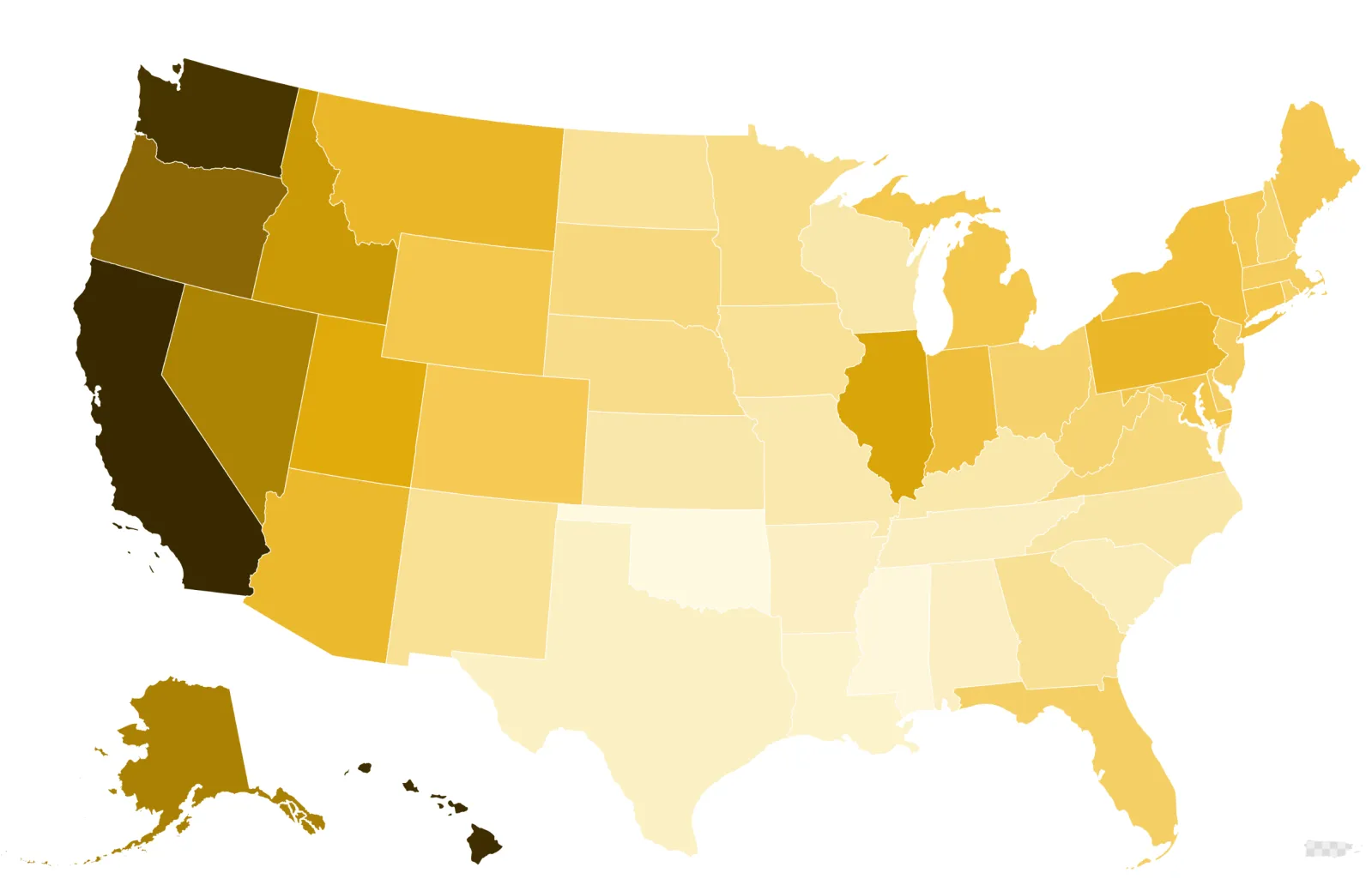
According to the AAA, California has the highest average gas prices of any state at $4.49 per gallon, well over a dollar more than the national average.
Regular prices have fallen from $4.60 in August 2024, though diesel prices have risen to $5.12 from $4.93 over the same period.
California consistently ranks among the most expensive states when it comes to paying at the pump. The U.S. Energy Information Administration (EIA), the government's official statistical agency for energy, has attributed this to a combination of "state taxes and fees, environmental requirements, special fuel requirements, and isolated petroleum markets."
California is followed by Hawaii and Washington at $4.46 and $4.40, respectively. This marks a 20-cent decline for the former and an equal increase for the latter.
At the opposite end of the spectrum, Southern states tend to benefit from much lower average gas prices. Oklahoma is bottom of the list at $2.67 a gallon, followed by Mississippi and Louisiana at $2.69 and $2.73, respectively.
Declining gas prices helped temper the Consumer Price Index (CPI) for July, which the Bureau of Labor Statistics released last week. The CPI increased by a seasonally adjusted 0.2 over the month—following a 0.3 percent gain in June—and was up 2.7 percent on a 12-month basis. However, the energy index dropped 1.1 percent as the gasoline index fell 2.2 percent from June. The latter is down 9.5 percent over the past year.
Jon Krosnick, a professor of political science and communication at Stanford University, said that taken alone, falling gas prices were "likely to translate into an increase in presidential approval."
"Of course, much more is going on in the political world than just gasoline prices, so we shouldn't necessarily expect to see a parallel in the short term of gasoline prices and presidential approval, but the drop in prices is likely to help President Trump," he told Newsweek.
What People Are Saying
Robert McNally, the founder and president of Rapidan Energy Group, told The New York Times that falling fuel costs were "like a dream come true for President Trump."
He added: "For American consumers, it's like a visible tax cut. You see it every day, even if you're not tanking up that day."
Trump said in a campaign speech at the Economic Club of New York in September: "Within 12 months of taking office, it will be an economic revival of our country like no one has ever seen before. Energy was what caused our problem initially. Energy is going to bring us back. That means we're going down and getting gasoline below $2 a gallon."
Jon Krosnick, a professor at Stanford University, told Newsweek: "This is a special case of a drop in gasoline prices, because it's easy for attentive Americans to see a link of presidential action to the drop in prices, because the White House has taken a variety of steps in recent months to facilitate oil drilling, which the public can easily see as a signal of increasing supplies, which is normally expected to reduce prices."
He added: "The change in gasoline prices will be just one factor affecting public approval of the president, and a wide array of other prices figure in to public thinking as well, including the prices of food and other consumer goods."
What Happens Next
According to the EIA, energy costs are expected to fall further into 2026. Last week, the agency lowered its forecasts for average brent crude prices next year to an average of $51 per barrel, down from its July forecast of $58.
Last month, Patrick De Haan, GasBuddy's head of petroleum analysis, told Reuters that the national average gas price had a "good chance of falling below $3 per gallon in September."
Update 8/19/25, 11:28 a.m. ET: This article was updated with a comment from Jon Krosnick.
View 0 Comments
Submit Correction
View Editorial & AI Guidelines