...

By Giulia Carbonaro
Senior Reporter
0
Share
Newsweek is a Trust Project member
See more of our trusted coverage when you search.Prefer Newsweek on Googleto see more of our trusted coverage when you search.
U.S. rent prices fell year over year for the 25th straight month in August, according to the latest data from Realtor.com, delivering some relief to Americans struggling with higher housing costs since the pandemic.
The median asking rent for properties with zero to two bedrooms in the 50 largest metropolitan areas last month was $1,713, down 2.2 percent from a year earlier—the equivalent of $38—and 2.6 percent from its August 2022 peak.
That is when rent prices—as well as home prices—exploded amid a sudden surge in demand as the pandemic triggered a wave of people moving from bigger cities to smaller towns and the suburbs or looking to live on their own.
Read More on News
Where Has Rent Fallen the Most?
When it comes to properties with zero to two bedrooms, rent prices have fallen the most from their peaks in Las Vegas, Nevada (-13.6 percent); Atlanta, Georgia (-13.6 percent); and Austin, Texas (-13.4 percent). These are all markets that have seen a stark correction after overheating during the pandemic.
"Las Vegas, Austin, and Atlanta saw the largest rent declines from their peaks due to rapid rent growth during the [COVID-19] pandemic, when many people moved to warm Sun Belt areas, creating a high starting point for corrections," Jiayi Xu, an economist at Realtor.com, said in the report.
The median rent in Las Vegas was $1,443 in August, down from $1,671 at its peak in June 2022. In Austin, the median rent price was $1,436, down from its September 2022 peak of $1,659. In Atlanta, the metro that has seen the biggest drop in rent prices from their pandemic peak, the median rent was $1,572, down from $1,820 in October 2021.
The main reason behind these rent declines is that domestic migration to these metros has slowed down significantly since the pandemic frenzy at the same time that new inventory has landed on the market, giving renters more options.
"Migration trends have slowed, and significant new multifamily supply has increased options for renters, exerting downward pressure on prices," Xu said. "Combined, these factors have pushed rents down more sharply than in other markets."
What About the Rest of the Country—and the Rental Market?
Median rent in all other categories than properties with zero to two bedrooms—including studios, one-beds and two-beds—also reported a year-over-year decline in August. Asking rent for studios was $1,430, down $25 (-1.7 percent) year over year; for one-beds, it was $1,593, down $35 (-2.1 percent) year over year; and for two-beds, it was $1,897, down $42 (-2.2 percent) year over year.
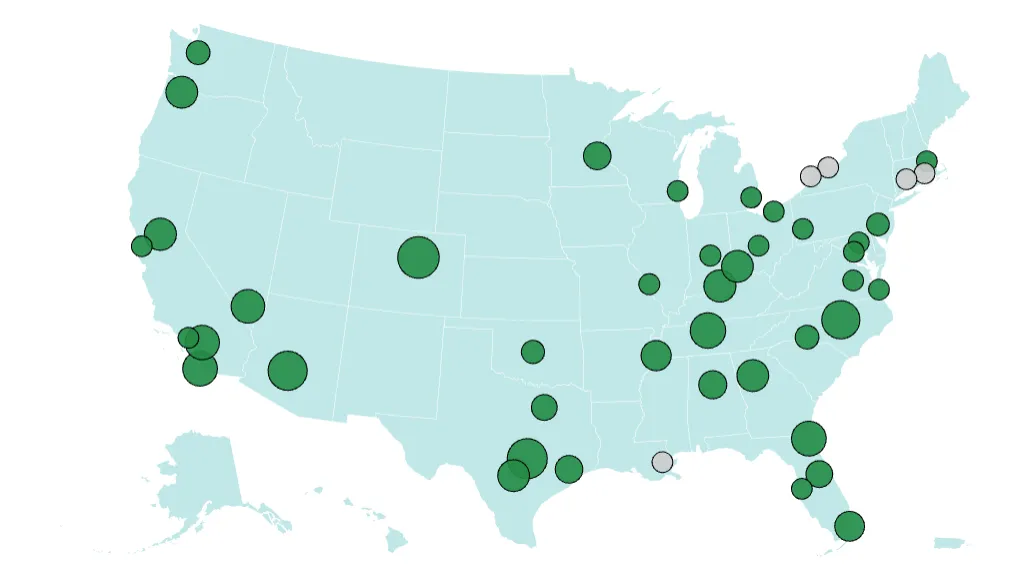
The biggest year-over-year declines were reported in Denver, Colorado (-7 percent); Austin, Texas (-6.5 percent); Phoenix, Arizona (-6.2 percent); Raleigh, North Carolina (-5.9 percent); Nashville, Tennessee (-5.1 percent); Jacksonville, Florida (-4.9 percent); Las Vegas, Nevada (-4.6 percent); Louisville, Kentucky (-4.2 percent); Atlanta, Georgia (-4.1 percent); and Cincinnati, Ohio (-4.1 percent).
Rent prices were up year over year in only four metros: Chicago, Illinois (+0.7 percent); Kansas City, Missouri (+2.9 percent); New York, New York (+0.5 percent); and San Jose, California (+1.6 percent).
While rents are declining year over year in most of the country's 50 largest metros, in all but one, they are still much higher than they were before the pandemic. San Francisco saw rent prices for all size categories down 3.2 percent in 2025 compared to 2019, with a median rent of $2,831.
The biggest six-year increases were reported in Pittsburgh, Pennsylvania (+39.9 percent); Tampa, Florida (+39.1 percent); and Indianapolis, Indiana (+32.3 percent).
Despite having fallen from its pandemic peak, the U.S. median rent was still $249—17 percent higher than in August 2019.
View 0 Comments
Submit Correction
View Editorial & AI Guidelines