...

By Giulia Carbonaro
Senior Reporter
0
Share
Newsweek is a Trust Project member
See more of our trusted coverage when you search.Prefer Newsweek on Googleto see more of our trusted coverage when you search.
Despite longstanding affordability issues and growing uncertainty, foreign buyers have flocked back to the U.S. housing market over the last year, snapping up $56 billion worth of American homes between April 2024 and March 2025, new figures show.
It is the first time that international buyer demand has risen in eight years, according to the National Association of Realtors (NAR), which shared the figures in its newly released 2025 International Transactions in U.S. Residential Real Estate report.
The increase represents a dramatic shift from the declines observed in recent years, which suggested that foreign buyers were exiting the U.S. housing market. Between April 2023 and March 2024, foreign buyers invested $42 billion in residential purchases in the country—about 33 percent less than in the previous year.
Read More on News
Over the past year, however, foreign buyers bought up 78,100 existing homes in the U.S. market, 44 percent up on a year earlier. While that is a significant increase, annual sales overall were the second-lowest since NAR began tracking such data in 2009.
"International interest in buying U.S. real estate increased following the global economic recovery from several years of pandemic-related disruptions," NAR's chief economist Lawrence Yun said, commenting on the latest data. "However, elevated home prices and interest rates continue to dampen overall sales activity."
Florida Leading The Way
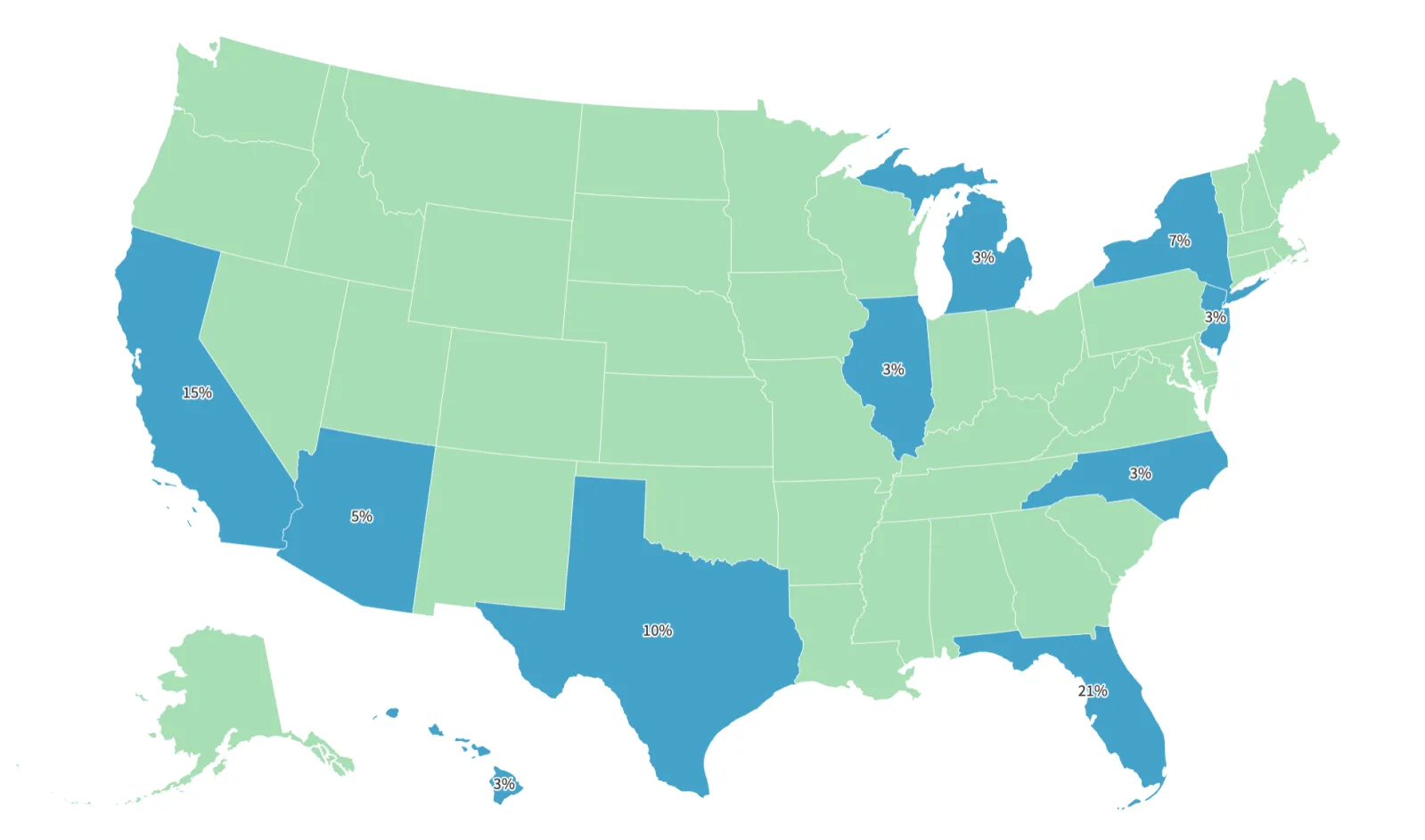
The Sunshine State continues to be the most attractive destination for a majority of foreign buyers, according to the report, accounting for more than one in five (21 percent) of international purchases.
This is nothing new for Florida, which has been the most popular destination for foreign buyers in the U.S. for some 15 years thanks to its sunny weather, relaxed lifestyle and favorable tax policies. But a recent surge in housing inventory in the state, supported by a boom in construction, has made it even more appealing to buyers, Yun said, as local buyers pulled back due to ongoing affordability challenges.
"Of course, people are attracted to the lifestyle, the natural beauty, and the amazing endless sunshine, but what really sets Florida apart is the opportunity it offers," Tim Weisheyer, 2025 Florida Realtors President and broker-owner of Dream Builders Realty and dbrCommercial Real Estate Services, told Newsweek. "Buyers from around the world are looking to put down roots in markets that offer both quality of life and long-term value, and Florida delivers on both."
Beyond the properties themselves, Florida offers global investors a powerful advantage, Weisheyer said.
"We're a gateway to the Americas, with world-class infrastructure, over $191 billion in trade volume, and direct access to global markets. Combine that with no state income tax, a business-friendly environment, and continued population and business growth, and it's clear why Florida stands out as a top place not just to buy a home, but to build a future," he said. "In a world where markets can shift quickly, Florida stands out as a smart, strategic place to grow wealth."
Weisheyer said investors are contributing to the strength and stability of the Sunshine State's housing market.
"These are often serious, cash-ready buyers competing in some of our most in-demand markets, like Orlando, Tampa and Miami. Their purchasing power, especially with so many paying in cash, can absolutely influence pricing, but only very limited and specific niches—such as the luxury and vacation home segments," he said.
While Florida is the number one state in the nation for international real estate purchases, they only represents 3 percent of the state's overall marketplace.
California is the second-most popular destination in the country, drawing 15 percent of all foreign buyers' purchases in the country. The Golden State overtook Texas as the second-most popular destination for foreign buyers, and between April 2024 and March 2025 it accounted for 10 percent of foreign buyers' purchases.
New York followed with 7 percent of all foreign buyers' purchases and Arizona with 5 percent.
Who Is Buying?
The biggest share of foreign buyers purchasing homes in the U.S. over the last year came from China (15 percent; spending $13.7 billion), followed by Canada (14 percent; $6.2 billion), Mexico (8 percent; $4.4 billion), India (6 percent; $2.2 billion) and the United Kingdom (4 percent; $2.0 billion). Some 56 percent of foreign buyers, overall, are U.S. residents.
The preferred destination for Chinese buyers, according to NAR's report, was California (which accounted for 36 percent of all purchases from Chinese buyers). For Canadian and British buyers, it was Florida (48 percent and 45 percent respectively). For buyers from both Mexico and India, Texas was the top choice (40 percent and 13 percent respectively).
Nearly half of all foreign buyers (47 percent) paid all-cash—significantly more than the 28% of overall sales that were all-cash purchases. Foreign buyers also paid more per property, on average. The median purchase price among foreign buyers was $494,400—higher than the median price of $408,500 paid for existing homes sold in the U.S. from April 2024 to March 2025 and the median purchase price the prior year.
That is likely because foreign buyers can afford to spend a little more, and prefer to buy generally more expensive properties in more central locations, analysts suggest.
...
Update, 7/17/25 11:25 a.m. ET: This article was updated with comment from Tim Weisheyer.
View 0 Comments
Submit Correction
View Editorial & AI Guidelines