
By Suzanne Blake
Reporter
0
Share
Newsweek is a Trust Project member
See more of our trusted coverage when you search.Prefer Newsweek on Googleto see more of our trusted coverage when you search.
Americans are being warned not to travel to parts of Africa as a deadly Ebola outbreak spreads across multiple countries.
The U.S. State Department has issued its highest-level warning, a Level 4: Do Not Travel, for several countries, while health officials ramp up screening and containment efforts.
President Donald Trump said he is “concerned” about the outbreak, which has already spread beyond its initial epicenter.
Read More on Health
"I’m concerned about everything...but certainly am [about Ebola]. I think it’s been confined right now to Africa, but it's something that has had a breakout,” Trump said.
Why It Matters
The outbreak has triggered a global public health emergency declaration and U.S. travel warnings for multiple countries. New entry restrictions and screenings have gone into effect for some travelers after an American medical worker contracted Ebola abroad.
Health officials still stress that the risk to the U.S. public remains low.
...
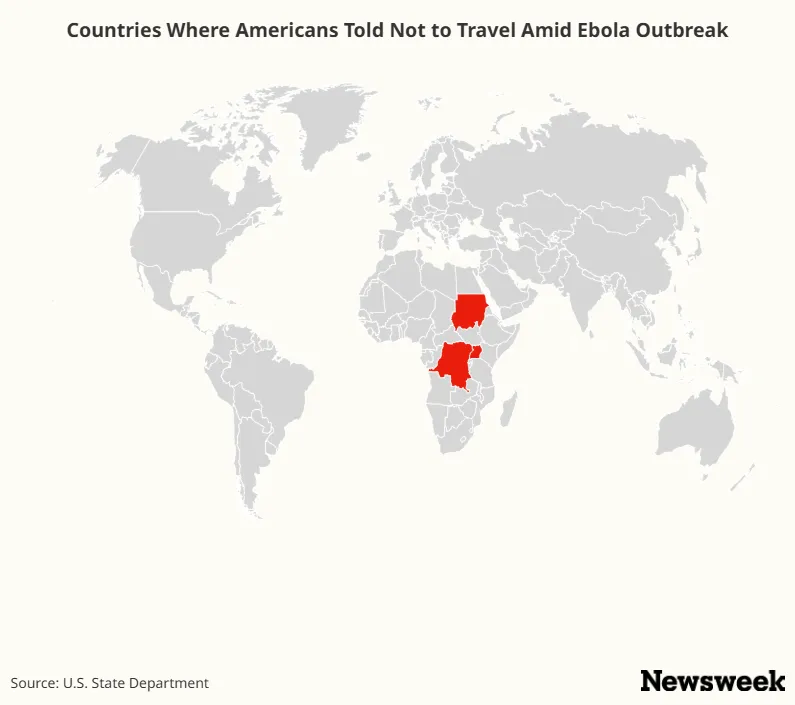
According to the U.S. State Department and related guidance, these countries are under the ‘Do Not Travel’ list:
- Democratic Republic of the Congo (DRC): Epicenter of the outbreak
- Uganda: Cases linked to cross-border transmission
- South Sudan: Included in travel warnings because of regional spread risk
These countries are currently under the Level 4: Do Not Travel advisories for U.S. citizens but Rwanda is also under a “Reconsider travel” advisory,
The guidance is focused on Americans traveling to these regions based on elevated health risks and limited medical resources.
The origin of the outbreak was in the Ituri Province in the eastern Democratic Republic of Congo. It spread to Uganda, and there’s a broader regional risk, including in South Sudan.
Currently, there are more than 500 suspected cases and 130 suspected deaths, according to the Congolese government.
Travel Advisory for Americans Returning From Ebola Areas
While outbound travel warnings are the primary focus, the U.S. has also implemented measures for people returning from affected regions. Non-U.S. citizens who traveled to the following countries within the past 21 days face entry restrictions:
- Democratic Republic of the Congo
- Uganda
- South Sudan
U.S. citizens are subject to enhanced screening at airports and may be monitored for symptoms. These measures are currently set for at least 30 days
“It’s always best to plan ahead, and in the case of significant outbreaks, avoiding those destinations is the safest choice,” Dr. Sharon Nachman, chief of pediatric infectious diseases at Stony Brook Children's Hospital in New York, told Newsweek. “Currently, we strongly recommend against any travel to areas affected by Ebola.”
Are There Cases of Ebola in the U.S.?
There are confirmed widespread cases in the U.S., but at least one American medical worker has been infected abroad. Officials continue to say the risk to the U.S. public is low and there is no evidence of community spread domestically.
Dr. Peter Stafford, a physician serving in eastern Congo with the Christian medical nonprofit Serge, contracted the rare Bundibugyo strain of Ebola while treating patients at Nyankunde Hospital near the city of Bunia, according to a statement issued by the organization.
“We have stood up a full, interagency response ... everyone is fully involved in tracking this ... that American, as well as six high-risk contacts are going to be taken out of that region and taken to Germany,” Heidi Overton, the chief policy officer and director for the Center for a Healthy America at America First Policy Institute and a member of Trump's domestic policy council, said in a statement.
...
Is Ebola Curable?
Ebola is a severe and often deadly virus, but outcomes depend on early care. There is no universally available cure for the current strain, but treatment generally focuses on supportive care, hydration and managing complications.
“Ebola virus has no treatment. The current circulating strain has no vaccine to be used as a preventative,” Nachman said. “All of our treatments revolve around support for individuals who are infected. Any current individuals in the U.S. infected with Ebola are from cases where it has been acquired outside of the U.S.”
The mortality rate can range from 25 percent to 50 percent or higher, depending on the strain.
How Is Ebola Transmitted From Person to Person?
Ebola spreads through direct contact, not through the air.
Transmission occurs via:
- Blood or bodily fluids of infected individuals
- Contaminated surfaces or objects
- Contact with infected corpses
Experts maintain that transmission requires close physical contact and is not airborne like COVID-19 or the flu.
What Happens Next
- U.S. officials are continuing travel advisories, airport screenings and coordination with global health agencies
- International efforts include contact tracing and medical evacuations for exposed individuals
- The situation remains fluid, with experts warning the outbreak could expand further if not contained quickly
“Travel is broadening but also is accompanied by some risk,” Nachman said. “While Ebola is in the news, many other illnesses can be acquired while traveling. Speaking with your family physician and investigating what are the illnesses circulating in that location is a sensible approach to travel.”
View 0 Comments
Submit Correction
View Editorial & AI Guidelines