J.P. Morgan Commodities Research, Kpler

By Joe Edwards
Reporter
0
Share
Newsweek is a Trust Project member
See more of our trusted coverage when you search.Prefer Newsweek on Googleto see more of our trusted coverage when you search.
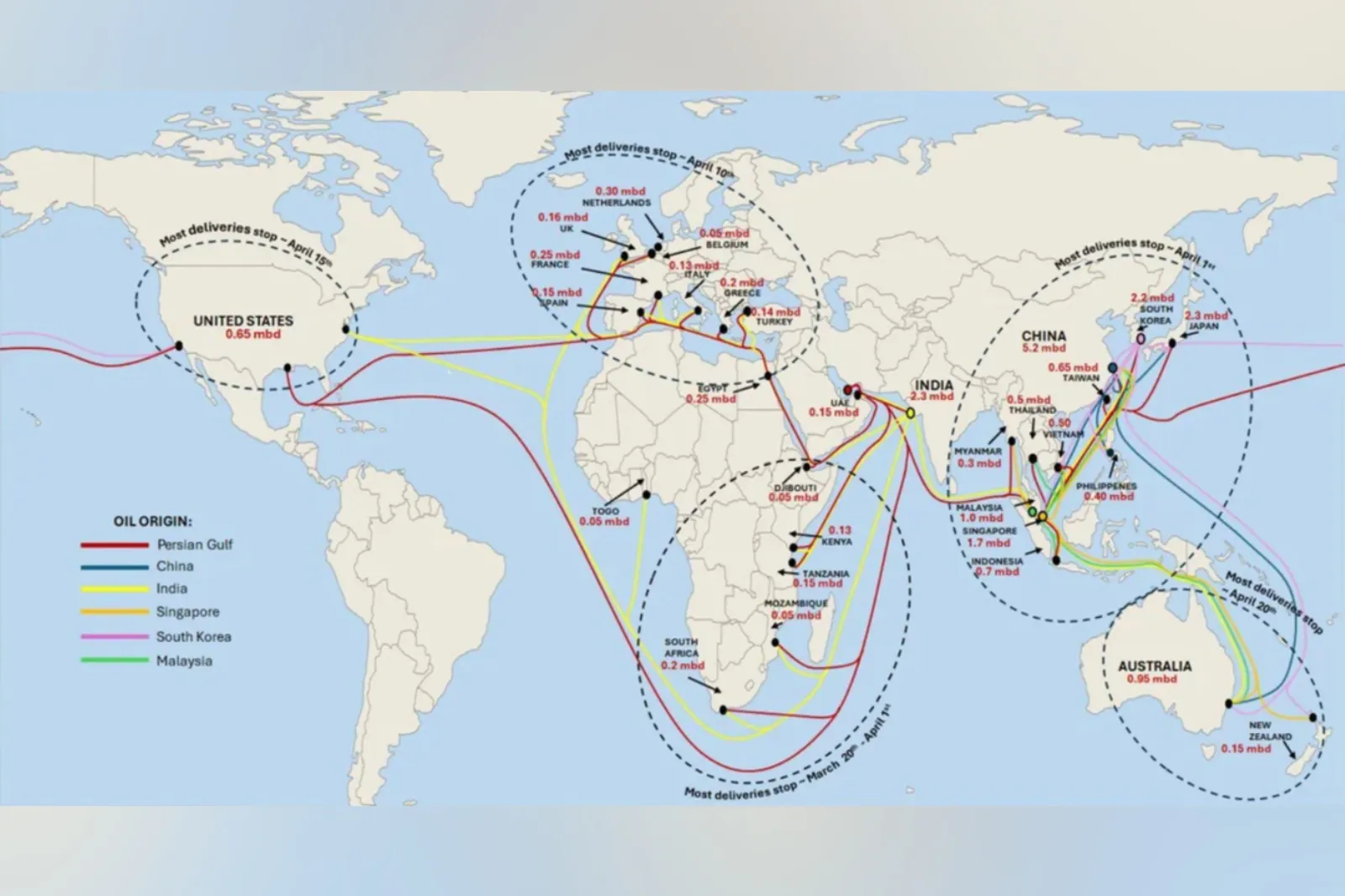
A map released by J.P. Morgan outlines when Gulf oil deliveries could largely grind to a halt across regions worldwide, including the U.S.
"The global system is shifting from a flow shock to a stock depletion problem, where timing—not just volumes—drives the impact," JP Morgan analysts said, according to MarketWatch.
Why It Matters
The U.S. and Israel has carried out strikes on key Iranian military sites over the past month, killing Supreme Leader Ayatollah Ali Khamenei and several other senior figures. Iran has responded by firing missiles and drones at Israel and at several Gulf Arab nations that host U.S. forces.
Read More on News
The conflict has caused major shipping disruptions through the Strait of Hormuz—a narrow but vital passage linking the Persian Gulf with the Gulf of Oman and the Arabian Sea—through which about 20 percent of global trade flows.
What To Know
Central, southern and eastern Africa are highlighted on the map, with most deliveries to these regions expected to stop by April. Another circle spans several Asian importers—including China, Japan and South Korea—and also covers parts of India within the same dashed boundary. This zone is stamped "Most deliveries stop—April 1."
...
Another broad oval arcs over Europe and extends to key receivers around the Mediterranean. Countries encompassed by that circle include the Netherlands, the U.K., Belgium and Germany, France, Spain and Italy as well as North African nations. The label inside the oval places the stop date for most deliveries at April 10.
The U.S. appears in its own oval, marked mid‑April for when most deliveries stop.
A final oval stretches across Australia and New Zealand. The legend inside that circle is April 20.
MarketWatch, citing J.P. Morgan analysts, reports that recent disruptions to oil flows through the Strait of Hormuz are setting off a westward‑moving, "sequential" global supply shock, with impacts emerging based on shipping times rather than volume alone.
The analysts say the oil market is "shifting from a flow shock to a stock depletion problem," with Asia already "feeling the squeeze," followed by Africa and Europe in April, and the U.S. by mid‑April. While most U.S. oil deliveries could halt around April 15, analysts say America is unlikely to face physical shortages, instead seeing higher prices and refined‑fuel "dislocations," according to the outlet.
What People Are Saying
White House spokesperson Kush Desai previously told Newsweek: "President Trump has always been clear about temporary disruptions as a result of Operation Epic Fury. While the U.S. Military continues making astonishing progress neutralizing the Iranian terror regime, the Trump administration remains focused here on the homefront implementing President Trump’s proven economic agenda of deregulation, tax cuts, and energy abundance.
"This agenda created historic prosperity in President Trump’s first term, and it’s again raising real wages and securing trillions in investments. After Operation Epic Fury’s objectives have been realized and the world is a safer place, America is set to achieve new highs."
What Happens Next
Newsweek reported on Tuesday that in the U.S., gas prices rose above $4 per gallon for the first time in over three years.
View 0 Comments
Submit Correction
View Editorial & AI Guidelines