
By Suzanne Blake
Reporter
0
Share
Newsweek is a Trust Project member
See more of our trusted coverage when you search.Prefer Newsweek on Googleto see more of our trusted coverage when you search.
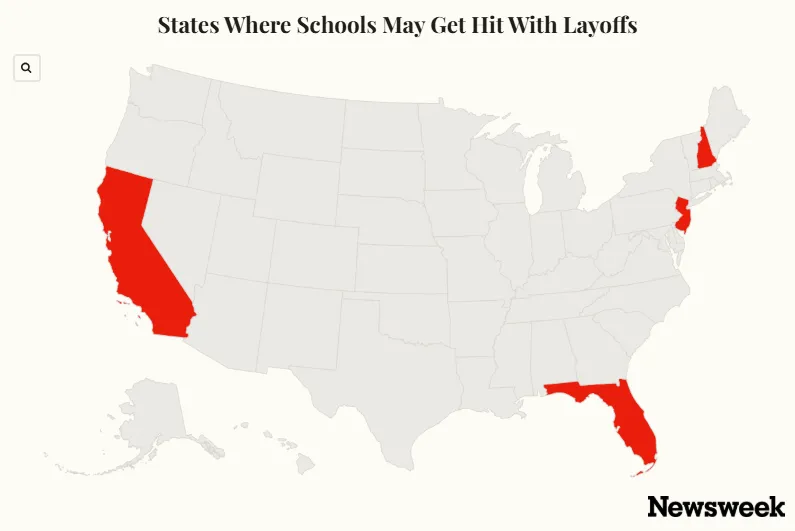
Schools across the country are set to be hit with major layoffs, and teachers in California, Florida, New Hampshire, and New Jersey will be impacted.
School districts across these states are warning of staff layoffs as declining enrollment, expiring federal aid, and structural budget deficits collide heading into the 2026–27 school year.
“It’s primarily elementary and middle schools getting hit the hardest, especially in areas dealing with declining enrollment, tighter budgets, and lower performance metrics,” Kevin Thompson, the CEO of 9i Capital Group and the host of the 9innings podcast, told Newsweek.
Read More on News
Why It Matters
Layoffs can indicate larger economic uncertainty. In the last year, the United States created 181,000 net jobs out of a total of 158 million jobs. Collectively, 2025 saw fewer additional jobs than during the Great Recession recovery period, despite the U.S. not currently being in a recession.
For education specifically, this can reflect strained state budgets and inflationary pressures.
...
What To Know
California Job Cuts
In Plumas County, the Plumas Unified School District approved sweeping layoffs to close a $9.5 million structural deficit, equal to roughly 27 percent of its total budget.
The district voted to eliminate 58 positions, including 19 teachers, 38 classified staff, and one principal, as it operates under state receivership following years of financial instability and enrollment loss.
Farther south, Sacramento City Unified School District is preparing to eliminate more than 400 positions amid a projected $113 million budget deficit. District officials say some of the positions are vacant, but hundreds of filled roles, including teachers, aides, custodians, and support staff, could result in layoffs or reassignments. The district cited long-term enrollment declines alongside the immediate budget crisis.
In Sonoma County, Windsor Unified School District drew headlines for potential teacher layoffs, but district officials clarified that most of the reductions were paper layoffs tied to restructuring and state requirements, not permanent job losses. According to the district, only three positions would not return, largely due to retirements and program changes rather than broad workforce cuts.
Florida Layoffs
Florida districts are also confronting staff reductions tied directly to shrinking student populations.
In Broward County, the state’s second-largest school district is considering cutting up to 1,000 positions as it faces an $80 million budget shortfall and projects the loss of thousands more students. District leaders emphasized that reductions would first come through attrition and administrative cuts, though targeted layoffs remain on the table.
On Florida’s Space Coast, Brevard Public Schools announced plans to reduce staffing by 7 percent across district departments, citing declining enrollment and funding tied to student counts. Superintendent Mark Rendell said non-school and district-level positions would be cut first, with classroom teaching roles affected only if enrollment drops leave classes underfilled.
“Layoffs are hitting hardest in systems that looked flush during the pandemic because they staffed up for emergency conditions with emergency money and fewer students,” Michael Ryan, a finance expert and the founder of MichaelRyanMoney.com, told Newsweek.
“This is a delayed reckoning for temporary stimulus, a demographic story with fewer kids and fewer traditional college students, and an efficiency story. Education is becoming the first big public sector forced to reconcile headcount with long-term demand instead of short-term politics.”
...
New Hampshire Teachers Lost
In New Hampshire, multiple districts are also warning that layoffs may be unavoidable due to budget constraints.
The Manchester School District could be forced to cut nearly $16 million from its budget if city funding remains capped, a scenario officials say could lead to 40 to 100 teacher and staff layoffs, larger class sizes, and reduced programs. District leaders blamed a combination of local tax caps and insufficient state and federal funding.
In Farmington, the school board is weighing layoffs to address a $330,000 deficit, part of which officials attributed to rising costs tied to the state’s SchoolCare benefits program. While the board described layoffs as a last resort, union leaders warned that any job cuts would impact student programs and staff stability.
New Jersey Likely Cuts Jobs as Well
In northern New Jersey, Jefferson Township and other Highlands-region school districts have not yet announced specific layoff numbers, but officials and residents have rallied over what they describe as chronic underfunding.
Jefferson Township Public Schools face a multi-million-dollar budget gap, prompting community protests and warnings that cuts to staff, athletics, and extracurriculars may follow without additional state aid. District leaders say years of declining state support tied to the Highlands Act have left schools with few remaining options.
“The drivers are pretty clear: state budget constraints, enrollment declines, and increased oversight on performance. But zoom out, and there’s a bigger shift happening,” Thompson said.
“You’re seeing more state intervention in curriculum, teacher certification, and even full takeovers of underperforming schools. At the same time, voucher programs are pulling dollars out of the public system. That creates a ripple effect, less funding, fewer resources, more closures.”
What People Are Saying
Alex Beene, a financial literacy instructor for the University of Tennessee at Martin, told Newsweek: “What we're currently seeing is the perfect storm of factors to produce layoffs at schools in many parts of the country. The two main culprits for many schools are a decline in the number of students being served and rising costs.
“Schools are funded based on their student count, and declining birth rates in America combined with more parents looking outside of the traditional school system for education have led to a decline in enrollment. Further complicating budgets are rising costs for virtually every part of providing for students which have slowly taken a great percentage of the limited funding pot available each year.”
Michael Ryan, a finance expert and the founder of MichaelRyanMoney.com, told Newsweek: “The next wave of school layoffs won't hit where parents expect. It will hit districts and colleges that grew the most during the pandemic to serve fewer students with temporary money. Most at risk are districts that relied heavily on ESSER federal COVID relief as a share of their budget, lost enrollment but kept staffing levels high, and used one-time money for recurring labor costs like salaries and new positions.”
What Happens Next
As declining enrollment reduces per-pupil funding and pandemic relief dollars are exhausted, more school districts are likely to announce layoffs in the months ahead.
“During the pandemic, additional funding received from federal and state governments softened these blows, but now that that money has been used completely, many school districts are having to face the consequences of these more long-term problems,” Beene said.
“It is important to note these issues are prevalent in all school systems. Some areas of the country that have been able to keep enrollment counts relatively unchanged and mitigate costs will feel the effects less.”
View 0 Comments
Submit Correction
View Editorial & AI Guidelines