
By Suzanne Blake
Reporter
0
Share
Newsweek is a Trust Project member
See more of our trusted coverage when you search.Prefer Newsweek on Googleto see more of our trusted coverage when you search.
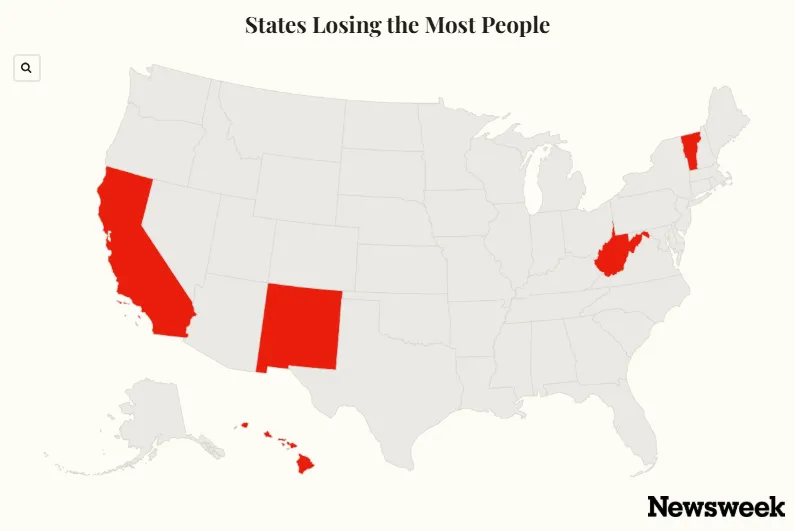
While the majority of the U.S. states grew in population from July of 2024 to July of 2025, five states actually saw population declines, according to a new Census report.
Across the U.S., population growth slowed but was still up 1.8 million or 0.5 percent for the same period, the U.S. Census Bureau found. However, the number of people living in California, Hawaii, New Mexico, Vermont and West Virginia dropped.
Why It Matters
While the United States population continues to grow, some states face decline due to several factors.
Read More on News
Cost of living, including inflation, taxes and home prices can push more residents out, such as likely the case with states like California. In other states, however, a stagnating economy and lower job prospects could be responsible for the dwindling populations.
...
What To Know
The U.S. experienced the slowest population growth from 2024 to 2025 since the early start of the COVID-19 pandemic, the Census Bureau reported.
In 2024, the U.S. added 3.2 million people, growing by 1 percent, which was the fastest annual population growth since 2006.
“The slowdown in U.S. population growth is largely due to a historic decline in net international migration, which dropped from 2.7 million to 1.3 million in the period from July 2024 through June 2025,” said Christine Hartley, assistant division chief for Estimates and Projections at the Census Bureau, in a statement. “With births and deaths remaining relatively stable compared to the prior year, the sharp decline in net international migration is the main reason for the slower growth rate we see today.”
California dropped by 0.02 percent or roughly 9,000 people, while Hawaii experienced a decline of 0.14 percent.
In New Mexico, the population shot down by a little over 1,000, with Vermont and West Virginia also hovering in the 1,000 to 2,000 range.
A negative net migration can have cascading effects for the impacted states, said Drew Powers, the founder of Illinois-based Powers Financial Group, told Newsweek.
“A smaller tax base puts strain on local public services like education, utilities, and infrastructure, which can cause even more residents to leave,” Powers said. “Businesses find it harder to employ a workforce and relocate—residents follow. Home prices fall, local economies fail, and tight-knit communities dissolve.”
Long term, California is likely to stabilize given its economic scale and GDP strength, according to Kevin Thompson, the CEO of 9i Capital Group and the host of the 9innings podcast.
“States with weaker job engines will have a harder time reversing population losses,” Thompson said. “The divergence between strong and struggling states is becoming more visible.”

...
What People Are Saying
Drew Powers, the founder of Illinois-based Powers Financial Group, told Newsweek: “Each of these five states mix and match reason for population loss, but the common denominator across the board is tightened immigration policies. California has been dealing with domestic out-migration for decades, but always had enough international migration to make up for it. California and Hawaii share a high cost of living burden, and Hawaii adds geographic isolation to the equation. New Mexico, West Virginia, and Vermont both show aging populations and have historically low migration.”
Alex Beene, a financial literacy instructor for the University of Tennessee at Martin, told Newsweek: “As much as some would like to simplify population declines as the result of state government policies, the reasoning is far broader and differs per state. While it's true states like California and Hawaii have seen a small exodus of residents due to the higher cost of living, other states with lower costs like West Virginia and New Mexico have also seen declines in population. Some of this is due to a shifting job market that is increasingly returning to offices instead of being remote, meaning job advancement options grow more scarce in some states.”
Kevin Thompson, the CEO of 9i Capital Group and the host of the 9innings podcast, told Newsweek: “Inflation is the common denominator. As household budgets tighten, quality of life becomes the deciding factor. Many people migrate toward states like Texas and Florida for perceived affordability and lower taxes, but those savings need to be fully analyzed. Property taxes, insurance, and local costs can quickly erode the headline benefits.”
Michael Ryan, a finance expert and the founder of MichaelRyanMoney.com, told Newsweek: “It's not just that people are leaving, it's the kind of people leaving and what that actually does to the math.
“Like, when a 35 year old software engineer bounces from California to Texas, CA doesn't just lose one person. They're losing someone who's probably got 30 years of peak earning years ahead of them. That's 30 years of income taxes, property taxes on houses they'd actually buy there, all the sales tax stuff that comes with wealth building. And what stays behind? Retirees and people who can't afford to leave. So you've got this weird squeeze happening. Expenses keep climbing while the people actually generating revenue are disappearing. I call it the ‘fiscal scissors’ thing, and it's brutal.”
What Happens Next
Powers said the five states with declining populations will need to fix their affordability and job opportunities to further boost their populations in the future.
“These states need to address their issues of affordability, encourage growth in higher-paying industries, and expand services attractive to younger families, or they risk facing the downward economic spiral,” Powers said.
View 0 Comments
Submit Correction
View Editorial & AI Guidelines