10
Loading video...

By Tom Howarth
Science Reporter (Nature)
0
Share
Newsweek is a Trust Project member
See more of our trusted coverage when you search.Prefer Newsweek on Googleto see more of our trusted coverage when you search.
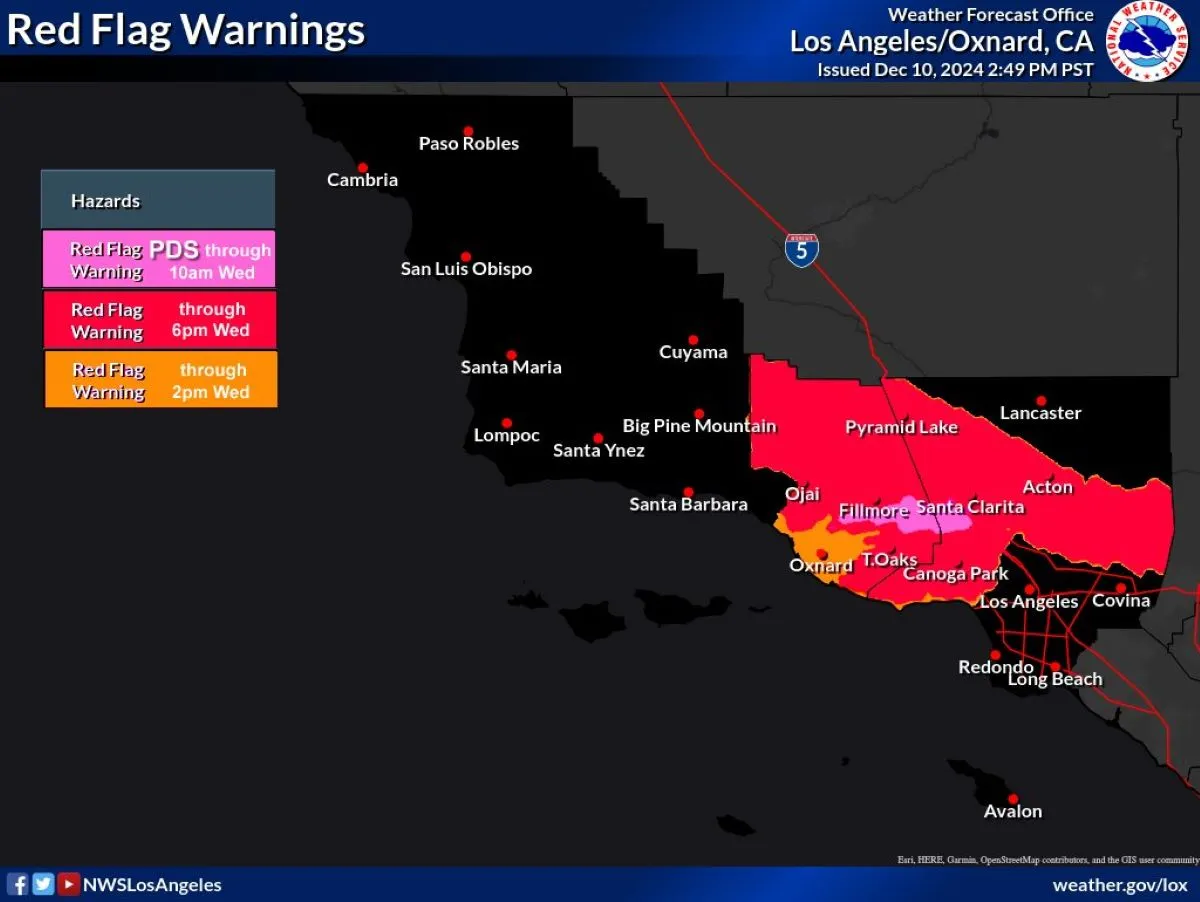
Critical fire weather conditions continue to grip parts of California, with the National Weather Service (NWS) issuing extensive Red Flag Warnings across the region.
These regions highlight areas where warm temperatures, very low humidity and strong winds have created elevated risks of fire weather. They come as the Franklin Fire continues to ravage areas near Malibu, scorching thousands of acres of land in 24 hours and forcing tens of thousands of evacuations.
A Red Flag Warning indicates an increased likelihood of fires spreading rapidly due to extreme weather conditions.
Read More on News
The NWS advised residents in affected areas to take precautions, such as properly extinguishing outdoor fires, covering burn barrels with weighted metal lids and ensuring that charcoal and embers are thoroughly cooled before disposal.
Residents are also urged to avoid tossing cigarettes or matches onto dry grass, as this could ignite a wildfire.
"Whenever there is a Red Flag Warning issued, the environment is favorable for fires to grow rapidly if one begins," Ryan Kittell, a meteorologist at NWS Los Angeles, told Newsweek.
"As a result, everyone should be extra cautious with anything that can spark a fire. For residents in high-fire-risk areas, stay aware of your surroundings and heed any evacuation orders by local officials."
...
Fires should never be left unattended, as sparks or embers can quickly ignite surrounding dry vegetation.
"A Red Flag Warning means that critical fire weather conditions are either occurring now, or will shortly. Use extreme caution with anything that can spark a wildfire," NWS Los Angeles said in its latest warnings issued on Tuesday.
"Residents near wildland interfaces should be prepared to evacuate if a wildfire breaks out."
The current warnings are in place until 6 p.m. PT on Wednesday for the worst affected areas, although Kittell said that they may end early if the winds weaken through the afternoon.
The Franklin Fire continues to burn in Malibu amid the dry and windy conditions. The fire ignited on Monday evening and has since scorched 3,983 acres, with firefighters achieving only 7 percent containment as of Wednesday morning, according to Cal Fire.
Fierce Santa Ana winds blowing from the desert region westward toward the California coast have driven the flames through homes, horse farms and businesses, forcing the evacuation of 20,000 residents.
"These winds typically form when cold, dense air settles into the Great Basin [a region that comprises much of Nevada and Utah] after low-pressure systems move through the West Coast," Kittell said.
Malibu's Mayor, Doug Stewart, called it "traumatic 20 hours" for the city as firefighters battle the blaze and work to protect vulnerable structures.
Schools in the area, including Malibu Elementary and Malibu High, have closed, while students at Pepperdine University are sheltering in place due to power outages and encroaching flames.
The Los Angeles and Ventura County regions are among the areas most affected by Red Flag Warnings. In the Santa Susana Mountains, the conditions have been classified as a Particularly Dangerous Situation, with winds gusting up to 55 mph.
The strong Santa Ana winds, combined with critically dry air, are creating high fire risks in the Santa Monica and San Gabriel Mountains, Ventura County valleys, and the western San Fernando Valley.
Santa Ana winds are most common between September and May and can feel literally hot, according to the NWS.
Kittell added that they are "most significant before our storm season becomes active to wet all the plants, which can start as early as November or as late as January."
Winds of 40 to 50 mph are expected in coastal and valley areas, with dry conditions persisting through Wednesday and potentially easing by Thursday.
Key areas like Simi Valley, Moorpark and the hills above Camarillo are experiencing the most severe conditions. With the prolonged duration of these weather patterns, new fire ignitions could quickly escalate into fast-moving wildfires, threatening homes, infrastructure, and lives.
In addition to the immediate fire threat, officials are warning residents about the health hazards posed by wildfire smoke, which can affect people even miles away.
Do you have a tip on a science story that Newsweek should be covering? Do you have a question about wildfires? Let us know via science@newsweek.com.
Update 12/11/24 11:46 a.m. ET: The article has been updated with comments from Ryan Kittell.
View 0 Comments
Submit Correction
View Editorial & AI Guidelines