AccuWeather

By Joe Edwards
Reporter
0
Share
Newsweek is a Trust Project member
See more of our trusted coverage when you search.Prefer Newsweek on Googleto see more of our trusted coverage when you search.
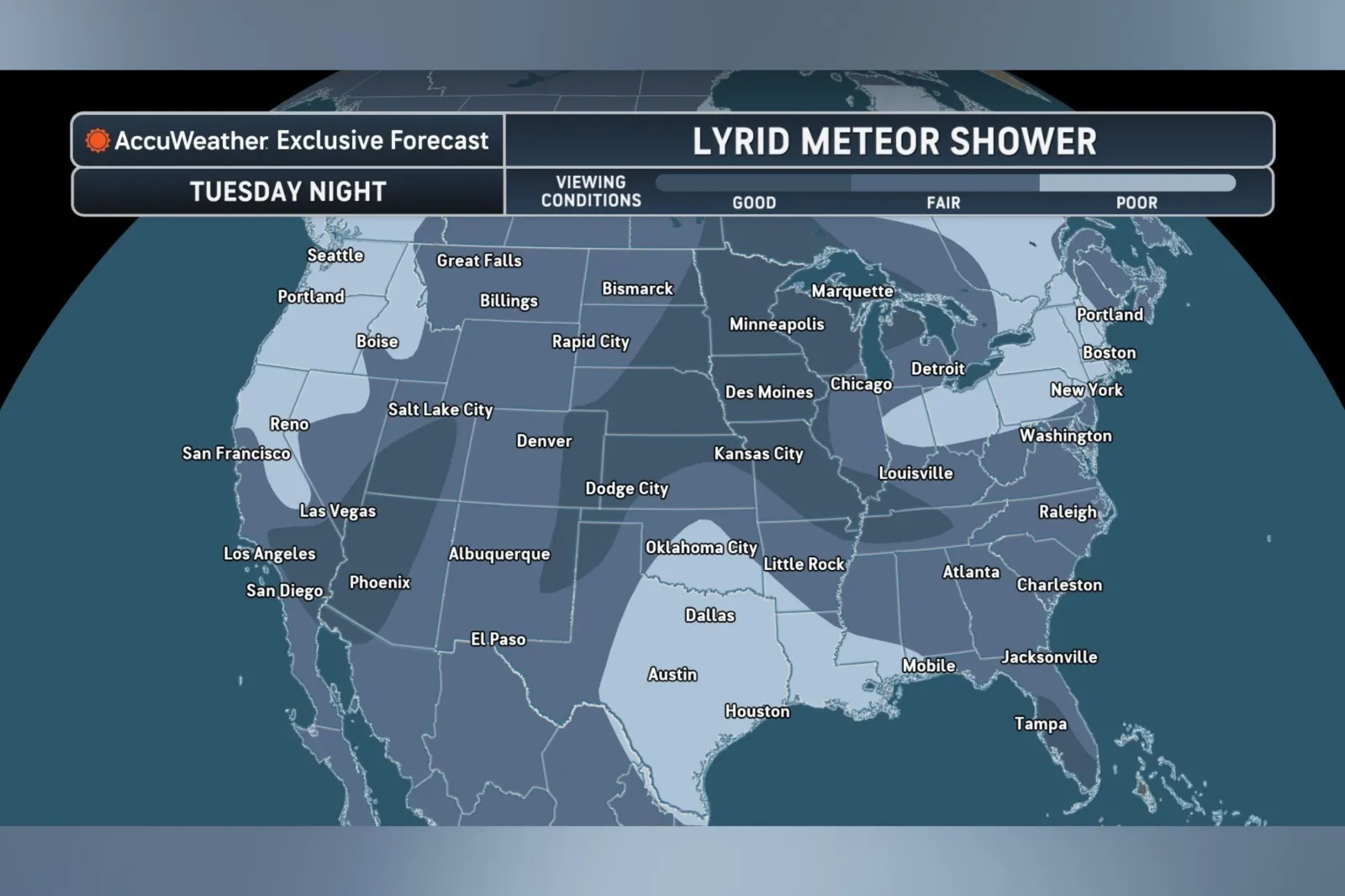
A forecast map from AccuWeather highlights the regions of the country expected to offer the best viewing conditions for the Lyrid meteor shower this week.
“AccuWeather meteorologists say the best viewing conditions are expected from the Southwest across the Plains into the Midwest, where the sky is likely to stay mostly clear,” the company said in an email sent to Newsweek on Monday. AccuWeather added peak night falls on Tuesday, April 21, into the early morning of Wednesday, April 22.
According to NASA, the Lyrids are among the oldest known meteor showers, peaking in late April and having been observed for roughly 2,700 years. NASA says historical records trace the first documented Lyrid sightings back to 687 BC.
Read More on News
They are known for producing quick, bright streaks across the sky. While they are generally less intense than the Perseids in August, the shower has occasionally delivered bursts of activity reaching up to 100 meteors an hour, including notable outbursts recorded in Greece in 1922, Japan in 1945, and the U.S. in 1982. More typically, observers see around 10 to 20 meteors per hour at peak, NASA said.
Unlike some meteor showers, Lyrids typically don’t leave long, glowing dust trains in their wake, though they can still generate the occasional fireball as they burn up in Earth’s atmosphere.
...
According to AccuWeather’s map, among the areas with good viewing conditions on Tuesday night will be southern California and Nevada, as well as Minnesota, Iowa, and much of Wisconsin. Portions of Tennessee, Kentucky, Michigan, Illinois, Missouri, and the Dakotas are also expected to see good conditions.
Areas highlighted as having poor conditions include the Pacific Northwest, central, southern and eastern Texas, Louisiana, as well as much of the Northeast.
Viewing tips recommended by NASA include finding an area far from street or city lights.
“Come prepared with a sleeping bag, blanket, or lawn chair,” the agency advises. “Lie flat on your back with your feet facing east and look up, taking in as much of the sky as possible. After about 30 minutes in the dark, your eyes will adapt and you will begin to see meteors. Be patient – the show will last until dawn, so you have plenty of time to catch a glimpse.”
NASA astronaut Jessica Meir also offered advice for hopeful skywatchers, writing on X on Monday: “The Lyrids are an annual event best viewed in the Northern Hemisphere by looking toward the constellation Lyra in the east, peaking on April 21-22 this year. So, keep your eyes to the sky, and you just might see us on the ISS pass by as well.”
View 0 Comments
Submit Correction
View Editorial & AI Guidelines