
By Giulia Carbonaro
Senior Reporter
0
Share
Newsweek is a Trust Project member
See more of our trusted coverage when you search.Prefer Newsweek on Googleto see more of our trusted coverage when you search.
Seventeen states and localities across the country raised their minimum wages this month to help workers keep pace with inflation, bridging a 17‑year gap in federal action on the national wage floor.
The federal minimum wage has remained at $7.25 per hour since 2009, when the final phase of the Fair Minimum Wage Act of 2007 took effect. In 20 states, that rate remains the baseline for what workers can expect to earn. However, after the longest period without an increase in U.S. history, the purchasing power of the federal minimum wage has significantly eroded.
According to an analysis by the nonprofit Economic Policy Institute (EPI), a worker earning the $7.25 federal minimum wage in 2022 made 27.4 percent less in inflation‑adjusted terms than a counterpart in July 2009. Compared with 1968—the historical peak of the minimum wage's value—the 2022 federal rate had lost 40.2 percent of its purchasing power.
Read More on News
This stagnation has prompted a growing number of state and local governments to adjust their own wage floors.
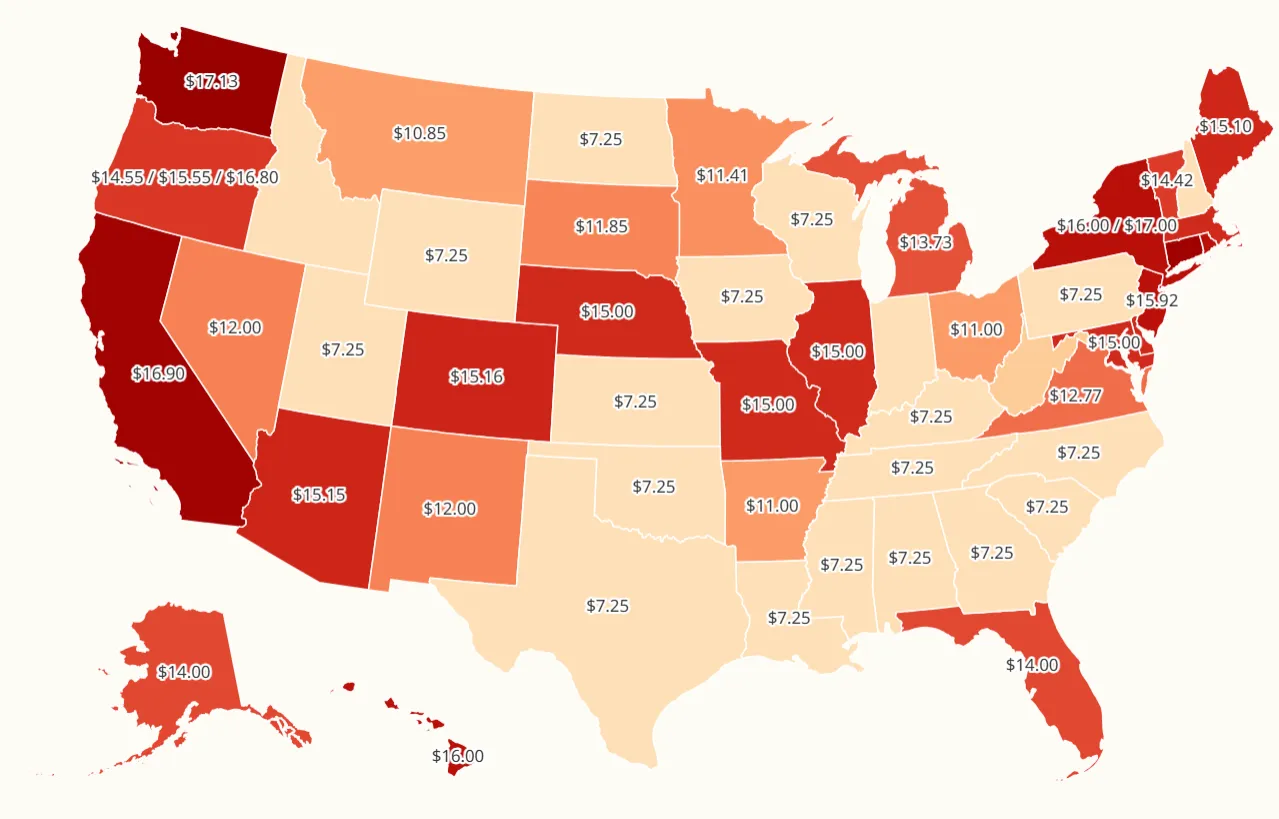
The localized increases have widened a geographic wage gap across the country. Washington currently maintains the highest statewide minimum wage at $17.13 per hour, creating a $9.88 gap with the 20 states adhering to the federal standard.
What Is the Minimum Wage Across the U.S.?
Currently, 30 states and the District of Columbia mandate minimum wages above the federal baseline. The rates are as follows:
- Alaska: $14
- Arizona: $15.15
- Arkansas: $11
- California: $16.90
- Colorado: $15.16
- Connecticut: $16.94
- Delaware: $15
- District of Columbia: $18.40
- Florida: $14
- Hawaii: $16
- Illinois: $15
- Maine: $15.10
- Maryland: $15
- Massachusetts: $15
- Michigan: $13.73
- Minnesota: $11.41
- Missouri: $15
- Montana: $10.85
- Nebraska: $15
- Nevada: $12
- New Jersey: $15.92
- New Mexico: $12
- New York: $16 / $17
- Ohio: $11
- Oregon: $14.55 / $15.55 / $16.80
- Rhode Island: $16
- South Dakota: $11.85
- Vermont: $14.42
- Virginia: $12.77
- Washington: $17.13
- West Virginia: $8.75
In the remaining 20 states, the minimum wage is tied to the federal standard by statute or default. Seven of those states—Alabama, Georgia, Louisiana, Mississippi, South Carolina, Tennessee, and Wyoming—apply the $7.25 rate because they either lack a state minimum wage or set it below the federal level.
What States and Localities Just Increased Minimum Wage In July
On July 1, wage hikes took effect in 17 states and localities. The adjustments will boost the earnings of approximately 361,000 workers by a collective $221 million, according to EPI estimates.
Alaska and Oregon were among the states implementing increases this month, alongside a significant upward adjustment in Washington, D.C. Fourteen municipalities also raised their rates to account for inflation, the majority of which are located in California, with two in Illinois and one in Maryland.
California's statewide minimum wage previously rose from $16.50 to $16.90 per hour at the start of 2026, keeping the state among the highest wage floors in the country.
What These Increases Mean for Workers
Using EPI’s full‑time assumption of 2,080 hours per year, a worked example shows how these adjustments translate into annual earnings:
- A full‑time worker in Vermont moving from $14.00 to $14.42 gains approximately $873 in annual gross pay.
- A full‑time worker in California moving from $16.50 to $16.90 gains approximately $832 per year.
These examples illustrate how even modest hourly increases can produce meaningful annual gains for workers navigating rising costs.
A New Proposal to Raise the Federal Minimum Wage
Lawmakers in Congress are considering multiple legislative tracks to address the federal baseline. Among them is "The Living Wage for All Act," introduced by Democrat Senator Chris Murphy and Democrat Representative Delia Ramirez.
The bill proposes an incremental path to a $25 per hour national minimum wage.
Under the proposal, the rate would initially rise to $12 an hour. Large employers would be required to meet the $25 threshold by the 2031–2032 cycle, while smaller businesses would be given until the 2038–2039 cycle to comply.
Murphy recently suggested that raising the federal minimum wage is a vital economic message for the Democratic platform, particularly in reconnecting with working-class voters.
"I think we have to understand that people do not believe that this version of capitalism has worked. And frankly, it hasn't worked," Murphy said during a late June interview on NBC News' Meet the Press. "You have 40 percent of Americans today that are working full-time and don’t have enough money saved up in the bank for an emergency car repair."
statistic-id1065466-real-federal-minimum-wage-in-the-us-1950-2025.pdf.PDF
Historical Context: The Raise the Wage Act (2021)
The article previously referenced the Fair Minimum Wage Act of 2007, but the modern legislative history also includes the Raise the Wage Act of 2021 (H.R.603) — which would have phased in a $15 federal minimum wage.
The bill passed the House in 2021 as part of the broader American Rescue Plan package. However, the Senate parliamentarian ruled that the minimum‑wage provision did not meet reconciliation rules, preventing it from advancing without 60 votes. Democrats lacked the support needed to override the ruling or pass the increase separately, effectively blocking the measure.
This legislative stalemate stresses the difficulty of raising the federal minimum wage through Congress, even when one party controls both chambers.
Related Story

Democrat Chris Murphy Says $25 Minimum Wage Could Win Back Trump Voters
Contact Newsweek editors for this story: John Fitzpatrick and Anthony Murray.
View 0 Comments
Submit Correction
View Editorial & AI Guidelines