...

By Jasmine Laws
Reporter
0
Share
Newsweek is a Trust Project member
See more of our trusted coverage when you search.Prefer Newsweek on Googleto see more of our trusted coverage when you search.
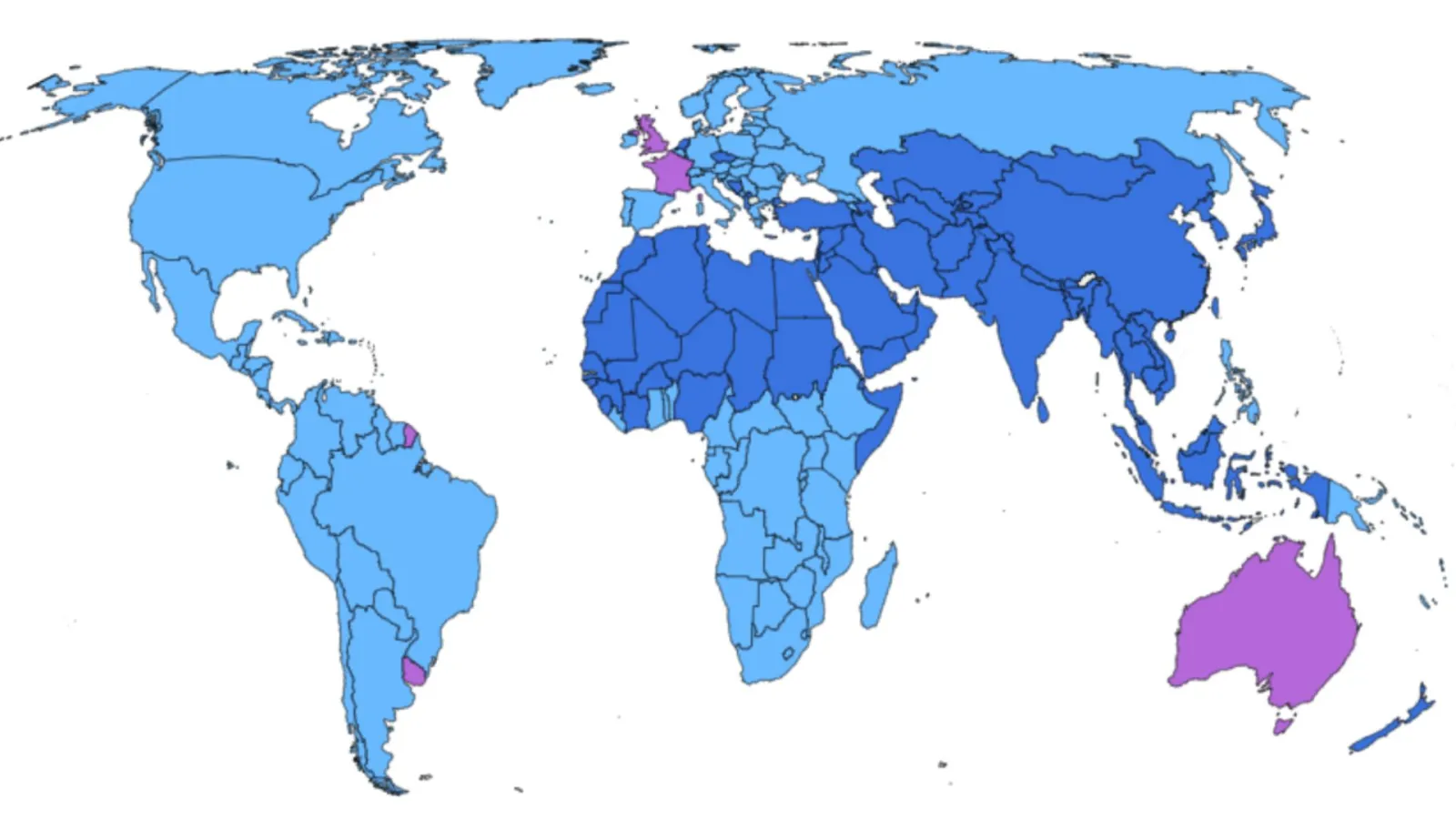
New data from Pew Research Center shows a decline in the number of countries where Christians are in a majority between 2010 and 2020.
While most countries still have Christian majorities—with more than half the people in those countries identifying as Christians—there has been a decline in the last decade—with the U.K., France, Uruguay and Australia no longer falling into this category.
Having previously had Christian majorities in 2010, the proportion of Christians in each country was 49 percent, 46 percent, 44 percent and 47 percent respectively in 2020, with no religious group holding a majority.
Read More on News
Uruguay was the only country in the Americas that didn't have a Christian majority in 2020, although French Guiana is an overseas department of France on the northeast coast of South America, and as such part of a country without a Christian majority.
Why It Matters
Millions of Christians across the globe have been leaving the religion in recent years, resulting in the number of Christians in many countries dropping in the last decade, Pew Research Center reported.
The center said that "religious switching" could be the main reason behind this, which refers to a person leaving one religion to join another, or abandoning religion entirely.
The center's findings show an increase in the number of countries with religiously unaffiliated majorities—with 10 countries in that category in 2020, three more than in 2010.
What To Know
Overall, the data showed that 120 out of the 201 countries and territories studied had Christian majorities in 2020, which was four fewer than in 2010.
It's important to note that other countries may have also lost their Christian majorities prior to 2010, while some may have lost them since 2020.
The reason the U.K., France, Uruguay and Australia no longer have Christian majorities, is because of the "continuation of a long, gradual process of religious disaffiliation that's been going on for many decades," David Voas, a professor of social science at University College London, told Newsweek.
He said that the "drift away from religion is largely generational."
"When older, more religious people die, they are replaced in the population by younger, less religious people," he added.
Voas said that there is also "some switching out of religion in adulthood," but that typically the largest shifts occur "between rather than within generations."
More broadly, lots of Christian-majority countries have seen "a decline in the proportion of their populations declaring themselves Christian," Paul Seabright, a professor of economics at Université Toulouse Capitole, France, told Newsweek.
This is down to many factors, including that more people, especially younger people, "are 'mixing-and-matching' their spirituality," he said.
"Many still believe in God but don't declare themselves members of a particular church or even a particular religion, and those who don't really believe in God are more comfortable saying so openly than their parents used to be," Seabright added.
Another contributor is the increase in childlessness, Seabright said, which has two effects—firstly, fewer children born of Christian parents, and secondly, childless couples and younger single people are less likely to belong to Christian churches than couples with children.
There may be variations from this trend, he added, as "some young people who are currently childless, especially Generation Z, are likely to become more religious when they eventually have children."
He said that technology could also be having an impact, as those who were teens when the iPhone launched in 2007, will be just entering their 30s now, and "are only just starting to grapple with the challenges of having a family."
"This should bring more of them out of their online bubbles into real-world communities," he said.
Another factor, according to Seabright, is that "in many countries the Christian churches were associated with the conservative establishment, which gradually eroded their legitimacy, especially in countries where the Church supported very conservative or authoritarian regimes. Examples include Spain and Chile, but also in Ireland, the U.K. and Germany."
Additionally, "the scandals of sexual, physical and financial abuse have led to significant numbers of people leaving the churches, for example in France, Ireland, the U.S."
What People Are Saying
Paul Seabright, a professor of economics at Université Toulouse Capitole, France, told Newsweek: "There are offsetting trends, such as urbanization which is leading to an increase in Christians belonging to evangelical and Pentecostal churches, especially in sub-Saharan Africa, for example, Ghana, Nigeria, Kenya, Zimbabwe, and some Asian countries, like The Philippines, and also to a Muslim revival in places like Indonesia, Nigeria, Tanzania."
He added: "Immigration from non-Christian countries explains part of the decline but only a small part. Immigration from other Christian countries often increases a country's Christian proportion, for example from the West Indies and Africa into the U.K."
Lois Lee, a senior lecturer in secular studies at the University of Kent, told Newsweek: "What we're seeing in historically Christian countries is a long-term cultural shift that involves the transformation of Christian traditions into new meaning systems. Humanism and alternative spirituality are significant examples, but there are others too. Like any cultural transformation, the causes are complex, multifactorial—in the same way there's no short answer to the question, why did the Reformation happen?"
She said: "We tend to focus on the decline of Christianity but the Reformation analogy is a reminder that cultural change doesn't overturn everything that came before it—it transforms it into something new. In the U.K., for example, humanism seems to be widespread and British humanism is shaped by Christianity in significant ways."
She added: "On one level, what is causing the shift is parents no longer finding it important to pass on Christianity as we know it to their children, and a big part of that is that they are passing on alternative meaning systems and values instead."
David Coleman, a professor of demography at the University of Oxford in England, told Newsweek: "To me the astonishing thing is that the data shows so many countries that still have Christian majorities. If the report had included the proportion of residents who were religiously active, praying at home, attending church, and use that as the criterion for the number of Christian countries then numbers would be far fewer. Many are happy to accept the cultural label without the religious involvement."
He said: "The cumulative effect of generations of education, the weak authority of the church and the huge damage of scandals, and growing material security is making active Christianity a curiosity. Rejection of religion is strong in countries where the (Catholic) church was dominant and authoritarian, in countries like Ireland, Italy, and Latin America. That is not to deny a revival of interest in Christian religion in the young and the strength of various kinds of evangelical Christianity in immigrant minorities, especially from Africa."
What Happens Next
It is likely that more countries will no longer have Christianity as the majority religion in coming years, experts told Newsweek.
"Countries that currently have only small Christian majorities are the most likely to see those figures drop below 50 percent in the decade or so ahead," Voas said.
Canada, Estonia, Belgium and Germany may all lose their Christian majorities, he added, while Suriname in South America is "on the borderline but there's no clear movement."
Additionally, in Africa, "Benin could lose a Christian majority if the share of Muslims continues to increase," he said.
Seabright also said that Chile, Norway, Sweden, Denmark and Spain may become "minority Christian countries in the next decade."
"In the longer term, this could happen to the U.S., but because of Christianity becoming associated with the political right, not because of immigration," he said.
"Lots of countries will continue to see Christian beliefs and identities morphing into new meaning systems since these are long-term cultural shifts," Lee said.
View 0 Comments
Submit Correction
View Editorial & AI Guidelines