
WalletHub

By Joe Edwards
Reporter
0
Share
Newsweek is a Trust Project member
See more of our trusted coverage when you search.Prefer Newsweek on Googleto see more of our trusted coverage when you search.
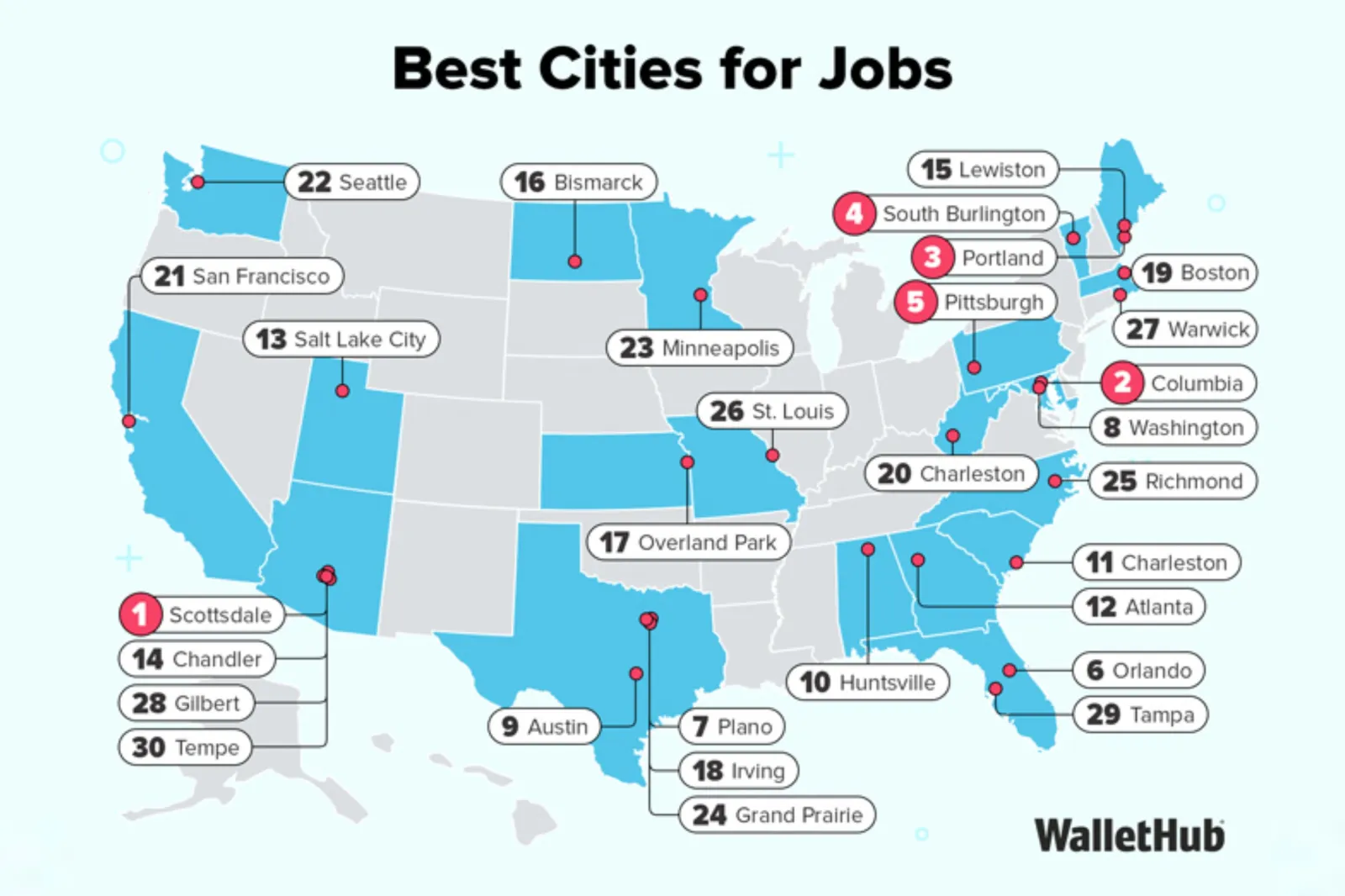
A recent report from personal finance website WalletHub has revealed the best cities in the U.S. for jobs.
Why It Matters
"It’s important to look at more than just the number of jobs available or the unemployment rate when determining the best place to find employment. Quality matters just as much as quantity, from the average salaries and benefits to job security and overall satisfaction," WalletHub analyst Chip Lupo said in the report.
Read More on News
"There are plenty of secondary factors to take into account as well, from how easy a city makes commuting to jobs to whether it’s a good place for raising a family or engaging in recreational activities outside of work."
What To Know
According to WalletHub’s rankings, the top five cities in the U.S. for finding a job are:
- Scottsdale, Arizona
- Columbia, Maryland
- Portland, Maine
- South Burlington, Vermont
- Pittsburgh, Pennsylvania
...
Scottsdale, Arizona ranks as the top city in the U.S. for finding a job, according to WalletHub’s study. The report cites the city’s low unemployment rate as a key factor. Scottsdale also places 16th nationwide for paid internship opportunities, a metric WalletHub notes is beneficial for students seeking early workforce experience.
The analysis highlights the city’s job quality as well, pointing to one of the highest cost‑of‑living—adjusted median household incomes in the country, which WalletHub estimates at more than $101,000.
WalletHub also ranks Scottsdale highly for overall livability. The city finishes seventh for recreation, 12th for families, and reports one of the lowest violent‑crime rates among major U.S. cities, placing 11th in that category.
Coming in second place is Columbia, Maryland. The report points to the city’s cost‑of‑living—adjusted median household income—nearly $129,000, the highest among cities studied—and its fourth‑place ranking for net employment outlook.
WalletHub also notes that Columbia faces relatively low automation risk, with the ninth‑smallest share of jobs deemed vulnerable to future technological displacement.
Housing affordability further strengthens the city’s standing. The analysis shows that fair‑market rent for a two-bedroom apartment equals about 16 percent of the typical household income, the fifth‑lowest share nationwide.
According to WalletHub, Portland, Maine, ranks as the third‑best city for jobs. The report highlights the city’s labor market, noting it places 21st for overall job availability and 12th for full‑time openings at highly rated companies on Glassdoor.
Portland also has the nation’s third‑highest employee‑engagement level and the second‑highest share of workers with access to employer‑based retirement plans.
The city’s livability contributes to its ranking as well. Portland offers the 17th‑best access to jobs within a 30‑minute commute, and reports the 23rd‑lowest violent‑crime rate in the U.S., according to the study,
How It Was Calculated
WalletHub said its rankings drew on a review of 182 U.S. cities, assessing both job‑market strength and socioeconomic conditions. The job‑market category carried greater weight because it more directly reflects relocation decisions for workers, it said. In total, WalletHub evaluated 31 indicators, each scored on a 100‑point scale. Cities were then given a weighted average across all metrics, and only conditions within city limits were included in the final rankings.
Sources used included the U.S. Census Bureau, Bureau of Labor Statistics, Federal Bureau of Investigation, U.S Department of Housing and Urban Development, among others.
What People Are Saying
Lupo told Newsweek: "When choosing a city to relocate for work, people should focus on both the strength and the quality of the local job market. It’s not enough to look only at how many jobs are available or how low unemployment is in that city. Factors like employment growth, job security, starting salaries, benefits, and overall job satisfaction matter just as much, because they affect long-term stability and career growth.
"Beyond the job itself, everyday life plays a big role. Commute times, transit access, housing affordability, safety, and whether a city supports families, recreation, or work-life balance can significantly affect overall satisfaction. The best cities tend to offer a mix of strong job opportunities and favorable socio-economic conditions, making it easier to not just find a job, but to build a sustainable and fulfilling life around it."
What Happens Next
WalletHub releases its "Best Cities for Jobs" report annually.
View 0 Comments
Submit Correction
View Editorial & AI Guidelines