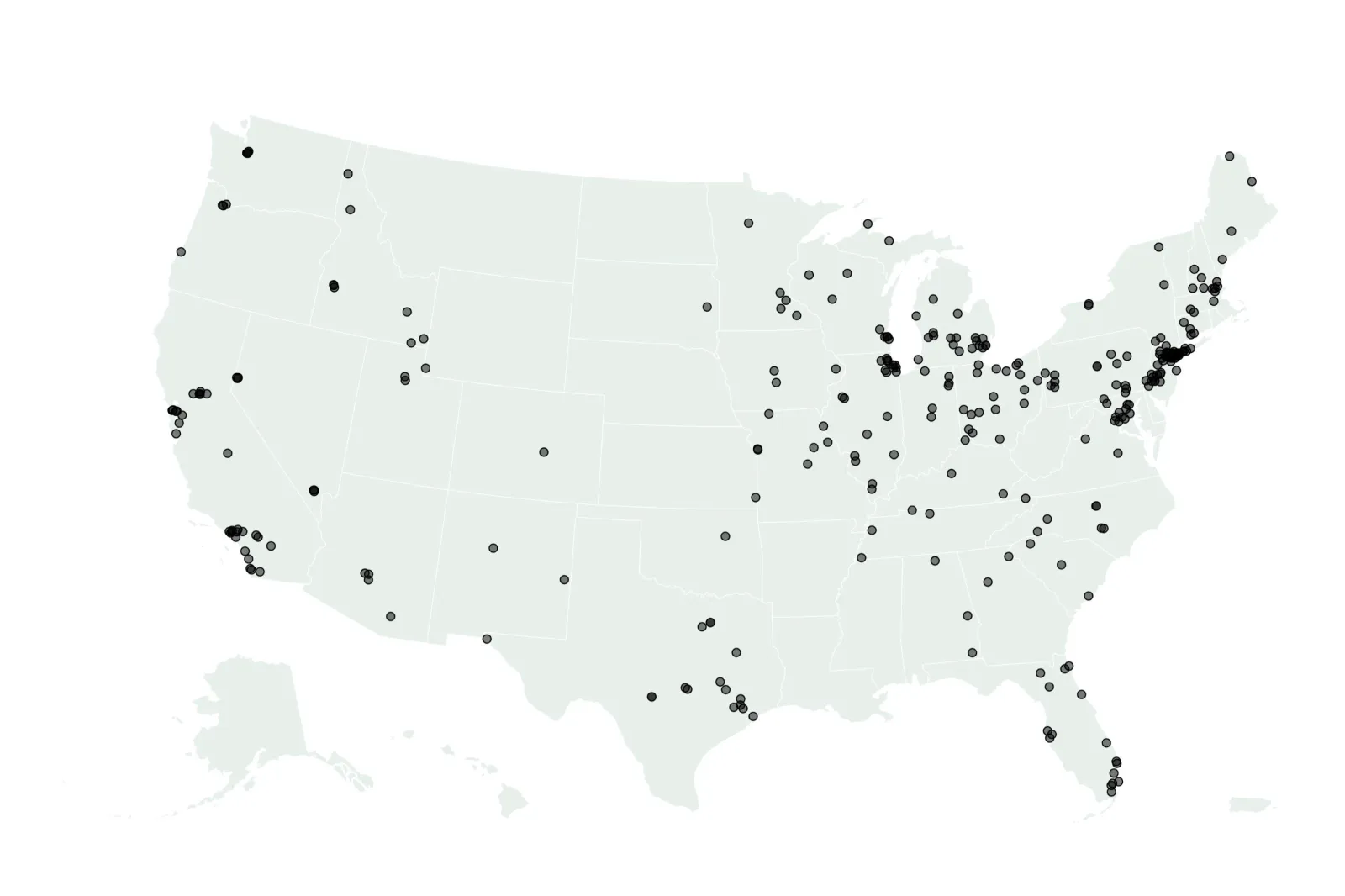
Newsweek/Bank map

By Joe Edwards
Reporter
0
Share
Newsweek is a Trust Project member
See more of our trusted coverage when you search.Prefer Newsweek on Googleto see more of our trusted coverage when you search.
Banks across the U.S. have proposed more than 300 branch closures in the first three months of 2025, data from the Office of the Comptroller of the Currency (OCC) shows.
Major financial institutions—including Wells Fargo, Bank of America, JPMorgan Chase and Flagstar—are planning to close numerous branches this year, reflecting an ongoing shift in the industry toward digital services.
Why It Matters
While online banking has rapidly expanded over the years, the wave of bank branch closures may have significant effects on consumers who rely on in-person banking services, particularly elderly and low-income individuals and those without reliable internet access.
Read More on News
The reduction in physical branches has also raised concerns about the emergence of "banking deserts," where residents lack convenient access to in-person banking services, including cash deposits and loan applications.
What To Know
The U.S. banking sector has experienced a notable reduction in physical branches over the past few years, with 439 branches closing in the third quarter of 2024 alone, data from S&P Global showed.
According to the Federal Reserve Bank of Philadelphia, between 2019 and 2023, the number of bank branches across the U.S. dropped by 5.6 percent, and the number of Americans living in banking deserts increased by 760,000 to 12.3 million.
Data analyzed by Self, a financial technology company, shows that on average about 1,646 branches have closed annually across the country since 2018, some states have been harder hit.
According to the fintech, in the decade between 2012 and 2022, California saw the most branch closures with 1,114. Florida and Illinois followed with 1,091, and 858, respectively.
The closures are largely driven by the rise of online and mobile banking platforms, which have reduced the demand for in-person services and prompted banks to reevaluate the necessity of maintaining extensive branch networks—a shift accelerated by the COVID-19 pandemic.
According to Statista, 45 percent of U.S. bank account holders reported conducting activities in person at a branch in the fourth quarter of 2024, an 8 percent decline from the first half of 2019.
Still, brick-and-mortar banking options continue to be essential for many, and fewer branches could signify longer travel times to and wait times at remaining locations.
A 2021 National Cash Systems report found that almost 40 percent of Americans used an ATM eight to 10 times each month, with more than 10 billion transactions occurring in the U.S. every year.
What People Are Saying
A Wells Fargo Spokesperson told Newsweek: "Branches continue to play an important role in the way we serve our customers in combination with our mobile app, online website, and ATMs. We are actively investing in our branch network by opening new locations and refurbishing our entire network.
"As we optimize our branch network, we are focused on evolving our branch presence based on customer usage and the changing traffic patterns and retail landscape to best meet the banking needs of each community we serve."
What Happens Next
According to Self, if current trends persists, there may be no physical bank branches in the U.S. by 2041.
View 0 Comments
Submit Correction
View Editorial & AI Guidelines