...

By Hollie Silverman
News Editor
0
Share
Newsweek is a Trust Project member
See more of our trusted coverage when you search.Prefer Newsweek on Googleto see more of our trusted coverage when you search.
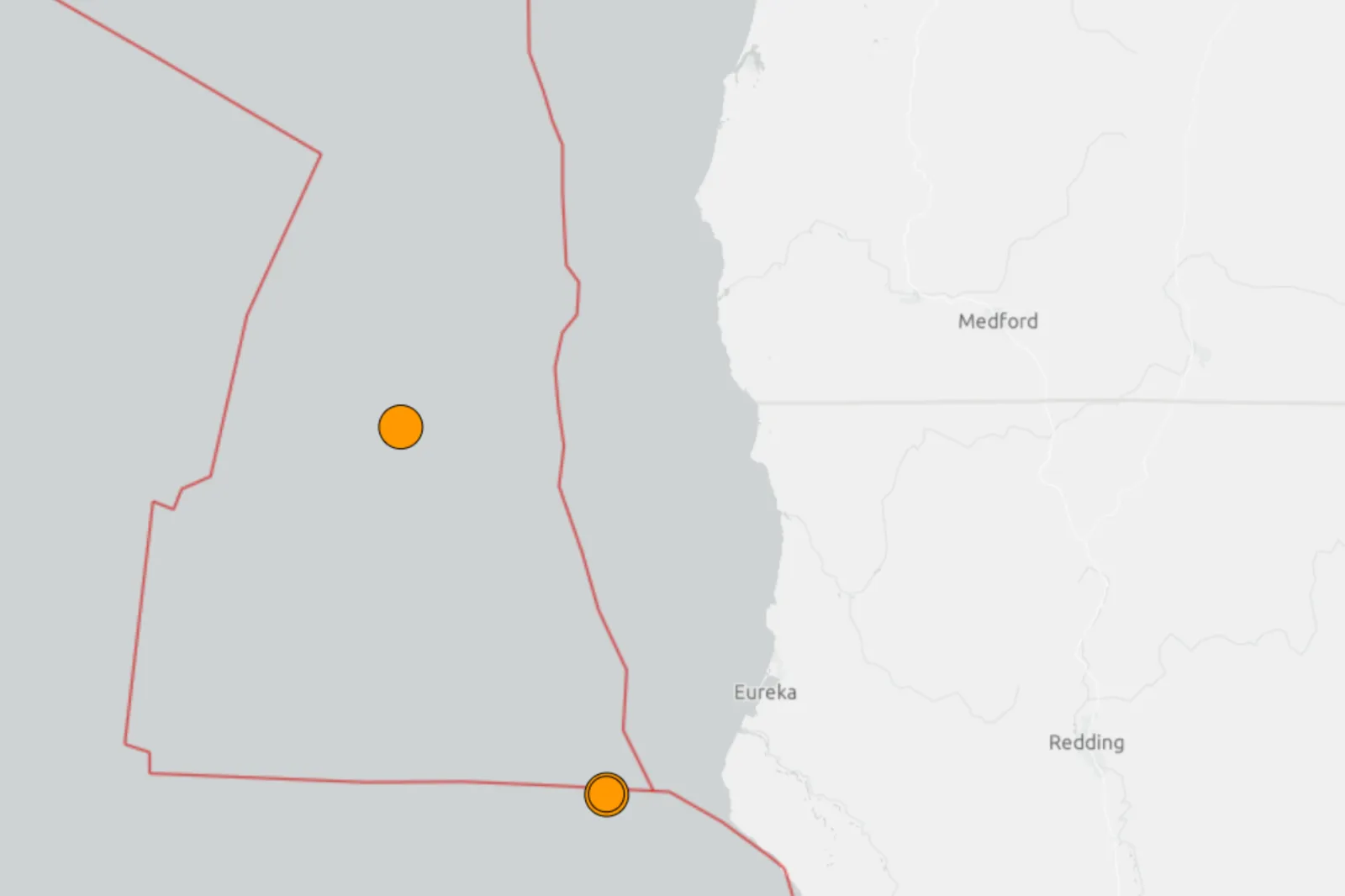
A cluster of offshore earthquakes, including two magnitude 5.0 or stronger tremors, struck in the Pacific Ocean off the Northern California coast early Wednesday, according to the U.S. Geological Survey (USGS).
The string of moderate earthquakes occurred within hours along a seismically active stretch near the California–Oregon border, raising concern in coastal communities already on alert following a stronger magnitude 5.7 quake off the Oregon coast earlier in the morning.
USGS data shows only a few reports that residents in the area felt the earthquakes, and no damage has been reported.
Read More on News
...
Where Did the Earthquakes Strike?
A magnitude 5.7 earthquake struck off the Oregon coast earlier in the morning, about 100 miles west-southwest of Pistol River, according to the data from USGS.
Then, a magnitude 5.1 earthquake struck about 40 miles, or 64 kilometers, west of Petrolia, California, at a very shallow depth of roughly .12 miles (or 633.6 feet).
That quake was followed by another measuring 4.5 magnitude and a 2.8 magnitude quake in the same location, the data shows.
A smaller 1.8 magnitude earthquake was also recorded nearby, about 11 miles west of Petrolia, according to the data.
Because the earthquakes were shallow, they had greater potential to be felt along the coast, though initial reports indicated limited impacts.
Officials said no tsunami warning or threat was issued, and there were no immediate reports of major damage or injuries.
Dozens of Smaller Earthquakes
There have been a series of smaller earthquakes throughout California in recent days, with a total of 82 quakes measured by USGS.
In Northern California, at least 35 quakes ranging in magnitude from 0.03 to 3.6 have been recorded, mostly clustered north of Santa Rosa, near Mercuryville, which has seen significant activity in recent months.
Additionally, 47 small earthquakes ranging in magnitude from .3 to 2.5 were measured by the USGS as far north as Parkfield and as far south as Imperial in Southern California.
Why Are Earthquakes Common in California?
Earthquakes are common in California mainly because it lies on a major tectonic plate boundary—one of the most active in the world.
California sits along the boundary between the Pacific Plate and the North American Plate. These two massive sections of Earth’s crust are constantly moving past each other along faults like the San Andreas Fault.
However, that movement isn’t smooth. The plates often get stuck due to friction, which causes stress to build up underground over time. When that stress finally releases, it happens suddenly—producing an earthquake.
Complicating this further, California isn’t defined by just one fault. It has a large network of faults, including the San Andreas and many smaller ones. This spreads seismic activity across the state, meaning earthquakes can happen in multiple regions—not just along a single fault line.
View 0 Comments
Submit Correction
View Editorial & AI Guidelines