...

By Tom Howarth
Science Reporter (Nature)
0
Share
Newsweek is a Trust Project member
See more of our trusted coverage when you search.Prefer Newsweek on Googleto see more of our trusted coverage when you search.
As the holiday season approaches, many Americans are dreaming of a snow-dusted Christmas morning.
While it's a little too early to get forecasts for December 25, a look in the Christmas past offers some clues about which major U.S. cities are most likely to wake up to a winter wonderland.
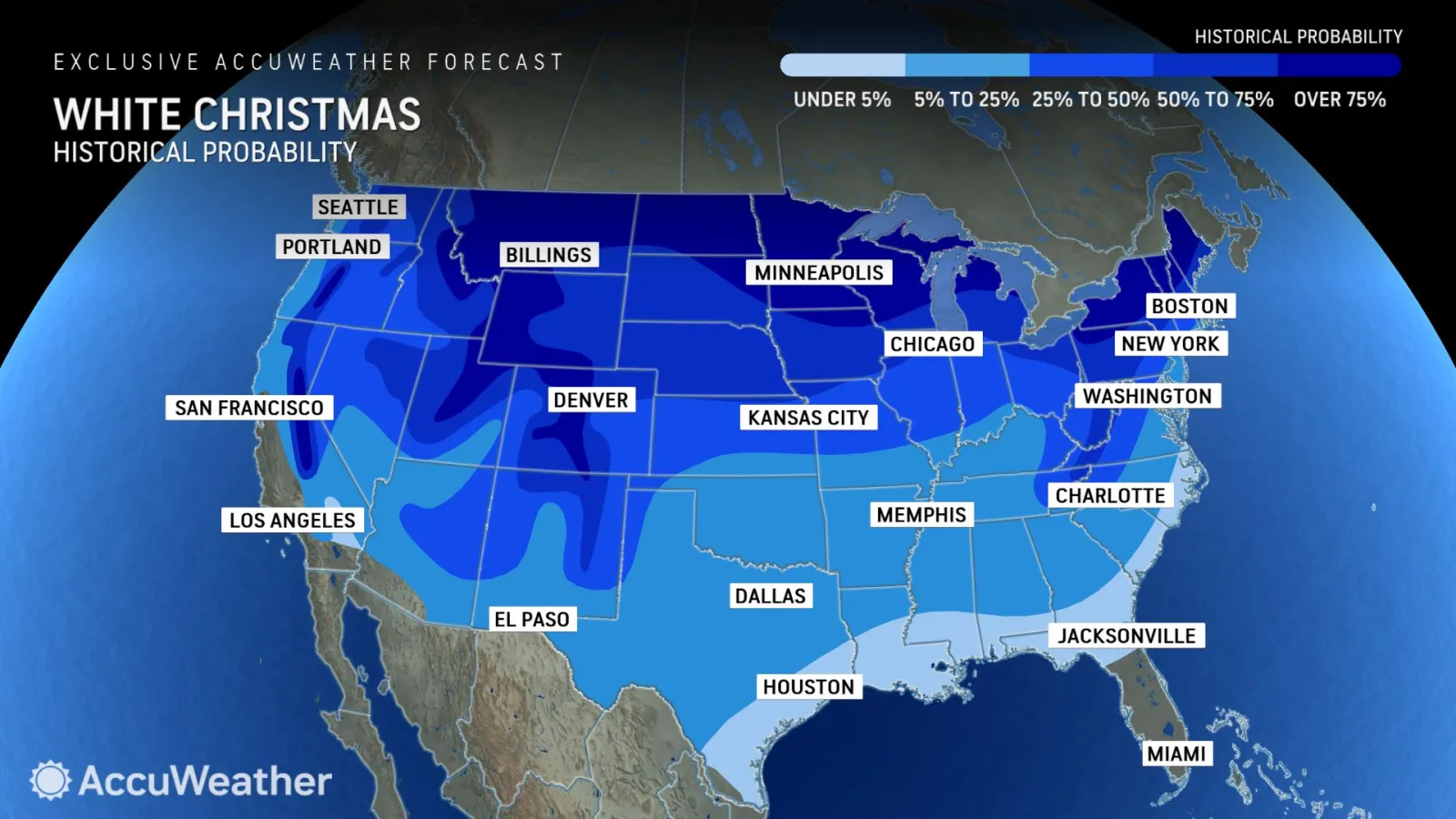
Using NOAA's 1991-2020 climate data and analysis from AccuWeather, the likelihood of a white Christmas—defined as at least 1 inch of snow on the ground on December 25—is mapped out for some of the country's largest cities.
Read More on U.S.
Unfortunately for snow enthusiasts, none of the 25 most populous cities boast more than a 34% chance. Here's how the top contenders stack up.
Denver Tops the List
Denver leads the pack with a 34 percent chance of a white Christmas, based on data from Stapleton Airport.
The city saw its most recent white Christmas in 2022, with 2 inches of snow on the ground.
Historically, Denver's snowy Christmases tend to come in clusters; for instance, between 2006 and 2012, only one Christmas lacked snow cover, according to AccuWeather.
However, since 2013, only two white Christmases have been recorded.
Chicago Comes Close
Chicago is a close second, with a 33.5 percent chance of snow at O'Hare International Airport.
A standout year was 2000, when a snowy December culminated in a foot of snow on Christmas morning.
The city has experienced eight white Christmases since then, most recently in 2022.
Indianapolis and Boston Follow
Indianapolis ranks third with a 26 percent chance. The city last saw a white Christmas in 2022, with other recent snowy holidays in 2017 and 2010.
In contrast, Boston's chance is slightly lower at 25 percent, influenced by its proximity to the Atlantic Ocean.
Boston last met the criteria for a white Christmas in 2009, though measurable snowfall on Christmas Day occurred in 2017.
Columbus, Ohio, Offers Modest Odds
Columbus, Ohio, has a 22.6 percent chance, with white Christmases in 2017, 2020, and 2022.
However, the city hasn't recorded significant Christmas Day snowfall of more than an inch since 1989.
New York City: A Long Shot
New York City has a slim 13.2 percent chance of a white Christmas, with the last occurrence in 2009 when 2 inches of snow lingered from a prior storm.
Snowfall on Christmas Day itself is even rarer, though flurries were observed in 2003 and 2017.
Other Cities Face Slim Odds
Other major cities in the country have less than a 10 percent chance of a white Christmas.
Philadelphia stands at 9.3 percent, Washington, D.C., at 7 percent, and Oklahoma City at 5 percent. Seattle rounds out the list with just 3.7 percent chance.
...
But just because major cities across the U.S. are unlikely to see a white Christmas doesn't mean everywhere is.
High elevations in the West, Rockies or New England have a much higher likelihood of seeing snow on the ground on Christmas morning.
Aspen, Colorado, for example, has a 99.9 percent chance of seeing a white Christmas, according to Mental Floss. Meanwhile, most areas in states bordering Canada have odds of greater than 50 percent.
As for this Christmas, the picture remains uncertain at this point.
"The week of Christmas looks like a transition week from this far out," AccuWeather lead long-range expert Paul Pastelok told Newsweek. "We will be going through a change in the pattern as the storm track shifts toward the west coast of Canada and moves across and sends storms south into the northern U.S. from Christmas and beyond."
Pastelok explained that this could bring some snow and cold weather for the northern Plains, Midwest and parts of the Great Lakes.
He added, "For the next couple of weeks, the U.S. will be mainly going through a stretch of milder weather compared to the last 10 days."
Do you have a tip on a science story that Newsweek should be covering? Do you have a question about white Christmases? Let us know via science@newsweek.com.
Update 12/9/24, 1:13 p.m. ET: The article was updated with comment from Paul Pastelok.
View 0 Comments
Submit Correction
View Editorial & AI Guidelines