10
Loading video...

By Ryan Chan
China News Reporter
0
Share
Newsweek is a Trust Project member
See more of our trusted coverage when you search.Prefer Newsweek on Googleto see more of our trusted coverage when you search.
China continues to bolster its ship-sinking capability amid United States naval presence in the Pacific, as a Newsweek map shows the East Asian military power is capable of targeting American warships off the West Coast with long-range ballistic missiles.
China has maintained a large and growing arsenal capable of directly threatening the U.S., challenging and disrupting its military presence in or around a conflict in the Asia-Pacific region, the Pentagon said in its Chinese military power report on Tuesday.
The Chinese Foreign Ministry did not immediately respond to a request for comment.
Read More on World
Why It Matters
Facing China's assertive activities that threaten its allies in the western Pacific, the U.S. maintains a persistent naval presence, including aircraft carriers, in line with its island chain strategy, which aims to deter and defend against potential Chinese aggression.
Meanwhile, the Chinese military has developed a missile-centered strategy that seeks to prevent or restrict U.S. forces from entering and operating in a given area, serving as a countermeasure against U.S. intervention in a potential conflict in the western Pacific.
What To Know
In the Pentagon report, a map displays the maximum ranges of China's conventionally armed missiles. The DF-27 intercontinental ballistic missile has the longest range, up to 4,970 miles, capable of reaching Alaska, Hawaii and much of the U.S. West Coast.
The missile can be used in both land-attack and anti-ship missions. Among the bases on the U.S. West Coast are Naval Air Station North Island in San Diego, and Naval Base Kitsap in Bremerton, Washington, which together host five aircraft carriers.
Hawaii, a midway point between the U.S. mainland and the western Pacific, is one of the home ports for the U.S. destroyer fleet and also hosts nuclear-powered submarines.
The DF-27 ICBM was first revealed by the Pentagon in its 2021 report, according to Zuzanna Gwadera, a research analyst at the International Institute for Strategic Studies. However, the Chinese military has yet to officially confirm the missile's existence.
In last year's report, the Pentagon assessed that China "may have deployed" the DF-27 ICBM, which it described as a "long-range," dual-capability ballistic missile designed for conventional land-attack and anti-ship missions, as well as nuclear strikes.
The missile also has an HGV payload option, referring to a hypersonic glide vehicle delivered by a rocket booster. It can travel at least five times the speed of sound and maneuver in flight toward targets, making it difficult for missile defenses to intercept.
It remains unclear whether the Pentagon has assessed that the DF-27 ICBM is now operational, as its range was not included on a map in the previous report, which cited Chinese media noting the missile could reach as far as Alaska and Hawaii.
In addition to the DF-27 ICBM, China possesses four other missile types for similar missions, according to the Pentagon, including air- and ground-launched cruise missiles, medium-range ballistic missiles and intermediate-range ballistic missiles.
...
These missiles have a range of 932 to 2,485 miles, covering a number of U.S. bases in the western Pacific, including those on the island of Guam—America's westernmost territory—and in Japan, where the U.S. deploys an aircraft carrier and fighter jets.
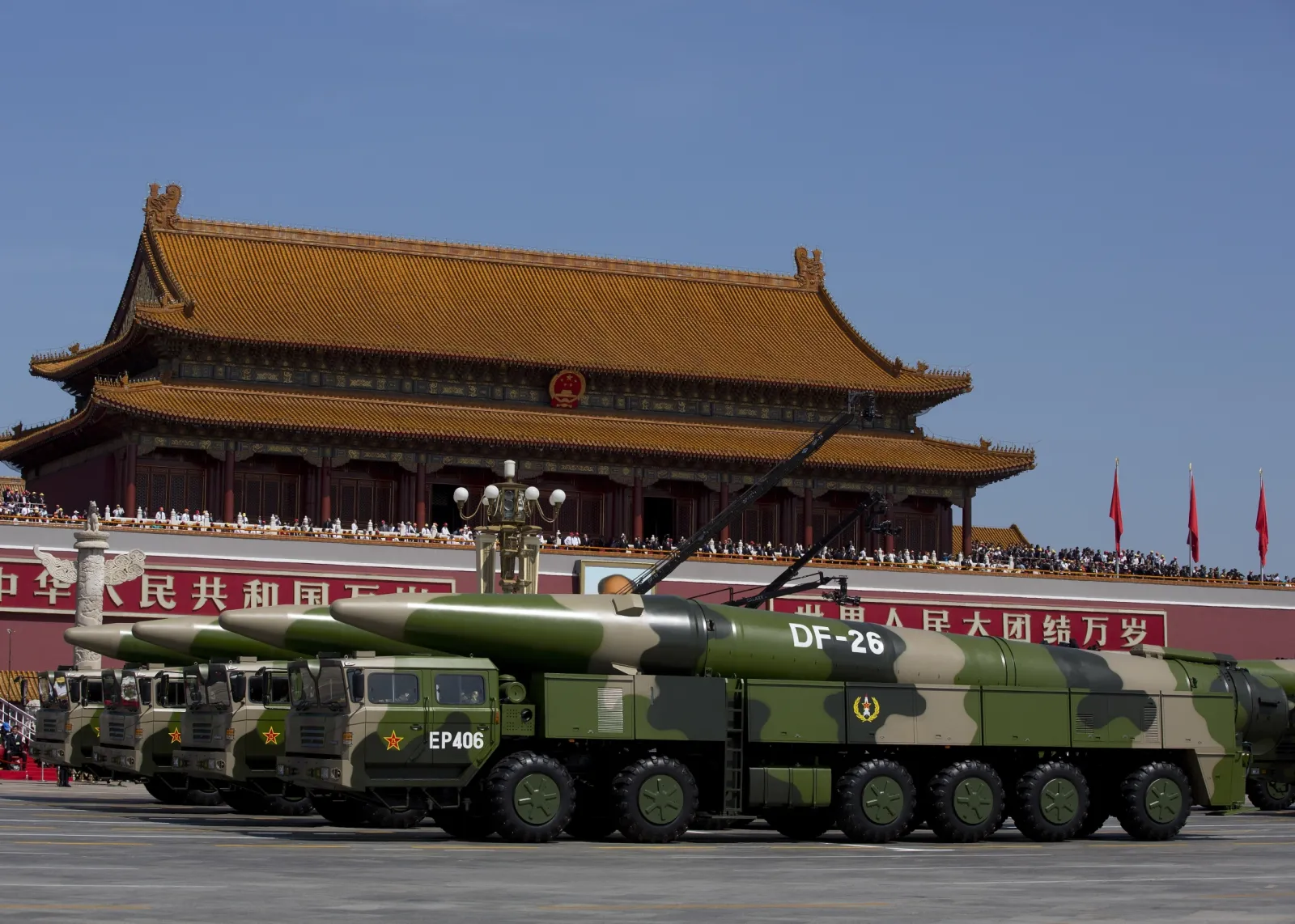
One of them, the DF-26 inter-range ballistic missile, is described in the Pentagon report as a "highly precise theater weapon" that can be launched for conventional and nuclear strike missions. It is commonly referred to by analysts as the "aircraft carrier killer" and the "Guam killer."
What People Are Saying
The Pentagon said in its report on Chinese military power: "China's historic military buildup has made the U.S. homeland increasingly vulnerable. China maintains a large and growing arsenal of nuclear, maritime, conventional long-range strike, cyber, and space capabilities able to directly threaten Americans' security."
Zuzanna Gwadera, a research analyst at the International Institute for Strategic Studies, wrote in May 2023: "The DF-27 could be useful for China's regional war-fighting strategy and could also potentially contribute to its strategic deterrent. China's success in developing HGVs will likely pressure other powers to keep investing in their own development [programs], despite the cost and technical challenges."
What Happens Next
It remains to be seen how the U.S. military will further strengthen the defenses of its ships operating in the Pacific to improve their survivability amid China's missile threat.
View 0 Comments
Submit Correction
View Editorial & AI Guidelines