
...

By Andrew Stanton
Reporter
0
Share
Newsweek is a Trust Project member
See more of our trusted coverage when you search.Prefer Newsweek on Googleto see more of our trusted coverage when you search.
Gas prices rose across the country Wednesday after President Donald Trump said he views the Iran war ceasefire as “over” and tensions in the Strait of Hormuz, a critical passageway for the global oil supply, strained.
When the war began in February, gas prices rose to over $4 per gallon nationwide due to the closure of the strait. Higher gas prices put pressure on Americans’ wallets amid ongoing concerns about the high cost of living and have also created a political backlash against Trump, who made tackling inflation a cornerstone of his 2024 presidential campaign.
The latest developments threatened to send gas prices rising once again after weeks of falling costs amid the ceasefire. Rising gas prices could also create new political challenges for Republicans if voters are frustrated over the economy in the midterm elections this November.
Read More on World
Newsweek reached out to the White House for comment via email.
Gas Prices Rise Nationwide
Overall, gas prices stood at $3.796 per gallon on Wednesday, up from $3.790 per gallon on Tuesday, according to AAA. Still, that is a decrease from one week earlier, when prices were $3.847 per gallon, and from one month earlier, when the average cost was $4.164 per gallon.
Gas prices were highest in Hawaii at $5.458 per gallon, California at $5.364 per gallon and Washington at $5.004 per gallon, according to AAA. On the other end of the spectrum, prices were lowest in Indiana at $3.064 per gallon, Oklahoma at $3.338 per gallon and Texas at $3.53 per gallon.
Trump addressed gas prices in a news conference on Wednesday.
“As you know, the oil is down. We'll see whether or not we keep it down. We should keep it down. We're doing things that should have been done 47 years ago with Iran,” he said.
GasBuddy analyst Patrick De Haan wrote in a post to X that gas prices could continue to rise.
“The end to the Iran cease fire is putting upward pressure on oil prices, which could start pushing the national average toward $4/gal in the days ahead. We're up 2c/gal since Monday, but still at $3.73/gal lower than a week ago. watch for potential price increases soon,” he wrote.
How Will Ceasefire Ending Impact Gas Prices? Analysts Weigh In
Scott Laing, a professor of finance at the University at Buffalo, told Newsweek the market “immediately reacted with oil jumping about 8 percent within hours of the announcement.”
He said there will be increases in “days, not weeks.”
“Stations price against what it costs to refill their tanks tomorrow, not what they paid last week,” Laing said. "Full pass-through of a crude spike typically takes two to three weeks, and there's a saying that encapsulates this as well: 'rockets and feathers.' Pump prices go up like a rocket and come down like a feather. If crude holds near $80, expect the national average to drift from $3.79 towards $4 or more within weeks."

...
Still, Laing said Americans should not be panicking.
“Nothing has actually stopped flowing. Today is the market pricing what -could- happen, not what has happened. If tensions cool, prices can fall just as fast as they rose (like the June ceasefire),” he said. He also noted that the United States is the world’s biggest oil producer, and that oil crises don’t hit “quite the same way” as in the 1970s.
Aixa Diaz, a spokesperson for AAA, told Newsweek it is “too early to know how this will affect pump prices.”
“Oil is currently in the mid $70/barrel range, so we haven't seen a major spike yet,” Diaz said. “The national average remains below $4/gallon, so drivers aren't seeing much of a difference at the pump. The situation is too volatile to predict where prices may go next.”
What Is the Purpose of the Strait of Hormuz and Why Is It Important?
The strait lies between Iran to the north and Oman to the south, with shipping lanes passing through the territorial waters of both countries, but the strait is governed by international maritime law. Iran exerts significant influence because of its long northern coastline and control of nearby islands that overlook the narrow strait, while Oman oversees the southern side.
The waterway is also a critical route for liquefied natural gas (LNG), carrying about 20 percent of global LNG trade, largely from Qatar. Most of the oil shipped through the strait is bound for Asian markets, making disruptions especially significant for global energy prices.
Related Story
Trump Says He’s Iran’s No. 1 Target Amid Air Force One Change Questions
Gas Prices Hang Over Midterms
Gas prices are likely to be a major political question in the 2026 midterms. Historically, the party in the White House loses seats, so Democrats have been optimistic about their chances of flipping seats in the House of Representatives and the Senate. The Iran war, which has been unpopular domestically, and its economic fallout have added to their belief that they can win back voters in this year's elections.
White House spokesperson Kush Desai has previously said Trump has “always been clear about short-term disruptions as a result of Operation Epic Fury, disruptions that the Administration has been diligently working to mitigate.”
A YouGov/CBS News poll found that 23 percent of Americans say gas prices have been a “financial hardship,” while 30 percent said they have been “difficult.” Twenty-nine percent said it has been an “inconvenience, but not difficult,” while only 7 percent said their finances have not been impacted.
The same poll found that 66 percent of Americans disapprove of Trump’s handling of the economy, compared with 34 percent who approve. It surveyed 2,519 adults in the U.S. from June 17-19, 2026, with a margin of error of plus or minus 2.4 percentage points.
A poor approval rating for Trump, particularly on the economy, could be a political challenge for Republicans in the midterms.
Iran Ceasefire Ends
Trump has said the Iran ceasefire has come to an end in his view.
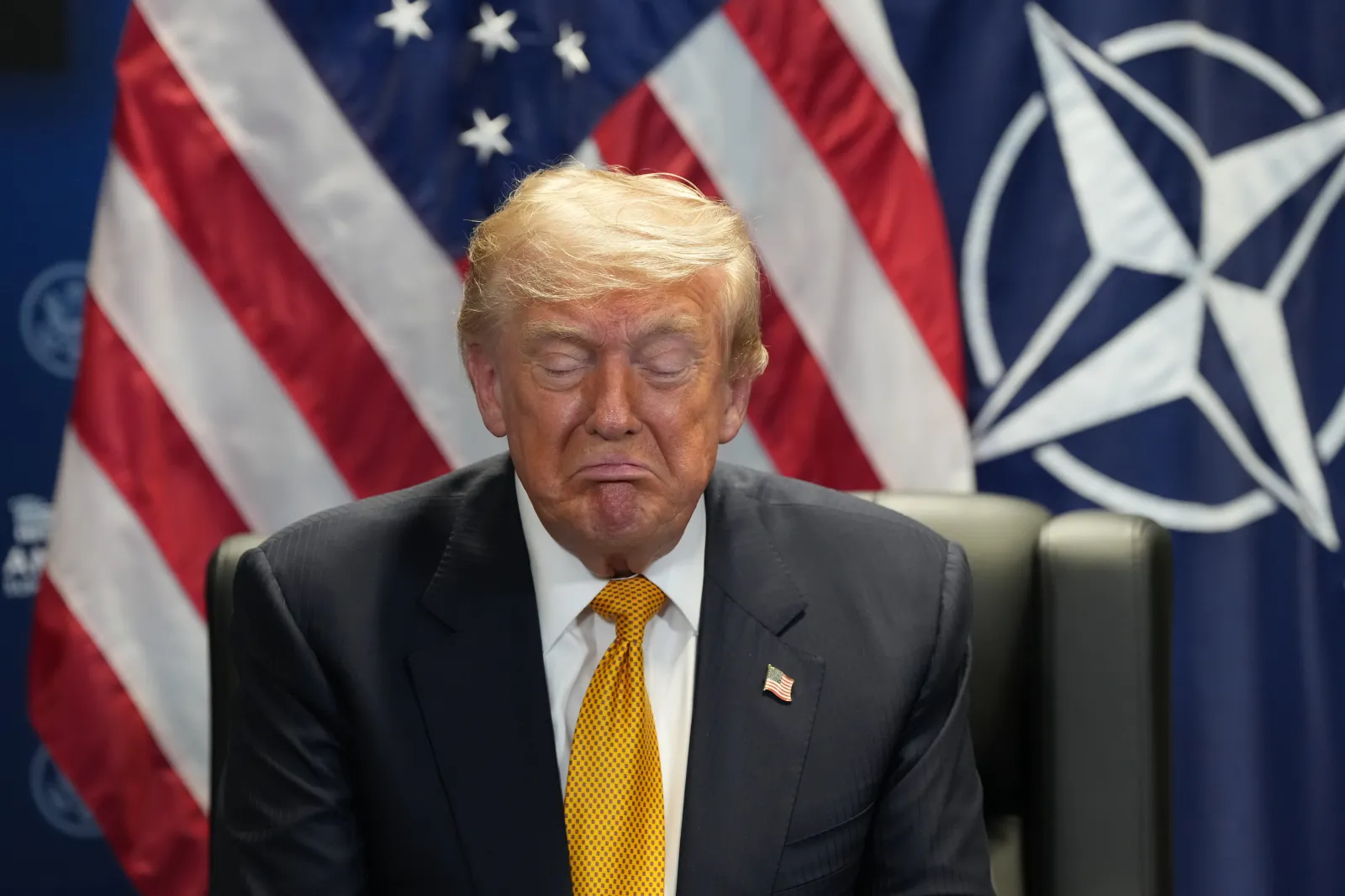
"To me, I think it's over. I don't want to deal with them anymore. They're scum," Trump said at the NATO summit in Ankara, Turkey, when asked if the ceasefire and the memorandum of understanding are dead.
He described Iranian leaders as “sick people.”
"They're led by sick people, and they're vicious, violent people, and if they had a nuclear weapon they'd use it,” he said. His remarks followed U.S. strikes on Iran that Washington said were retaliation for attacks on tankers in the Strait of Hormuz on Tuesday.
The U.S. military attacked Iran on Wednesday after saying Iran struck three ships in the Strait of Hormuz. Iran said it would “take whatever measures it deems necessary,” raising the risk of the conflict resuming across the Middle East. The tensions come amid the funeral for Iranian Supreme Leader Ayatollah Ali Khamenei.
Negotiations for a final deal were set to begin after the dayslong funeral ended on Thursday.
The U.S. also revoked a license that allowed the sale of Iranian oil on international markets in U.S. dollars as part of the deal.
The ceasefire was first put in place on April 8.
The ceasefire ended fighting and reopened the Strait of Hormuz after Iran’s blockade, providing some relief to the global oil market. The Trump administration had always insisted that it had been fully reopened under the terms of the memorandum of understanding, but the ruling regime and Iranian state media presented it as still being under Tehran's control.
This article includes reporting by the Associated Press.
Contact Newsweek editors on this story: Samantha Beech and Sam Wilson.
View 0 Comments
Submit Correction
View Editorial & AI Guidelines