...

By Alia Shoaib
Reporter
0
Share
Newsweek is a Trust Project member
See more of our trusted coverage when you search.Prefer Newsweek on Googleto see more of our trusted coverage when you search.
Health nonprofit the Environmental Working Group has released a map it says shows that nearly 100 million Americans are drinking water contaminated with three toxic chemicals.
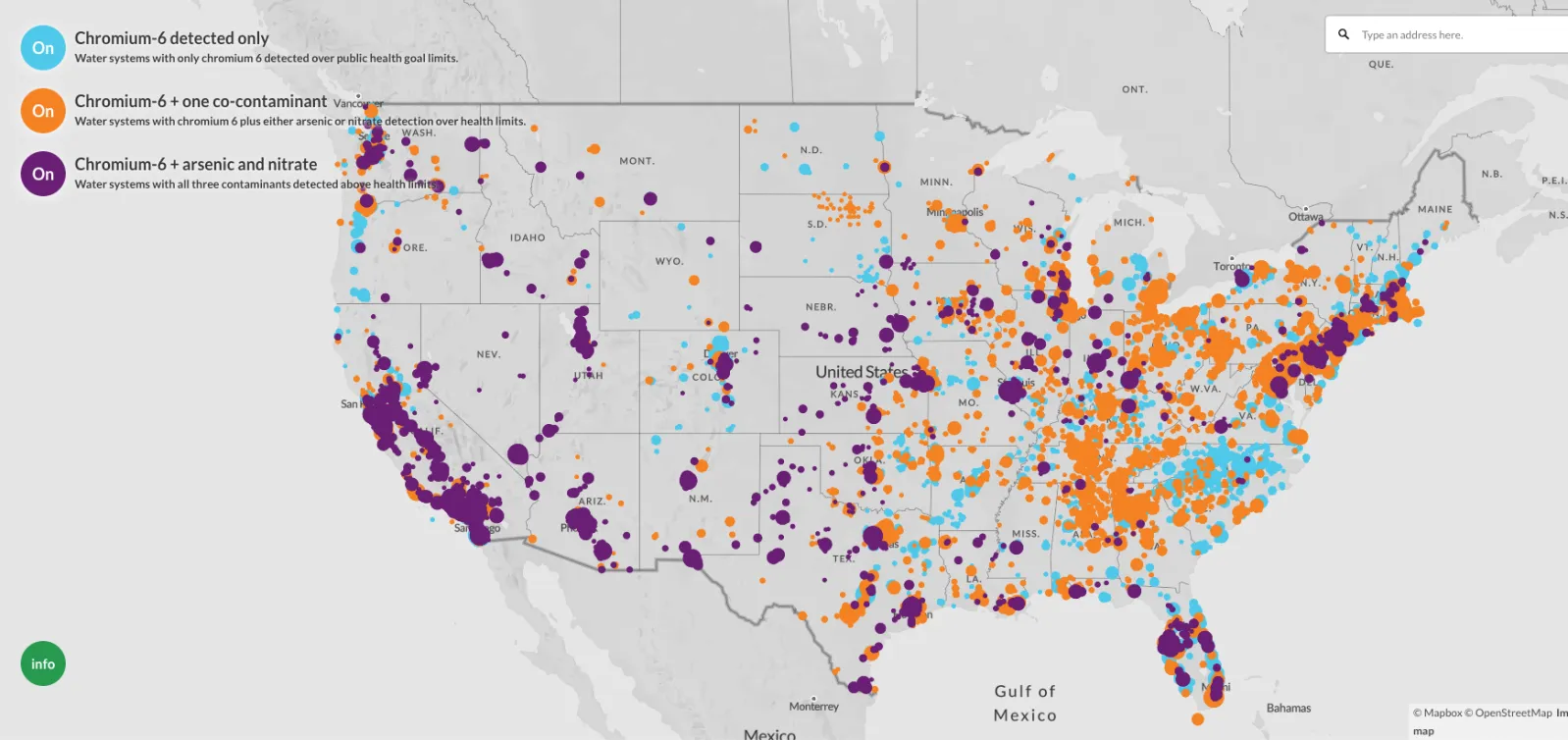
The map shows which areas have water supplies simultaneously contaminated with the three potentially cancer-causing chemicals—chromium-6, arsenic, and nitrate.
Why It Matters
Long-term exposure to these contaminants, even at low levels, can pose health risks, such as cancer, birth defects and liver damage, according to the EWG.
Read More on U.S.
The group is calling for action to update drinking water treatment systems to target multiple contaminants at one time, rather than just one at a time, which is currently the norm.
The EWG used information from its Tap Water Database as a source for the map data, which is put together by collecting test results from state and federal water authorities.
...
What To Know
The map shows areas across the country where drinking water reportedly contains levels of these contaminants above public health goal limits.
Blue dots indicate areas where just chromium-6 was detected, orange dots indicate chromium-6 detected along with one other co-contaminant, and purple dots represent chromium-6 along with both arsenic and nitrate.
The map shows that California, Arizona, and Texas are the worst affected hotspots, where high levels of all three contaminants are found.
Across the country, chromium-6 alone contaminates water serving more than 260 million people, the EWG claims, while arsenic affects the water supply of 134 million, and nitrate is found in supplies for 263 million.
The EWG says that these chemicals can be removed from water through treatments such as ion exchange or reverse osmosis.
The nonprofit notes that U.S. drinking water regulations focus on single contaminants, overlooking the fact that multiple harmful chemicals often co-occur. It has called for advanced filtration systems that can target multiple several contaminants simultaneously.
The EWG said it found in a peer-reviewed study that treating multiple contaminants simultaneously could prevent an estimated 50,000 cancer cases over a lifetime.
What People Are Saying
The U.S. Environmental Protection Agency told Newsweek in an emailed statement: “EPA is aware of this campaign and will review the findings. The agency is committed to ensuring that Americans can rely on clean and safe drinking water as part of the agency’s Powering the Great American Comeback initiative.”
“The agency uses multiple tools to achieve this goal, including establishing federal drinking water regulations, administering water infrastructure funding programs, and providing technical assistance to communities. The Safe Drinking Water Act requires EPA to review each national primary drinking water regulation at least once every six years and revise them, if appropriate.”
Tasha Stoiber, a senior scientist at the EWG, said: "This is a significant national problem and public health issue.
"People are exposed to multiple contaminants in their drinking water, and analysis shows that regulating and treating them simultaneously is a more effective and efficient approach than focusing on each chemical separately."
Melanie Benesh, EWG's vice president of government affairs said: "It's time for Congress and federal regulators to adopt a 21st-century strategy for a 21st-century crisis. Investing in water treatment not only prevents cancer, it improves the health for millions."
Bernadette Del Chiaro, EWG's senior vice president for California, said: "Millions of Californians are exposed to a toxic soup of cancer-causing chemicals in their tap water every day, yet state policy continues to move too slowly to address weak limits and maximize public health protections."
What Happens Next
The EWG is urging federal and state regulators to update drinking water standards and adopt treatment strategies that address multiple contaminants at once.
Update 9/25/2025 3:15 a.m. ET: This article has been updated with comment from the U.S. Environmental Protection Agency.
View 0 Comments
Submit Correction
View Editorial & AI Guidelines