...


By Sam Stevenson and Matthew Robinson
0
Share
Newsweek is a Trust Project member
See more of our trusted coverage when you search.Prefer Newsweek on Googleto see more of our trusted coverage when you search.
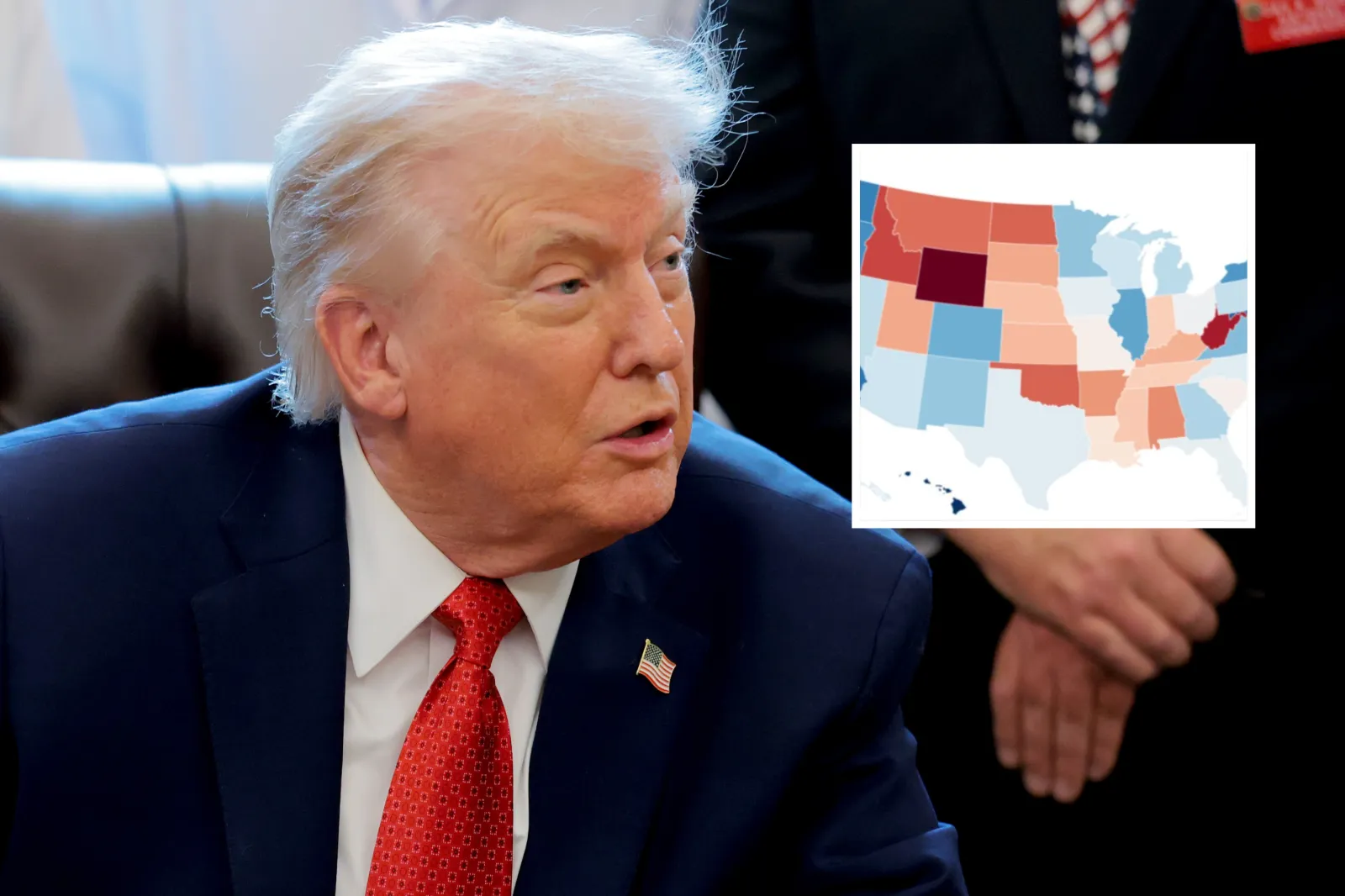
A new polling map has shown President Donald Trump’s approval ratings continue to reflect deep regional divides across the U.S.
According to the latest state-by-state data compiled by Civiqs, only about 40 percent of Americans approve of Trump’s job performance, while roughly 56 percent disapprove and four percent of respondents neither approve nor disapprove.
This national approval figure is virtually unchanged from the previous month’s polling, indicating that public opinion has stabilized at a level currently unfavorable to the president.
Read More on Politics
Newsweek contacted the White House via email for comment.
Why It Matters
As Trump enters the 11th month of his second term, a state-by-state examination reveals entrenched support in Republican strongholds and persistent challenges in Democratic bastions and competitive swing states. Trump’s approval rating being below 50 percent is a potentially troublesome sign heading into an election year.
What To Know
Well into his second term, Trump's approval rating remains underwater nationwide, reflecting a persistently polarized electorate.
Trump’s overall net approval (approve minus disapprove) is still around –16 points, scarcely better than it was a month ago.
In practical terms, a clear majority of voters continue to voice dissatisfaction with Trump as he nears the end of his first year back in office.
This status quo underscores how entrenched attitudes have become: supporters and opponents alike appear firmly dug in, with few undecided voters left in the middle.
Trump’s approval rating is highest in Wyoming, with 66 percent approving of his job performance. His support also remains strong in West Virginia, Idaho, North Dakota, Montana, and Oklahoma, each recording net positive approval rates higher than +15 percentage points.
Other Republican-dominated states with positive net approval include Alabama, South Dakota, Arkansas, Kentucky, and Utah.
Trump faces significant headwinds in Democratic-leaning states—Vermont, Hawaii, Maryland, Massachusetts, California, Rhode Island, Washington, Oregon, and New York—all of which report net disapproval rates exceeding -30 percentage points.
...
Approval Underwater in Swing States
The battleground “swing states”—the politically purple states that often decide presidential and congressional elections—continue to spell trouble for Trump. In these competitive states, Trump’s approval is underwater across the board.
In Arizona, Georgia, Michigan, Nevada, Pennsylvania, Wisconsin, and North Carolina, disapproval rates outpace approval by margins ranging from -11 percent to -15 percent.
Even in states that Trump carried in the last election, such as North Carolina and Texas, more voters disapprove than approve of him at this stage.
Demographic Divides
Demographically, Trump's approval is lowest among voters aged 18-34 (27 percent approve, 68 percent disapprove), and those with postgraduate degrees (28 percent approve, 69 percent disapprove).
He polls highest among voters identifying as Republican (87 percent approve), non-college graduates (43 percent approve), and in the oldest age brackets (almost evenly split between approval and disapproval among seniors).
Racial and ethnic divisions are evident. Trump’s support among white voters is roughly split down the middle (around 47 percent of white respondents approve and 49 percent disapprove of him), but voters of color are decisively anti-Trump.
Only about one in ten Black Americans (roughly nine percent) approve of Trump’s presidency, while nearly 88 percent disapprove, an almost unanimous level of opposition.
Hispanic and Latino voters also lean strongly against Trump, with only about one-third approving of him and around two-thirds disapproving.
What People Are Saying
White House spokesman Kush Desai said in a previous statement: "Over the past year, the Trump administration has delivered critical progress to turn the page on Joe Biden’s economic disaster: cooling inflation, rising real wages, private-sector job growth, and trillions in investments to make and hire in America. The Trump administration will continue to build on this progress in the new year to continue delivering economic relief for the American people."
What Happens Next
With the 2026 midterm elections approaching, Trump’s persistent sub-majority approval in most states places additional pressure on the Republican Party to shore up competitive districts and win over swing voters.
Historical trends show that when a president’s approval falls below the 50 percent threshold, the incumbent party often suffers significant losses in Congress during the midterms.
These ratings are influencing both party strategies and Congressional forecasts, potentially affecting the president’s policy agenda and the Republican Party’s electoral prospects in Congress.
View 0 Comments
Submit Correction
View Editorial & AI Guidelines