10
Loading video...

By Giulia Carbonaro
Senior Reporter
0
Share
Newsweek is a Trust Project member
See more of our trusted coverage when you search.Prefer Newsweek on Googleto see more of our trusted coverage when you search.
Several areas of the United States, including the Northeast and Northern California, are now facing a higher risk of extreme flash rainstorms due to climate change, which could lead to deadly flooding and landslides because of a lack of proper response, according to a recent study.
The research, published on Nature.com earlier this month by First Street Foundation—a New York-based non-profit analyzing America's climate risk—found that "the magnitude and frequency" of extreme precipitation events in the early 21st century has already increased at a much faster pace than expected compared to the previous century.
"These updated precipitation estimates highlight the country's current underestimation of flood risk from extreme rainfall events," Jeremy Porter, Head of Climate Implications at First Street Foundation (FSF), told Newsweek.
Read More
El Niño Forecasts: 2024 Weather To Be Radically Different Than Last Year3 min read

Blizzard and Winter Storm Weather Warnings Issued for 6 States4 min read

Videos Show Blizzard Pummeling Nebraska, Snarling Christmas Traffic4 min read

"In the most extreme cases the 1-in-100 year event, as defined by NOAA Atlas14 (the current national standard for precipitation climatology), actually occurs every eight years due to climate change," Porter said.
The National Oceanic and Atmospheric Administration's (NOAA) Atlas 14 is used to assess flood risks and set standards of prevention for engineers.
Within a 2-week period last year, there were five 1-in-1000-year events—on July 26 in St. Louis, Missouri; on July 28 in Eastern Kentucky; on August 1 in Southeastern, Illinois; on August 5 in Death Valley, California; and on August 22 in Dallas, Texas.
These events are increasingly short, with heavy rainfalls that can last only one hour but create significant damage, according to the study.
Jungho Kim, Director of Hydrologic Sciences of FSF and one of the researchers involved in the study told Newsweek that these new intense, short-lived rainstorms should be considered the "new normal." The researchers estimate that over a third of the U.S. population will likely experience this.
According to a map based on data from the FSF study and recreated by Newsweek, among the areas of the U.S. facing the higher risks of extreme precipitation events are Maryland, New Jersey, Delaware, District of Columbia, Pennsylvania, Ohio, Virginia, West Virginia, Illinois, North Carolina in the Northeast and Northern California.
US Counties Facing Highest Risks of Extreme Precipitation Storm
(Four categories: minor, moderate, major, and extreme)
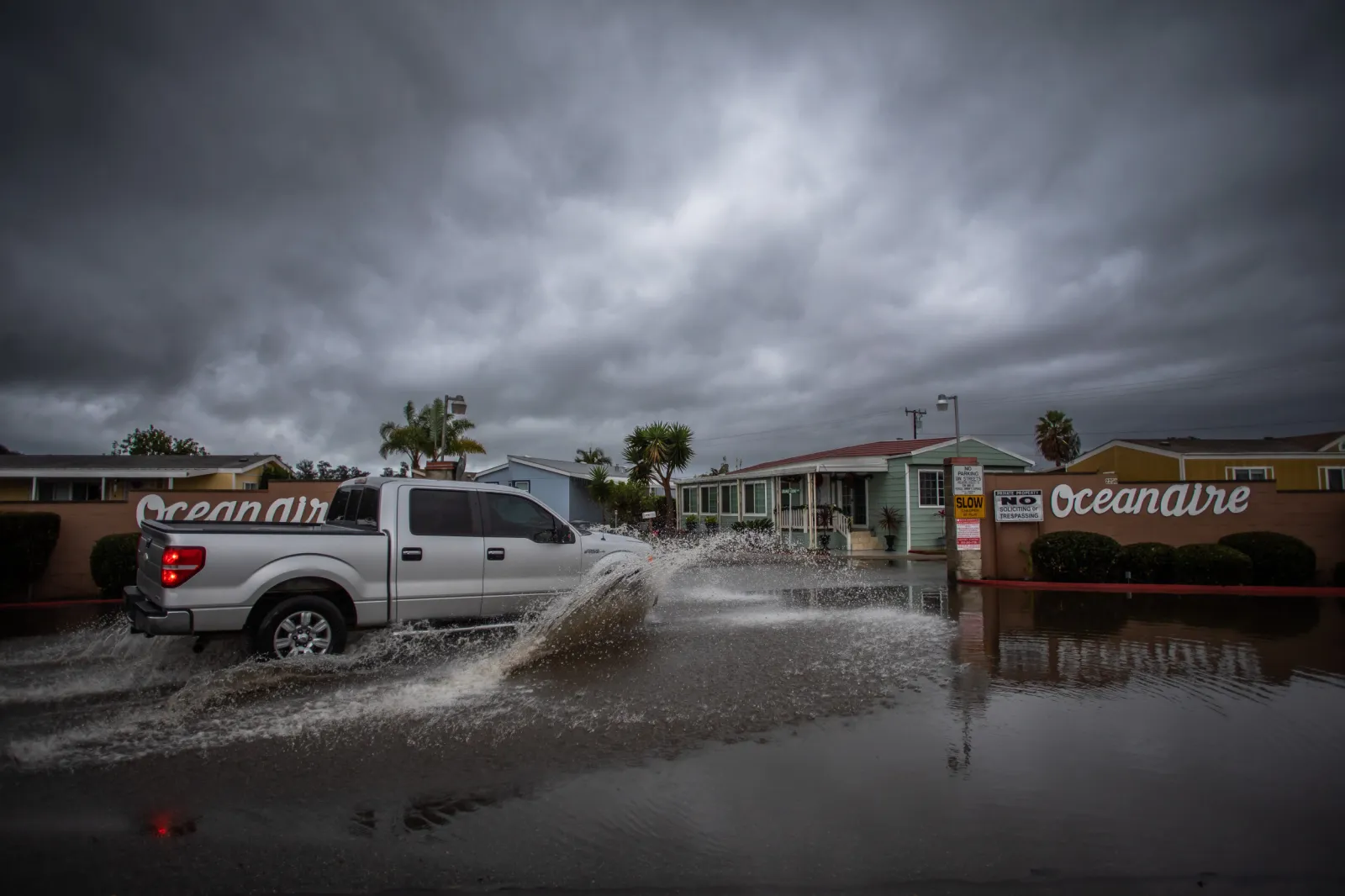
"This shift could lead to destructive precipitation-driven flooding events like pluvial floods, flash floods, landslides, and debris floods," he said. "Highly intensified rainfall (heavy rainfall) for a few hours or less serves as a trigger for an uncontrollable amount of surface water in a short period."
That means a lot of water suddenly flowing over the land, potentially causing property damage and loss of life. The problem, the study's researchers write, is that the U.S. is currently lacking a climate-adjusted national standard considering the 'new normal' already brought about by global warming.
"Understanding areas prone to this physical flood risk is crucial for public safety," Kim said.
The impact of these storms is estimated to be worse on some of the densest populated areas in the U.S., including the Midwest—for example, Chicago—and the Northeast, with cities like Boston, New York City, Philadelphia and Washington D.C., according to Porter.
"The implications in these areas are that the protection standards that we build our stormwater management for are out of date, and even new projects are being built to suboptimal standards," he said.
...
View 0 Comments
Submit Correction
View Editorial & AI Guidelines