10
Loading video...


By Andrew Stanton and Jennifer Radcliffe
0
Share
Newsweek is a Trust Project member
See more of our trusted coverage when you search.Prefer Newsweek on Googleto see more of our trusted coverage when you search.
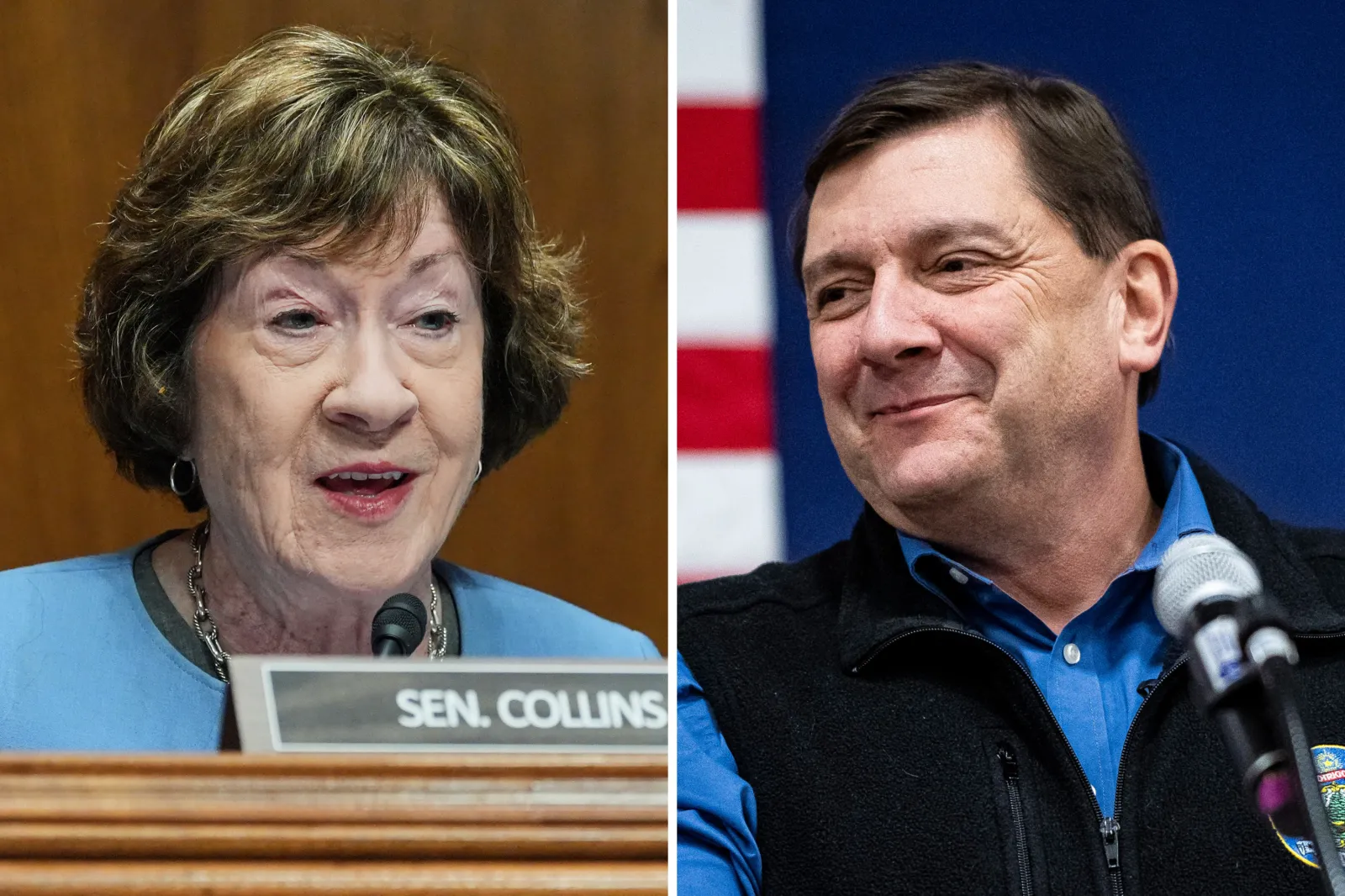
Republican U.S. Senator Susan Collins and Democratic challenger Troy Jackson spent their fourth and final debate in the Maine Senate race Thursday night trying to establish their independence—both from their parties and elite political interests.
Jackson repeatedly sought to tie Collins to President Donald Trump, arguing that the five-term senator ultimately backs the administration when key votes are on the line, despite her reputation as a bipartisan moderate. Collins countered by portraying Jackson as a partisan Democrat and accusing him of violating his own campaign pledge to reject billionaire and corporate influence.
The two also clashed over packing the Supreme Court, campaign finances and immigration enforcement, while a man protesting data centers briefly interrupted the debate by shouting that they are destroying the climate. Collins quipped that the individual was "obviously one of Troy's supporters." Jackson responded: "Oh, shut up. I don't even know that kid."
Read More on Politics
Collins, Jackson Clash Over Trump, Bipartisanship and Campaign Money
The night's sharpest exchanges centered on Collins' longstanding claim that she is one of the Senate's most independent lawmakers.
Collins pointed to studies showing she is the Senate's most bipartisan member, she said, and cited votes against Trump administration nominees, arguing Maine benefits from having a senator willing to break with her own party.
"We need more people in the center," Collins said. "We don't need more people who are going to vote a straight party line."
Jackson dismissed those examples as "managed votes" that do not affect the final outcome and argued Collins supports Trump when it matters most.
"What I know is 100 percent of the time when Donald Trump goes to Susan Collins for a vote, he gets it," he said.
The candidates later sparred over campaign finance after Collins accused Jackson of breaking promises not to benefit from billionaire or corporate-backed money through Democratic Senatorial Campaign Committee-linked advertising.
"That totally violates the promise that Troy made," Collins said.
Jackson rejected the accusation, arguing that outside groups make their own spending decisions and that he has not coordinated with them. He also defended a delayed campaign finance filing, saying his campaign received contributions from more than 200,000 donors and that he wanted the report to be accurate before submission.
Candidates Split on RFK Jr. and ICE
One of the more notable moments came when Jackson said he would vote to impeach Health and Human Services Secretary Robert F. Kennedy Jr. if such a measure reached the Senate, though he stressed it would not be a priority and that lawmakers should focus on issues such as healthcare, prescription drug costs and childcare.
Collins said that while she disagrees with Kennedy's stance on vaccines, she does support several of his other initiatives. She said she does not regret supporting his appointment.
On immigration, Collins called for additional oversight and reforms to U.S. Immigration and Customs Enforcement (ICE), including restrictions on enforcement actions at schools, hospitals, doctor's offices and houses of worship.
Jackson, who has advocated dismantling ICE, argued the agency has become unaccountable and pointed to recent enforcement controversies as evidence that major changes are needed.
The candidates also exchanged accusations over responsibility for rising debt and budget shortfalls, with Collins stressing fiscal restraint and economic growth while Jackson repeatedly faulted Republicans for tax cuts he said disproportionately benefit wealthy Americans.
Candidates Offer Different Visions of Democracy, Courts and America's Future
The candidates also sparred over the Supreme Court, campaign finance and the state of American democracy.
Jackson said the Supreme Court has become overly influenced by wealthy interests, backing ethics reform and term limits for justices, and leaving the door open to expanding the court beyond nine members.
"We have the best court that money can buy right now," he said.
Collins rejected court expansion, arguing that adding seats would politicize a branch of government that was designed to remain independent.
"What we want is a Supreme Court that is insulated from politics," Collins said.
The two also clashed over dark money in politics. Collins said donors behind outside spending groups should be disclosed regardless of party affiliation, while Jackson renewed his criticism of the influence of billionaires in elections and called for campaign finance reform.
Asked whether American democracy is under attack, Jackson warned that a second Trump term had heightened the risk of backsliding and argued Republicans have failed to hold the president accountable.
Collins took a more optimistic view, saying the country has weathered challenges under both Democratic and Republican presidents and that "our democracy will be just fine."
Why Is the Maine Senate Race Important in the 2026 Midterms?
Maine’s Senate race is expected to be among the most competitive of the 2026 midterms, and it’s one of a handful of toss-ups that could determine whether Democrats or Republicans control the chamber when the new Congress convenes next year.
The Pine Tree State is generally seen as having a Democratic hue, but Collins has been able to win by large margins in the past due to her personal popularity and bipartisan credentials, helping her reach independents and moderates who may otherwise prefer Democratic candidates.
...
But Democrats believe Collins is in for her toughest race yet in a state that President Donald Trump lost three times.
Trump’s approval rating has slipped nationwide as economic concerns centering around the cost of living mount, driving a national environment that is more favorable to Democrats this year. Democrats believe they will be able to compete in more conservative states to contest the Senate majority, but flipping Maine is seen as a critical step to do so.
Republicans hold a 53-47 majority in the Senate, so Democrats need to flip four seats to gain the majority.
Maine is seen—along with North Carolina, which Trump won by 3 points—as a top Democratic flip opportunity. With limited other easy flip opportunities, Democrats would have to win Senate seats in two states Trump won by double digits in 2024 to win control. This means that if Collins holds on, the Democratic path to a majority narrows.
Jackson Holds Edge, But Independents Still Prefer Collins
The Suffolk University poll was broadly welcome news for Jackson, but it still found that Collins held a slight lead among independent voters. She held a 3-point lead among the critical voting bloc, 47 percent to 44 percent.
But Jackson still held onto the vast majority of Democrats, winning them 94 percent to 5 percent. That would mark a notable shift from 2020, when Democrat Sara Gideon won Democrats by an 84-13 margin over Collins, according to CNN exit polling data.
Jackson held leads along the South Coast, 57 percent to 39 percent, and Mid Coast, 55 percent to 41 percent, while Collins was favored in East Maine, 55 percent to 41 percent, and the vast, rural Northern region, 71 percent to 25 percent, the poll found.
Among those who said they were “very likely” to vote, Jackson led Collins by 3 points, 50 percent to 47 percent, according to the survey.
What Earlier Polls Show
The Maine Senate race is seen as a true toss-up, and polls reflect the competitive nature of the race.
Jackson held a 4-point lead among 800 likely voters in a poll from The Washington Post and George Mason University.
Fifty percent of respondents said they planned to vote for the Democratic candidate, while 46 percent said they would back Collins for reelection, according to the September 30 to October 5 survey, which had a margin of error of plus or minus 3.6 percentage points.
Jackson also led by 4 points in a recent Marist University poll of 1,505 registered voters from October 1 to 4. Jackson’s support stood at 51 percent, while 47 percent supported Collins in the poll, which had a margin of error of plus or minus 3.8 percentage points.
But a YouGov/CBS News poll showed a dead heat, with each candidate at 50 percent. It surveyed 1,136 likely voters from September 23 to October 1 and had a margin of error of plus or minus 4.7 percentage points.
The RealClearPolitics polling aggregate gave Jackson a 1.3-point lead as of Wednesday, underscoring the competitive nature of the race.
However, polling underestimated Collins in her 2020 reelection bid. She trailed Democrat Sara Gideon in most surveys but went on to win her reelection with a slim majority of the vote. Polling errors are not necessarily repeated from cycle-to-cycle, but whether a similar miss will occur this year remains a question hanging over the campaign.
Latest Developments in the Maine Senate Race
Both parties are focusing on the Maine Senate race in the final stretch of the campaign.
Former President Barack Obama endorsed Jackson last week, while Vermont Senator Bernie Sanders, an independent who caucuses with Democrats, traveled to the state to campaign with him over the weekend.
Trump has also floated the idea of visiting Maine ahead of the midterms in remarks to reporters, though Collins said during an earlier debate she does not believe the president will visit the state.
"I’ve heard nothing from his office, and I’m not exactly his favorite senator," she said. "I would say that he is not coming to Maine."
Candidates are facing a looming deadline to report third-quarter federal campaign expenditure filing.
Collins has broken with Trump over his plan to import Russian diesel to combat high prices, writing in a bipartisan statement with other senators that Trump’s decision "runs directly counter" to a ban on Russian energy imports in 2022 that was passed "to prevent American dollars from financing Putin's brutal war against Ukraine."
A pro-Collins PAC this week drew attention after it mistakenly bought ads attacking Jackson in Portland, Oregon, instead of Portland, Maine.
The PAC, Defending Main Street, told Newsweek the mistake was made by a media vendor and that the ads were "immediately stopped and corrected" once it was identified.
What Prediction Markets Show
Jackson was narrowly ahead of Collins in prediction markets on Thursday, having a 57 percent chance of winning on Kalshi and a 60 percent chance on Polymarket.
His chances have narrowed as Election Day inches closer. One month earlier, he had a 66 percent chance of victory on Kalshi and a 71 percent chance on Polymarket.
Prediction markets allow traders to buy and sell contracts tied to political outcomes and current events, aggregating real‑money wagers into probability estimates.
Prices fluctuate as traders react to polling, fundraising, candidate developments and broader political trends. They measure trader sentiment at a given moment but do not always predict the future accurately.
Maine Voting: What to Know
In-person absentee voting began on October 5 and will continue until October 29, according to the Maine secretary of state’s office. More than 70,000 Mainers had requested an absentee ballot as of October 2, according to the office.
Polling locations are open between 6 a.m. or 10 a.m. to 8 p.m., depending on a town’s population, according to the secretary of state’s office.
Newsweek’s reporters and editors used Martyn, our AI assistant, to produce this story.
Contact Newsweek editors on this story: Jenna deJong, Geoffrey Rowland and Edward T. Cummins
View 0 Comments
Submit Correction
View Editorial & AI Guidelines