...

By Barney Henderson
Content Director
0
Share
Newsweek is a Trust Project member
See more of our trusted coverage when you search.Prefer Newsweek on Googleto see more of our trusted coverage when you search.
The priceless items stolen from Paris’s Louvre museum are not covered by private insurance, France’s culture ministry has said.
Thieves launched an audacious heist on the world-renowned art gallery on Sunday morning, stealing eight items, including a diamond brooch that belonged to Empress Eugénie, Napoleon III’s wife.
In a statement, France’s culture ministry said the state would not be reimbursed for the loss of items that have an "inestimable heritage and historical value."
Read More on World
...
The statement, given to Le Parisien newspaper, explained that "the state acts as its own insurer when national museums’ works are in their typical place of conservation, given the cost of taking out insurance when the loss rate is low."
Unlike private galleries, which would generally buy private insurance, national museums self-insure and assume the risk of loss through theft or fire, for example.
Romain Déchelette, president of Serex Assurances, a French insurance firm, told Le Parisien: "In the event of a theft like the one that occurred Sunday at the Louvre, national museums are left with nothing but tears."
How Did Daring Louvre Heist Unfold?
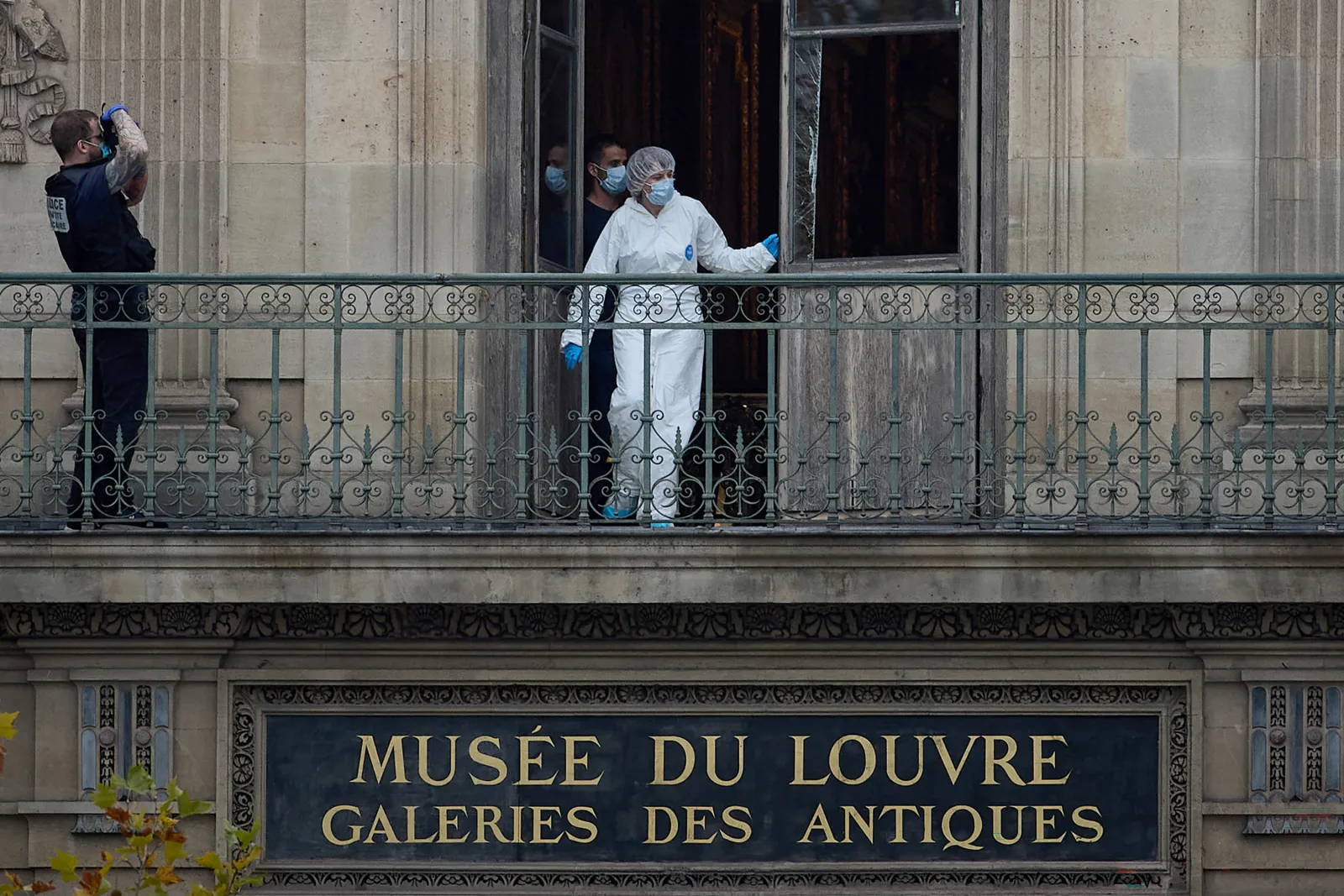
Around 9:30 a.m., a group of intruders broke into the Louvre in a daring daylight heist, forcing a window open and slicing through panes with a disc cutter before heading straight for the museum’s prized glass display cases, officials said.
Interior Minister Laurent Nunez reported that the thieves accessed the museum from the riverfront side, using a basket lift to reach the Apollon Gallery—a grand hall that houses the royal Crown Diamonds, including the famed Regent, the Sancy, and the Hortensia.

...
Once inside, the gang smashed two display cases and made off with several jewels before speeding away on motorbikes. No injuries were reported. Security alarms drew Louvre staff to the scene within moments, but the thieves had already vanished with their haul.
A major search is underway for the suspects across Paris and beyond. It is feared the stolen items will be broken up, and the precious stones sold individually.

...
What was Stolen from the Lourve?
Eight objects were taken, according to officials: a sapphire diadem, necklace and single earring from a matching set linked to 19th-century French queens Marie-Amélie and Hortense; an emerald necklace and earrings from the matching set of Empress Marie-Louise, Napoleon Bonaparte’s second wife; a reliquary brooch; Empress Eugénie’s diadem; and her large corsage-bow brooch—a prized 19th-century imperial ensemble.
One object, the emerald-set imperial crown of Napoleon III’s wife, Empress Eugénie, containing more than 1,300 diamonds, was later found outside the museum on the street. It was broken.

...
When was the Louvre built?
The Louvre Palace was originally built in the late 12th century, around 1190, under King Philip II of France.
It began as a fortress designed to defend Paris against Viking invasions via the Seine River. Parts of those medieval fortifications can still be seen today in the museum’s lower levels.
Over the centuries, the Louvre was transformed and expanded—first into a royal palace during the 16th century under Francis I, then into the world-famous museum it is today after the French Revolution in 1793, when it officially opened to the public as the Muséum central des arts de la République.
The Louvre has long been shadowed by a history of audacious thefts and near-misses. The most famous came in 1911, when Leonardo da Vinci’s Mona Lisa vanished from its frame—stolen by Italian decorator Vincenzo Peruggia and missing for more than two years before resurfacing in Florence.

...
Decades later, in 1956, the masterpiece suffered another assault when a visitor hurled a stone at the painting, chipping pigment near her left elbow. The attack led to the museum’s decision to encase the Mona Lisa behind protective glass.
French President Emmanuel Macron said in January that the museum is undergoing a renovation with a new entrance near the River Seine planned to open by 2031.
View 0 Comments
Submit Correction
View Editorial & AI Guidelines