...

By Khaleda Rahman
National Correspondent
0
Share
Newsweek is a Trust Project member
See more of our trusted coverage when you search.Prefer Newsweek on Googleto see more of our trusted coverage when you search.
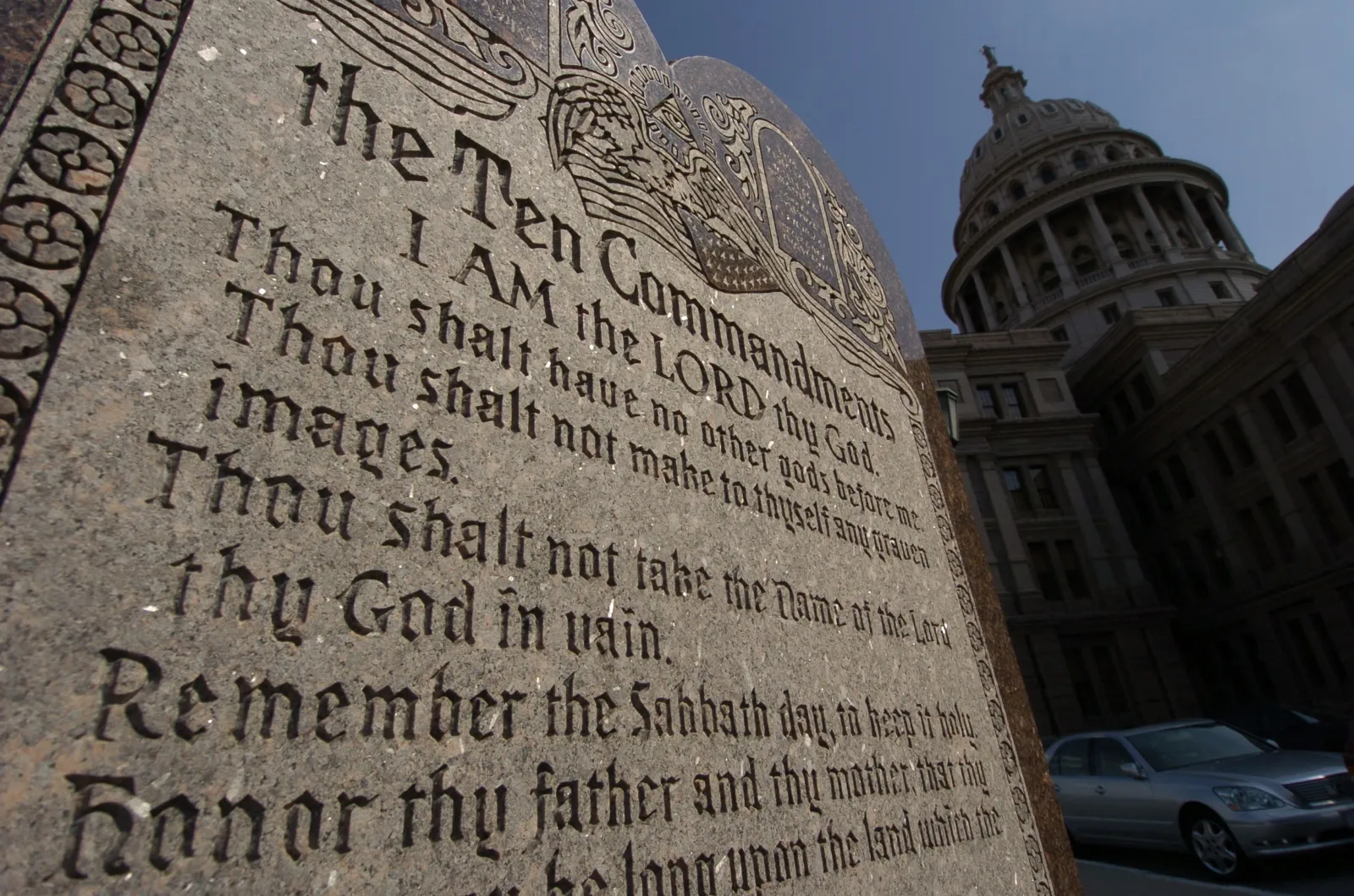
A federal appeals court will reconsider its recent decision that declared a Louisiana law requiring the display of the Ten Commandments in all classrooms of the state's public schools and universities "plainly unconstitutional."
In a brief order on Monday, the 5th U.S. Circuit Court of Appeals in New Orleans said its 17 active judges will sit "en banc" to review the decision from June 20.
Newsweek has contacted Louisiana Governor Jeff Landry for comment via an email sent outside regular business hours.
Read More on News
Why It Matters
The June decision had been a major victory for the civil rights advocacy groups who challenged the mandate on constitutional grounds, arguing it violates the separation of church and state.
But the court’s review could lead to the mandate, touted by Republicans and conservative groups who want expressions of faith to be more prominent in society, going into effect after all since the 5th Circuit is widely viewed as among the country's most conservative federal appeals courts. Most of the court’s active judges were appointed by Republican presidents though two of the three judges who struck down the law were appointed by Democrats.
...
What To Know
Louisiana's law required the display of poster-sized presentations of the Ten Commandments in all K-12 schools and state-funded colleges.
The law was challenged by nine families with children attending public schools, arguing it violates First Amendment language that guarantees religious liberty and forbidding government establishment of religion.
In seeking en banc review, Louisiana and school board defendants said the appeals court panel had mistakenly relied on an abandoned Supreme Court precedent that struck down a similar Kentucky law, Reuters reported. In a legal context, en banc refers to a session in which a case is heard before all the judges of a court—rather than by a panel of selected judges—typically used for important or complex cases.
The June decision cited the high court’s 1980 decision in Stone v. Graham, ruling that the Kentucky law requiring the display of the Ten Commandments in public school classrooms violated the Establishment Clause of the U.S. Constitution, which says Congress can "make no law respecting an establishment of religion."
The American Civil Liberties Union (ACLU) and other groups representing the plaintiffs challenging the law said in a joint statement that they "remain confident that the constitutional values and principles at the heart of the First Amendment, which guarantee religious freedom for all students and families, will prevail in the end."
What People Are Saying
The ACLU, ACLU of Louisiana, Americans United for Separation of Church and State, the Freedom From Religion Foundation and Simpson Thacher & Bartlett LLP, who are serving as pro bono counsel in the case, said in a statement: "The panel’s unanimous ruling last June was well reasoned and correctly followed binding Supreme Court precedent. We believe there is no reason to revisit it. Nevertheless, we look forward to presenting our clients’ case to the entire court of appeals, and we remain confident that the constitutional values and principles at the heart of the First Amendment, which guarantee religious freedom for all students and families, will prevail in the end.
"We emphasize that the district court’s preliminary injunction order in the Roake case—where the Court found that this law is facially unconstitutional—is not disturbed by the Fifth Circuit’s decision to rehear the appeal."
Louisiana Attorney General Liz Murrill wrote on X: "Glad to see the Fifth Circuit is taking this en banc. Looking forward to those arguments in court."
Robert Tuttle, a professor of law and religion at the George Washington University Law School, told Newsweek: "I'm not surprised that they agreed to hear it en banc, especially given that Texas also has a district court decision against the state. I have no idea how the court will decide en banc, but as Chip Lupu and I have written, there's no basis in existing Supreme Court law for a court to rule in favor of the state - to do so would be directly contrary to a significant body of still-binding precedent."
What Happens Next
A date for a hearing before the full 5th Circuit is yet to be set.
Louisiana’s law has not taken effect after being blocked by a lower court judge in November.
Judges have also blocked laws in Texas and Arkansas that require similar displays of the Ten Commandments, in response to lawsuits.
Update, 10/08/2025, 6:29 a.m. ET: This article was updated with additional information and comment from Robert Tuttle
View 0 Comments
Submit Correction
View Editorial & AI Guidelines