...

By Daniella Gray
Reporter
0
Share
Newsweek is a Trust Project member
See more of our trusted coverage when you search.Prefer Newsweek on Googleto see more of our trusted coverage when you search.
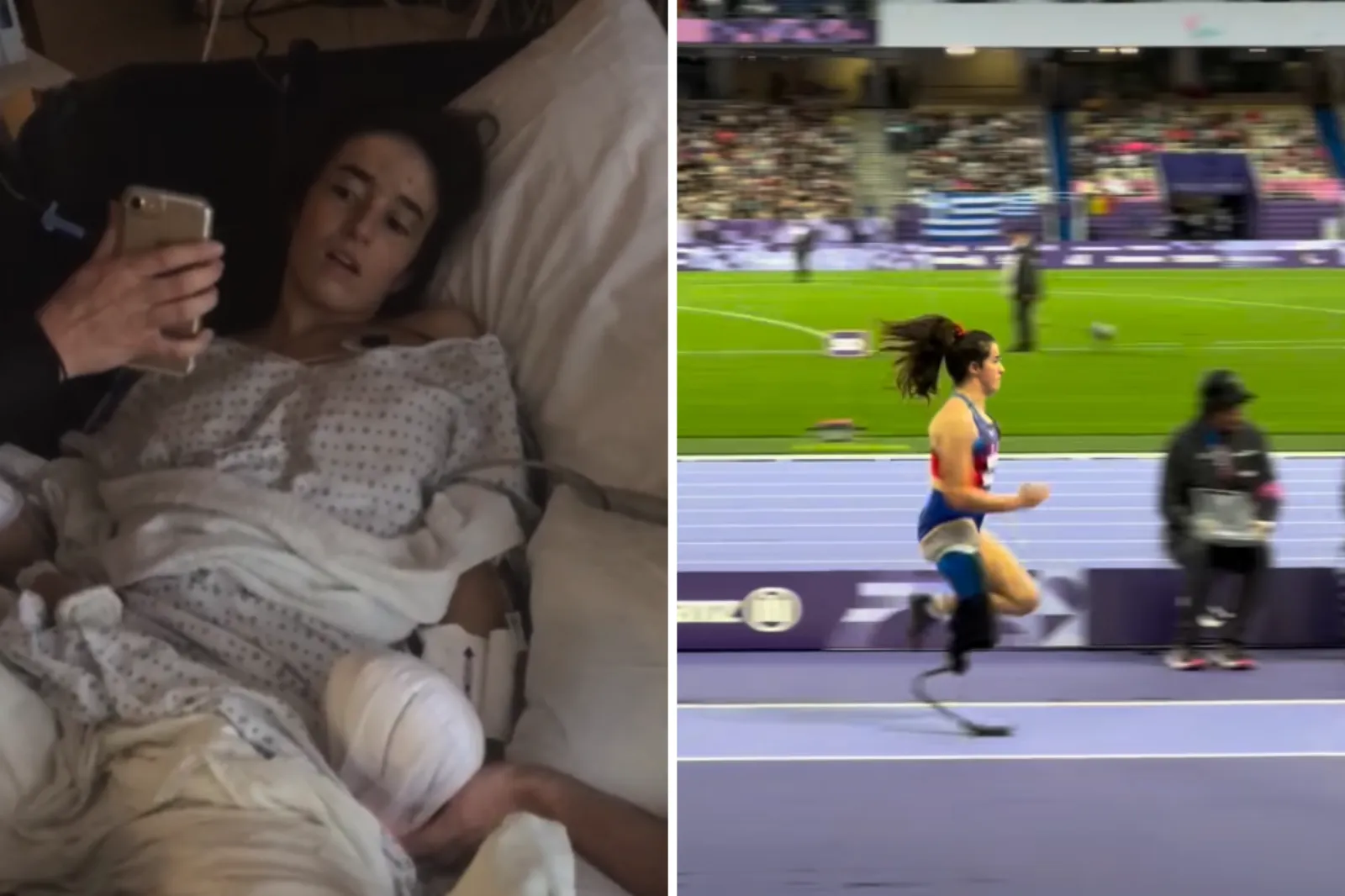
Thirteen days after Lindi Marcusen married the love of her life, she woke up in a hospital bed to learn she had lost her leg—and nearly her life.
Just weeks earlier, 29-year-old Marcusen, from Spokane Valley, Washington, had been celebrating her wedding to her husband, Nate, after graduating from college. Their day was intentionally simple and deeply personal.
“Before the ceremony, we had a quiet moment alone where we told each other we were all in, no matter what,” Lindi told Newsweek. “It was simple, but it felt really steady and certain.”
Read More on Health
Less than two weeks later, everything changed. Still settling into married life, Lindi was driving into town to work on wedding thank-you notes when she was involved in a catastrophic car crash.
Much of the accident itself remains unclear, and large parts of that day are still missing from her memory.
“I just remember driving, and then the next thing I knew, I woke up in a hospital bed,” she recalled. “And I was told I didn’t have a leg.”
Her car had been hit by a heavy truck on a two-lane highway and torn in half. Her leg was amputated on impact, and she sustained severe trauma to her lower body along with extensive internal injuries.
She was stabilized at a local emergency room in Idaho, then flown to Boise, where a trauma team worked to save her life.
...
Lindi underwent multiple surgeries, including the removal of her spleen, parts of her colon and appendix, and the placement of rods and pins through her hips and remaining leg.
At one point, after receiving 30 units of blood and continuing to bleed internally, she was placed on palliative care while doctors searched for answers.
“I was in the fight for my life,” she said.
One of the most serious injuries wasn’t immediately visible: a severe diffuse axonal brain injury. When Lindi slowly became more alert, she realized she couldn’t write her name the same way, couldn’t follow simple movements and couldn’t recall basic information.
Recovery was grueling. Lindi relearned how to move in a body that no longer felt familiar, juggling physical, occupational, speech and recreational therapy every day.
“I still have the journal I kept during that time, and you can actually see the progression,” she said. “My handwriting changes as my brain and my coordination start to come back. At the beginning, I could barely hold a pen and over time it slowly started to look like mine again.”
Emotionally, she felt everything—but anger gave her energy.
“It gave me something to push with and I’m really proud of how I used that,” she said. “But those early days… I was broken.”
Learning to walk on a prosthetic was another challenge. It felt mechanical at first, foreign and exhausting. At just 97 pounds, Lindi had to rebuild strength and balance from the ground up. She also had to learn how to advocate for herself, navigating a new reliance on medical devices—and on others.
“In a strange way, that’s what forced me to figure out who I was at my core,” Lindi said. “Looking back, I’m grateful for that part.”
Grief followed in waves: for her old body, her confidence and the future she once imagined. With help from a therapist she worked with for five years, Lindi began to face that grief head-on, even holding a symbolic “funeral” for her former self.
“I realized something important,” she said. “Even with everything stripped away, I was still me. The core of who I am never left. It just got refined.”
Before the crash, much of Lindi's identity had been rooted in movement and expression. She had been a gymnast for years, loved to dance and spent her time creating—painting, working with ceramics, making books and practicing goldsmithing. With her injuries, all of that suddenly felt out of reach.
While still in rehab, Lindi was first introduced to the idea of competing in the Paralympics. An occupational therapist showed her videos of runners using blades and talked through what might be possible.
“At that point, I couldn’t even walk yet,” Lindi said. “I had multiple breaks in my pelvis and I just wasn’t in a place to hear it. It felt too far away.”
About a year and a half later, something shifted. Back in the gym consistently, her competitive instincts returned.
With the encouragement of her coach, she began training seriously as a para-athlete. Today, she’s chasing ambitious goals, including breaking her own American record in the 100 meters and pushing further in the long jump—all while recovering from additional surgery.
After competing in the 2024 Paralympics—a dream she never thought possible—Lindi is now on the road to the Games in Los Angeles, which are just under two and a half years away.
Looking back, Lindi said her story comes down to one truth: life can be rebuilt.
“Step into your life,” she said. “The good, the hard, all of it. That’s how you become someone who can handle anything. Resilience glitters because you keep showing up and the light that makes it shine has always been yours.”
View 0 Comments
Submit Correction
View Editorial & AI Guidelines