
NewsweekGetty

By Newsweek Editors
0
Share
Newsweek is a Trust Project member
See more of our trusted coverage when you search.Prefer Newsweek on Googleto see more of our trusted coverage when you search.
A recent complaint about President Donald Trump’s administration isn't just that its men are vain, excessively telegenic, or unusually devoted to hair products. It is that they are carrying out political looksmaxxing, as the internet descriptor goes: treating grooming, tailoring, posture, and camera appeal as a core part of their offering. Defense Secretary Pete Hegseth has become the clearest subject of such angst, with his neatly groomed hair, dark blue suits, and American flag pocket square. The accusation is not that he looks polished. Plenty of politicians look polished. The accusation is that it represents a new (and for critics, baser) form of politics.
Beyond the internet slang, what are the critics really saying? Trump has long liked people who "look the part," and his first transition team said so openly: spokesman Jason Miller argued that "presentation is very important" because cabinet officials represent America to the world. Fair enough.
This is not some mutation cooked up by TikTok, podcast bros, and the evident national shortage of shame. It is not new. It is just less discreet. Trump and his inner circle did not invent political looksmaxxing. They inherited an old American habit, slathered it with product, and taught it to flex.
Read More on Analysis
Common Knowledge
Liberal criticism of the Trump cabinet is that it's revealing. GQ has said that Trumpism’s public style is bound up with a reactionary ideal of masculinity. The Daily Beast has described it as "hyper-curated masculinity." Salon has treated Hegseth’s presentation as part of a larger "manly act."
The right’s response usually comes in two lines. The first is to argue that visual politics is not new, and certainly not unique to Trump. The second is that presentation is part of public leadership, especially in a media environment in which political figures are constantly filmed and photographed.
That is what makes the older history more useful than the newer outrage. The question is not whether Trump’s cabinet has made appearance unusually conspicuous. It has. The question is whether this represents a break with the American past. It doesn't.
Uncommon Knowledge
Even a cursory glance through American history turns up five pre-Hegseth political looksmaxxers, or at least looksmaxx-adjacent, understood not simply as handsome or well-groomed men, but as figures for whom appearance was a notable asset in the most important medium of their era.
5. John C. Calhoun

...
John C. Calhoun was born in 1782 in the Abbeville district of South Carolina. He graduated from Yale in 1804 with highest honors, studied law, and entered politics rapidly. He served in the South Carolina legislature, then in the U.S. House of Representatives from 1811, where he became one of the most prominent members of the war generation that pushed James Madison toward conflict with Britain. Later he served as secretary of war under James Monroe, vice president under both John Quincy Adams and Andrew Jackson, secretary of state under John Tyler, and one of the most consequential senators of the antebellum period.
Calhoun’s image developed alongside a remarkable public career. The Miller Center notes that his "striking appearance" contributed to his rise as a national celebrity before the age of 40. In an era before television and mass photography had taken over political life, appearance still traveled. It moved through paintings, print, reputation and personal bearing.
The Metropolitan Museum of Art describes Calhoun's 1846 likeness in sharp physical terms: "piercing, deep-set eyes, high brow, thin lips, and hollow cheeks," with the hair modeled in "full, sinuous lines." The Library of Congress and Smithsonian preserve similar portraits and images.
What made Calhoun visually effective was that he looked formidable, intense, intellectual, and slightly unearthly. His physical appearance reinforced the impression of a man of principle and unbending conviction. That mattered in the political culture of the early 19th century, when oratory, posture, dress, and portraiture helped establish rank.
As secretary of war from 1817 to 1825, he worked to reorganize the War Department, supported military academies and infrastructure, and tried to rationalize administration after the War of 1812. That bureaucratic seriousness, combined with his memorable physical presence, made him a figure whose authority was both intellectual and visual. In modern terms, he was not merely a handsome television warrior, akin to Hegseth. He was a statesman whose face itself became a political instrument.
4. William W. Belknap

...
William Worth Belknap was born in Newburgh, New York, in 1829. He graduated from Princeton in 1848, studied law at Georgetown, was admitted to the bar in 1851, and moved to Keokuk, Iowa, where he entered local politics. During the Civil War he served with the Fifteenth Iowa Infantry, fought at Shiloh, Corinth and Vicksburg, and rose to the rank of brevet major general. After the war he returned to public life and in 1869 President Ulysses S. Grant appointed him secretary of war, a post he held until 1876. His career ended in scandal, resignation and impeachment, but before that collapse he was one of the most visible men in Washington society.
Belknap’s embodied a certain kind of authority. He had a war record, cabinet office, and a place in the political household of the Grant era. In the 19th century, more so than today, military service was one of the most reliable sources of masculine credibility in American public life.
Descriptions of Belknap’s appearance are unusually direct. The Palimpsest, published by the State Historical Society of Iowa, remembered him as the "tall, handsome, blond-haired, blue-eyed Secretary of War." The Library of Congress preserves Civil War-era Brady portraits that show a broad-shouldered officer with a heavy beard and a strong, composed face. Even in still images, Belknap appears physically substantial.
That physicality mattered in the world of Washington. The Senate’s own history of Belknap’s impeachment notes that he and his three wives were associated with lavish entertaining and conspicuous style. Cabinet life was not confined to the office. It also ran through dinner tables, drawing rooms, receptions and the rituals of social display. Belknap excelled in that world. His looks were not minimalist or austere. They were expansive and military.
That makes him a revealing case. Belknap’s appearance worked politically even though his administration of office ultimately collapsed into scandal. He resigned in 1876 amid allegations that he had profited from kickbacks connected to military traderships. The House impeached him anyway, and the Senate tried him after his resignation before ultimately acquitting him.
3. George B. Cortelyou

...
George Bruce Cortelyou is obscure enough to make this list. He was born in New York City in 1862, trained as a stenographer, and entered federal service through clerical and administrative work rather than through a public career. The White House Historical Association recounts that he mastered shorthand, worked in the Post Office Department, and eventually came to the attention of Grover Cleveland, who brought him into the White House as a confidential secretary. William McKinley kept him on. Theodore Roosevelt made him even more central.
Cortelyou was not a military hero. He was something more modern: a technocrat. He was standing near McKinley when the president was shot in Buffalo in 1901. Under Roosevelt he became one of the most important organizers of presidential operations, helping rationalize White House processes, media relations and discipline. The White House Historical Association credits him with major improvements in how the president’s office handled reporters, travel, information flow and scheduling.
Cortelyou’s appearance matched this style of public service. The Library of Congress preserves a formal portrait of him seated at a desk, turned slightly toward the viewer. He had the neat mustache, controlled expression, formal posture, and carefully ordered presentation of a man whose authority came from his own competence.
That made him especially well suited to the emerging 20th-century state. Cortelyou looked like a senior official before the modern senior official had been invented. James Creelman, quoted by the White House Historical Association, described his effect in terms of "common-sense, sobriety, gentleness and orderly industry." In an age of growing bureaucracy, that itself was a powerful political look.
2. Donald Rumsfeld

...
Donald Rumsfeld was born in 1932 in Chicago, graduated from Princeton in 1954, served as a Navy aviator and flight instructor, then entered politics in the House of Representatives in 1962 at the age of 30. He went on to serve in a series of senior executive positions: director of the Office of Economic Opportunity, ambassador to NATO, White House chief of staff, secretary of defense under Gerald Ford, and later secretary of defense again under George W. Bush. Between those two Pentagon terms he also ran major corporations.
Rumsfeld’s public image was inseparable from that career. He did not project romance, softness or charm. He projected competence, impatience and structural discipline. Obituaries and profiles repeatedly returned to the same physical vocabulary: "square-jawed," compact, controlled, hard-edged. PBS, summarizing coverage of his death, used the phrase "square-jawed with an acid tongue."
What places him so high on this list is that his appearance functioned within a medium that earlier cabinet members did not have to master in the same way. Rumsfeld belonged to the age of live, repeated, broadcast executive performance. During the run-up to and opening stages of the Iraq War, he became one of the central figures in Pentagon briefings. The Defense Department’s photo archive preserves him speaking at podiums, answering reporters, and appearing on monitors within the Pentagon briefing room.
His appearance helped that performance. Rumsfeld was not flashy. He was visually efficient. The suit, the posture, the clipped manner, the controlled face, the impression of coiled impatience—these all communicated authority in the television age. If Calhoun mastered the portrait and Belknap mastered the military photograph, Rumsfeld mastered the live briefing.
Rumsfeld is also useful because his case shows that looksmaxxing in politics need not be ornate. He did not rely on conspicuous grooming or decorative national symbolism. His look was managerial, not theatrical. His authority, whatever one thinks of the wars he oversaw, was transmitted partly through that.
1. Lillian Brown
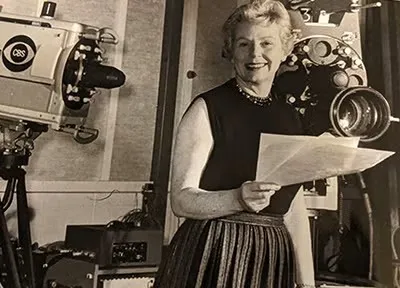
Lillian Brown is the most revealing figure in the ranking because she exposes the system underneath it. Brown was born in 1914 on a farm in Huntsville, Ohio. She earned a teaching certificate from Bowling Green State University, did graduate work at Ohio State, taught in a one-room schoolhouse, and later moved into communications and media education. Georgetown recounts that she became the first director of radio and television at George Washington University in 1956 and later held similar roles at American University and Georgetown. She spent decades in broadcasting and education, including a 40-year career at CBS News in Washington.
Brown was not famous because she held office. She was famous because she understood how politicians had to appear once television took over political life. Georgetown says that after producing a TV series called Churches of the Presidents, she was asked by staff at Face the Nation why her guests looked good on television while theirs did not. Her answer was simple: she powdered their noses. That practical answer opened onto a much larger role. Brown became the senior makeup artist for CBS News’ Washington bureau and worked on presidential inaugurations, campaigns, summits and televised political appearances.
She also taught politicians, broadcasters and public officials how to speak and present themselves more effectively. Her books—Your Public Best, The Polished Politician, and Speaking to Be Understood—make clear that she thought of appearance and voice as part of the same mission. She was helping to construct the modern style of political presentation.
She worked with presidents from Dwight Eisenhower to Bill Clinton, nine in all. She applied makeup to both Kennedy and Nixon during the now infamous 1960 debates, after advising Kennedy ahead of the first one.
That is why Brown ranks first. Calhoun, Belknap, Cortelyou and Rumsfeld each turned appearance into authority in the mediums available to them. Brown helped make the medium itself politically essential. Once that happened, the decades-later debate over Hegseth’s hair or Trump’s camera-conscious appointees ceases to be a story about vanity.
Hegseth’s presentation is more explicit, more muscular and more self-aware than the approach of earlier administrations. But the underlying pattern is the same.
Hey gang, Carlo Versano here. I hope you enjoyed this article. As Newsweek's Director of Politics and Culture and editor of the 1600 newsletter, I'm keen to hear what you think. Now, Newsweek is offering a new service to allow you to communicate directly with me in the form of a text message chat. You can sign up and get a direct line to me, as well as the reporters who work for me. You can shape our coverage, and even get your own Uncommon Knowledge article.
As a Newsweek member, we're offering this service to you for free. You can sign up below, or read more about how it works here. Let's talk!
View 0 Comments
Submit Correction
View Editorial & AI Guidelines