10
Loading video...


By Mandy Taheri and Leonardo Feldman
0
Share
Newsweek is a Trust Project member
See more of our trusted coverage when you search.Prefer Newsweek on Googleto see more of our trusted coverage when you search.
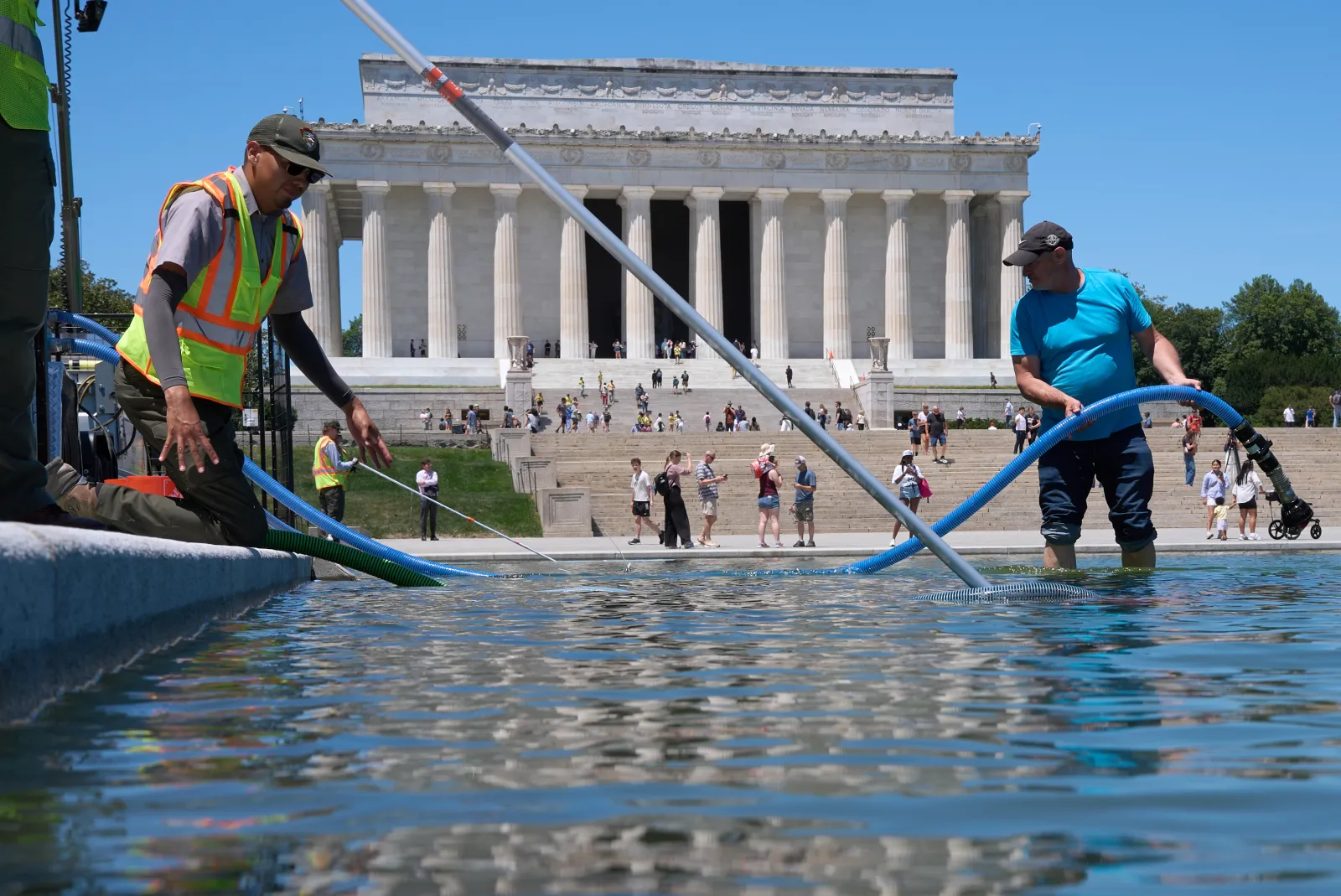
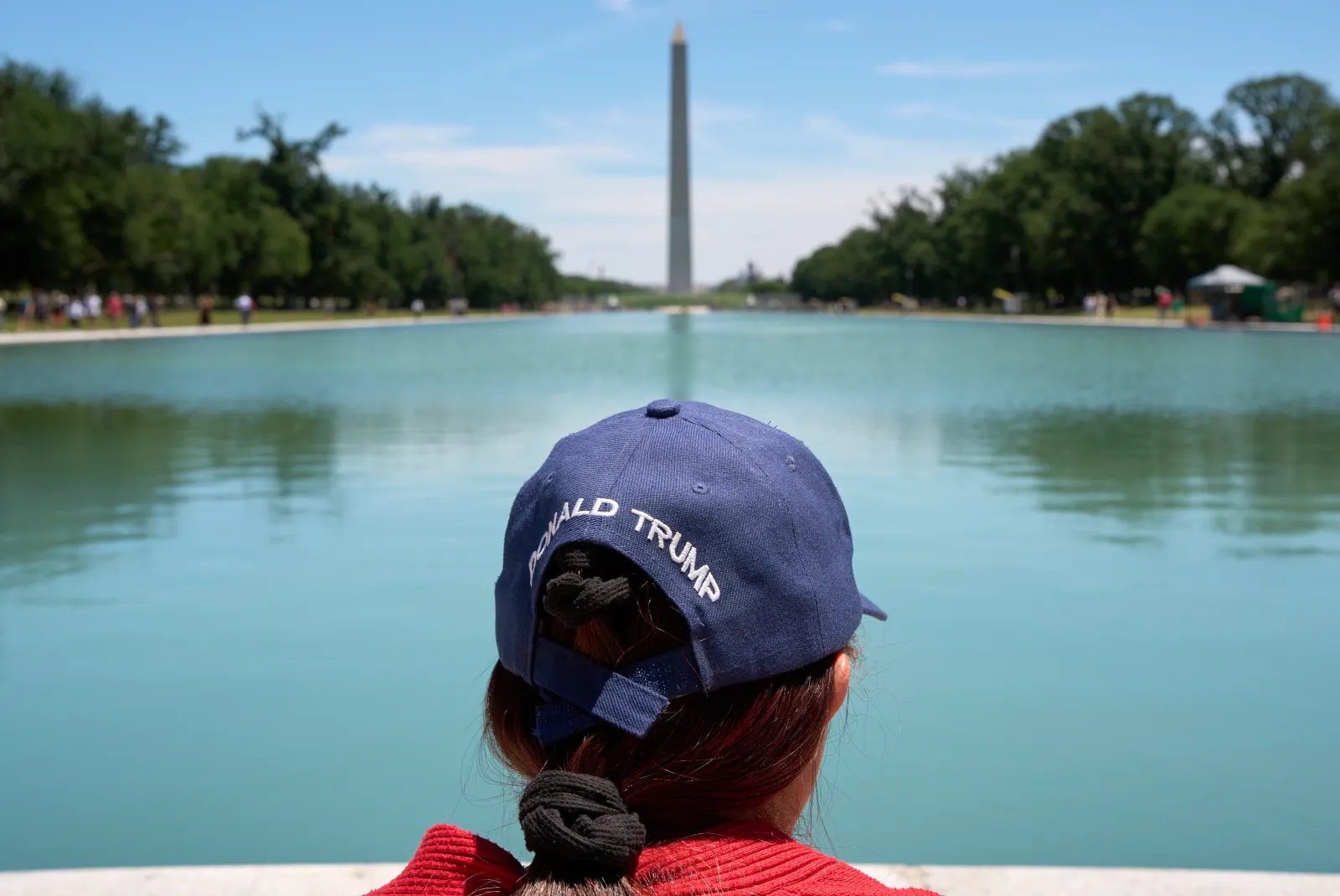
A multimillion-dollar renovation of the Lincoln Memorial Reflecting Pool, intended to give the landmark a deeper "American flag blue" appearance, has recently drawn attention for its greener hue. Passersby who spoke with Newsweek were divided on the pool’s actual water color and on whether the costly project was worth the investment.
“I heard that it was supposed to be blue, and it's pretty evident--looks pretty green to me*,”* one man told Newsweek, adding, “Where’s the blue?”
However, another said, “It’s both blue and green. I think, look, for some parts it’s green, for some parts it’s blue.”
Read More on U.S.
...
What Color Do People Think The Pool Is?
Images of the pool from the last few days show algae spreading across the surface just days after the pool was refilled, raising questions about whether the redesign has altered conditions in ways that favor rapid blooms.
One passerby told Newsweek that the color “depends” on where you are looking and the “reflection of the sun.”
The green color itself is caused by chlorophyll—the pigment algae use for photosynthesis. As algae multiply, they begin to dominate light absorption and reflection in the water, overpowering the underlying blue coating and shifting its appearance from deep blue to green.
Alla Silkina, an algal biotechnology expert at Swansea University, previously told Newsweek that under the right conditions, this visual change can happen quickly.
“Under ideal conditions algal populations can double within hours to a few days,” she said. “Visible blooms may develop within several days to one or two weeks, depending on the species and environmental conditions.”

...
Silkina also noted that darker surfaces could contribute to conditions that favor growth, but stressed that other factors are typically more important.
“Darker surfaces can absorb more solar radiation and increase local water temperatures,” she said. “This may create more favorable conditions for algal growth, although nutrient availability, water residence time, and species composition are often the primary factors controlling bloom development.”
Was It Worth the Money?
While Trump had suggested the project would cost between $1.5 million and $2 million, federal records show the contracts ultimately totaled roughly $14 million, a figure that has prompted scrutiny and pushback from critics.
“I like what they tried to do, like obviously it didn't work, so it's just the original color back to what it used to be*,”* one man said, adding, “it’s a lot of money spent on the thing as well, that could mean spent on other things.”
Another person told Newsweek that she is “mixed” on whether the pool was worth it, saying “the part that is blue looks very nice, but it does look already like it's getting algae on it, so I'm not sure if it was a great use of taxpayer dollars.”
One woman said that the pool is “always drained, empty, and broken. So it’s fantastic that they finally fixed the leaks.” She noted that the nanobubble filters on top are supposed to fix the algae and help the dark blue shine through.
Trump’s Renovation of the Lincoln Memorial Reflecting Pool
The overhaul, ordered by President Donald Trump as part of a broader effort to revamp the National Mall ahead of the U.S. 250th anniversary, involved resurfacing the century-old pool with a dark blue coating intended to improve its appearance and seal leaks.
The Lincoln Memorial Reflecting Pool, stretching more than 2,000 feet between the Lincoln Memorial and the Washington Monument, has faced long‑standing structural issues, including leaks, algae buildup, and water‑quality problems.
The pool was drained earlier this year to allow for repairs to its aging basin and infrastructure. Crews then moved in to resurface the interior with the darker coating designed to deliver the “American flag blue” finish Trump had called for, before the pool was refilled and reopened shortly after. The compressed timeline—from draining to repainting to refilling within weeks—has left a relatively short window for systems to be flushed and stabilized, a period when water quality can be especially vulnerable to rapid changes.
...
The work was awarded via a no-bid contract that has come under scrutiny and prompted a lawsuit from The Cultural Landscape Foundation, which argues the changes were carried out without required historic review.
An Interior Department spokesperson previously told Newsweek: "Versus previous administrations, the National Park Service is actually maintaining the beautifully completed Reflecting Pool. The nanobubbler technology has successfully destroyed the algae bloom that has plagued every pool reopening since 1922, most infamously, the Obama pool reopening that resulted in massive algae clumps taking over the pool’s surface following years of construction that cost taxpayers millions upon millions only to be broken and disgusting days later. Now, due to deploying the advanced nanobubbler technology, the algae is dead and being vacuumed up as we speak. We thank President Trump for fixing the Reflecting Pool for good."
A Historic Pool With Long-Standing Algae Problems
The Lincoln Memorial Reflecting Pool was built between 1922 and 1923. Managing the reflecting pool has long been a delicate logistical balance between aesthetics and environmental reality. It relies on constant circulation, filtration and chemical treatment to maintain clarity across its shallow, sun-exposed surface.
By the 1980s, the pool was already deteriorating badly, with officials pouring concrete into the base to try to patch damage. In the 2000s, the pool was losing hundreds of thousands of gallons per week due to leaks and structural failure, which ultimately triggered a full drain and reconstruction between 2010 and 2012.
Algae blooms are also nothing new. The shallow, slow-moving water has long been prone to appearing green in summer, particularly when heat, sunlight and stagnant conditions combine.
Over the decades, crews have repeatedly drained, scrubbed and recalibrated the system following major works, including after its $34 million renovation in 2012 under former President Barack Obama's administration, often contending with the same rapid return of algae once water is reintroduced.
View 0 Comments
Submit Correction
View Editorial & AI Guidelines