...

By Alice Gibbs
Senior Reporter
0
Share
Newsweek is a Trust Project member
See more of our trusted coverage when you search.Prefer Newsweek on Googleto see more of our trusted coverage when you search.
For more than a century, the Lincoln Memorial Reflecting Pool has appeared fixed and inevitable—a calm strip of water stretching between Abraham Lincoln and the Washington Monument.
But the pool was never a settled idea. It emerged from architectural disagreement, was shaped by compromise from the start and is now being dramatically altered again as President Donald Trump puts his personal stamp on one the iconic space.
Standing in the drained basin on May 7, Trump praised the new color—calling it “American flag blue”—and criticized the pool’s former appearance as uninspired.
Read More on U.S.
The change, fast‑tracked under an “urgent” procurement exemption, has triggered lawsuits and a backlash from preservation groups. But the controversy reaches far beyond paint. It revives a much older argument about how the National Mall should look.


...
A Design Fight From the Beginning
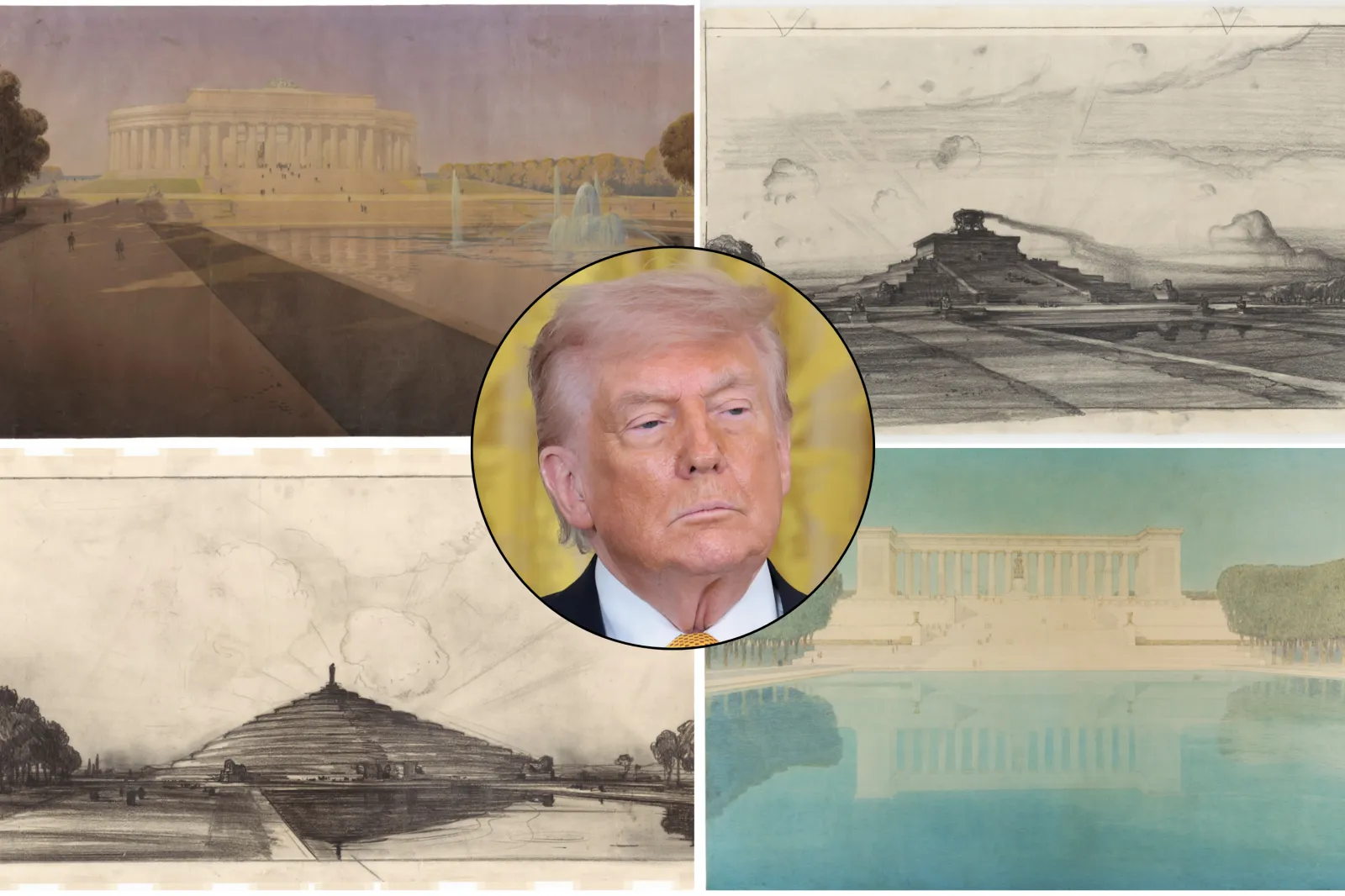
When Congress approved the Lincoln Memorial in 1911, it created a commission and turned to the newly established Commission of Fine Arts for advice. Out of that process emerged two competing visions, advanced by two architects whose ideas could scarcely have been more different.
One was John Russell Pope, already one of the country’s most ambitious neoclassical designers and later the architect of the Jefferson Memorial, the National Archives and the National Gallery of Art. Pope believed democratic power should be expressed through monumentality. His multiple proposals for the Lincoln Memorial included enormous circular structures, terraced pyramids, Mayan-inspired styles and ziggurat‑like forms—buildings meant to dominate the Mall and announce themselves from afar.
The other was Henry Bacon, whose eventual design now anchors the western end of the Mall. Bacon favored restraint. His Lincoln Memorial took the form of a simple Greek temple, carefully aligned with the Washington Monument and embedded within the surrounding landscape.

...

...

...

...

...
1 of 5
A Compromise From the Start
The Commission of Fine Arts endorsed Bacon’s plan, but that was not the end of the fight for what one of the nation’s most iconic spaces would look like.
Bacon left no written manifesto explaining the Reflecting Pool. Instead, its purpose is inferred from its design.
Architectural historians describe the pool as a visual plane rather than a focal point—long, shallow and axially aligned so it would recede beneath reflections of sky, trees and stone rather than compete for attention.
That intent was reinforced through material choices. The original pool used dark, neutral finishes selected to enhance reflection, not appearance. When the National Park Service rebuilt the pool in 2010-2012 after decades of leaks and subsidence, the basin was deliberately tinted a neutral gray to preserve that same reflective effect.
The 1902 McMillan Plan, a sweeping blueprint to remake the National Mall, called for a far more elaborate system of reflecting basins arranged in a cruciform pattern, with fountains, terraces and formal gardens extending around the Washington Monument.
Engineers ultimately warned that such excavation could destabilize the monument’s foundations. Cost and ground conditions meant the plan was scaled back significantly.

...
From Mirror to Makeover
Trump’s decision to repaint the basin blue marks a sharp break from decades of architectural restraint.
In public remarks, the president said he wanted the pool to look “beautiful” and blamed previous administrations for allowing it to deteriorate. Documents first reported by The New York Times show the $6.9-million resurfacing contract was awarded without competitive bidding under an emergency procurement exemption typically reserved to prevent serious harm to the government. The whole project's projected cost is now $13.1 million.
The Cultural Landscape Foundation, a Washington‑based preservation nonprofit, filed a lawsuit seeking to halt the project, arguing that the Trump administration bypassed legally required reviews before altering a site listed on the National Register of Historic Places.
"The Reflecting Pool’s profound reflective quality—achieved through deliberate design choices, including the dark color of its basin—creates the sweeping mirror image of the Lincoln Memorial and the Washington Monument that millions of visitors experience every year. The dark gray, achromatic basin was not incidental to the design. It was the design," the lawsuit says.
The suit contends that repainting the pool fundamentally alters the historic character of the Lincoln Memorial grounds and violates the National Historic Preservation Act by proceeding without review or approval from Congress or preservation authorities.

...
Why the Disagreement Matters Now
The legal fight has sharpened a debate as old as the pool itself.
The pool framed Marian Anderson’s 1939 concert after she was barred from Constitution Hall. It mirrored the crowds gathered for the March on Washington in 1963, and was the backdrop for the iconic "I Have a Dream" speech by Rev. Martin Luther King, Jr. And in 2021, lights traced its rim to mark lives lost during the COVID‑19 pandemic.
Many visitors may not know architect Henry Bacon’s name, but they recognize the sightline he engineered.
View 0 Comments
Submit Correction
View Editorial & AI Guidelines