


By Gabe Whisnant and Joshua Rhett Miller
0
Share
Newsweek is a Trust Project member
See more of our trusted coverage when you search.Prefer Newsweek on Googleto see more of our trusted coverage when you search.
A magnitude 3.8 earthquake struck Nevada on Thursday near the Las Vegas area, according to the U.S. Geological Survey (USGS), marking the strongest seismic event recorded in the state that day.
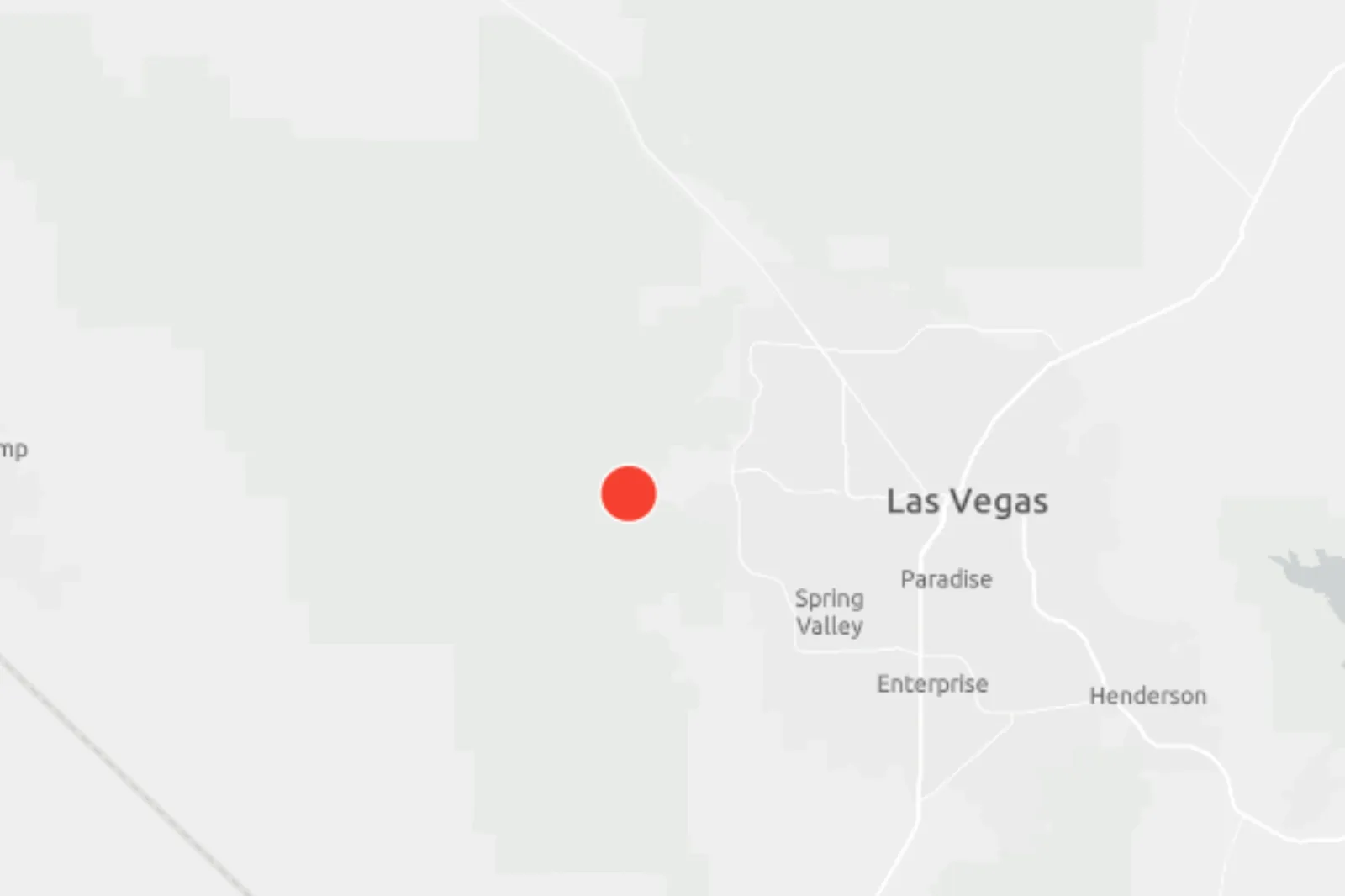
The quake, initially recorded as magnitude 4.1, was centered in Summerlin South, a community on the western edge of Las Vegas, and occurred at a shallow depth of about 6 kilometers, based on preliminary data.
There were no immediate reports of damage or injuries following the tremor, which is considered moderate and is often felt but rarely causes significant disruption.
Read More on News
Clark County public information officer Jennifer Cooper told Newsweek via email that there was "no damage to roads, pipelines, buildings or infrastructure."
Nevada is one of the most seismically active states in the U.S., with frequent small earthquakes linked to regional fault systems, though stronger events are less common.
“Our magnitude estimate is a 4.1 with the epicenter at Red Rock Canyon,” Nevada Seismological Laboratory director Christie Rowe told the Las Vegas Review-Journal. “Our analysts are looking at it right now. It looks like it was felt pretty widely.”
“It reminds us that Nevada is earthquake country,” Rowe said. “We’ve always got to be ready for something bigger.”
Map: Where the Nevada Earthquake Hit
Where Was the Earthquake Felt?
Shallow earthquakes of this magnitude are often felt by residents close to the epicenter, particularly in nearby Las Vegas suburbs.
While a 3.8 magnitude quake is considered moderate, shaking can still be noticeable indoors, especially in multi-story buildings. There were no immediate reports of widespread damage or injuries, though such tremors can be felt across a broader region depending on local geology and population density.
The LisaLasVegas account posted on X, "I’m on the east side in Las Vegas and it was like a train coming through the house. Literally had me and the dog running outside. And I felt it a good 10 minutes before it came over the earthquake app or even on the news."
Could There Be an Aftershock?
Aftershocks are common following earthquakes, even smaller events like a magnitude 3.8.
These secondary quakes occur as stress adjusts along the fault line and can happen minutes, hours or even days after the initial tremor. Most aftershocks are typically weaker than the main quake, though seismologists monitor activity closely to track any clusters or unusual patterns in the region.
When Was the Last Major Earthquake in Nevada?
The most recent major earthquake in Nevada was a magnitude 5.7 event that struck near Silver Springs on April 14, 2026, according to the U.S. Geological Survey. The quake was centered about 45 miles east of Reno and hit at a shallow depth of about 5 kilometers. It triggered a series of aftershocks in the region in the days and weeks that followed.
Events of this size are considered moderate to strong and are capable of being felt across wide areas, though damage is often limited depending on location and infrastructure.
Later in April, an earthquake and 15 aftershocks struck a remote stretch of southern Nevada near the highly restricted Area 51 military installation.
The April 30 earthquakes, plotted on a USGS interactive map, were concentrated across southern Nevada, with the first quake striking on Wednesday morning, followed by more than a dozen, weaker tremors occurring roughly 28 miles east of the classified test site northwest of Las Vegas.
A hypothetical magnitude 7 earthquake near Las Vegas could cause about $21 billion in damage, ripping through vulnerable buildings and infrastructure, according to the Nevada Bureau of Mines and Geology.

...
Nevada's Fault Systems: What to Know
Nevada’s fault systems are shaped by its location in the Basin and Range Province, where the Earth’s crust is gradually being pulled apart.
That long-running stretching has created hundreds of active normal faults—fractures where one side drops relative to the other—producing the state’s pattern of parallel mountain ranges and valleys. Nearly every range is bounded by one or more faults, and many remain active, allowing stress to build and be released as frequent, typically shallow earthquakes.
Unlike California’s San Andreas, Nevada’s seismicity is spread across a broad network rather than a single dominant fault. A key zone is the Walker Lane along the California–Nevada border, a wide belt of interconnected faults that accommodates a significant share of plate movement and combines both horizontal and vertical motion.
Elsewhere, activity is distributed across multiple fault belts throughout the state, meaning earthquakes often occur in clusters or swarms as strain is released across many smaller structures instead of one continuous rupture.
This is a breaking news article. Updates to follow.
...
View 0 Comments
Submit Correction
View Editorial & AI Guidelines