10
Loading video...

By Anna Skinner
Associate News Editor
0
Share
Newsweek is a Trust Project member
See more of our trusted coverage when you search.Prefer Newsweek on Googleto see more of our trusted coverage when you search.
Federal officials on Friday unveiled a new long-term framework for managing the Colorado River system, outlining how Lake Powell and Lake Mead will be operated through 2036 as the West continues to grapple with drought and shrinking water supplies.
The Bureau of Reclamation (BOR) released its Final Environmental Impact Statement (EIS), designating a preferred alternative that establishes an adaptive decision-making framework for the nation's two largest reservoirs.
The plan is designed to provide operational flexibility while allowing the seven Colorado River Basin states—Arizona, California, Colorado, Nevada, New Mexico, Utah and Wyoming—to continue pursuing consensus-based agreements over water use.
Read More on U.S.
Interior Secretary Doug Burgum said the framework balances immediate stability with long-term collaboration.
"The Department has a responsibility to ensure the Colorado River system remains reliable and resilient for the millions of Americans, communities and industries that depend on it," he said in a statement. "This framework provides the flexibility to respond to changing hydrologic conditions while preserving the opportunity for the Basin States to continue working toward durable, consensus-based solutions."
Related Story
Can Lake Powell and Lake Mead Be Saved? The Ideas Reshaping the Debate

...
A Strained River System
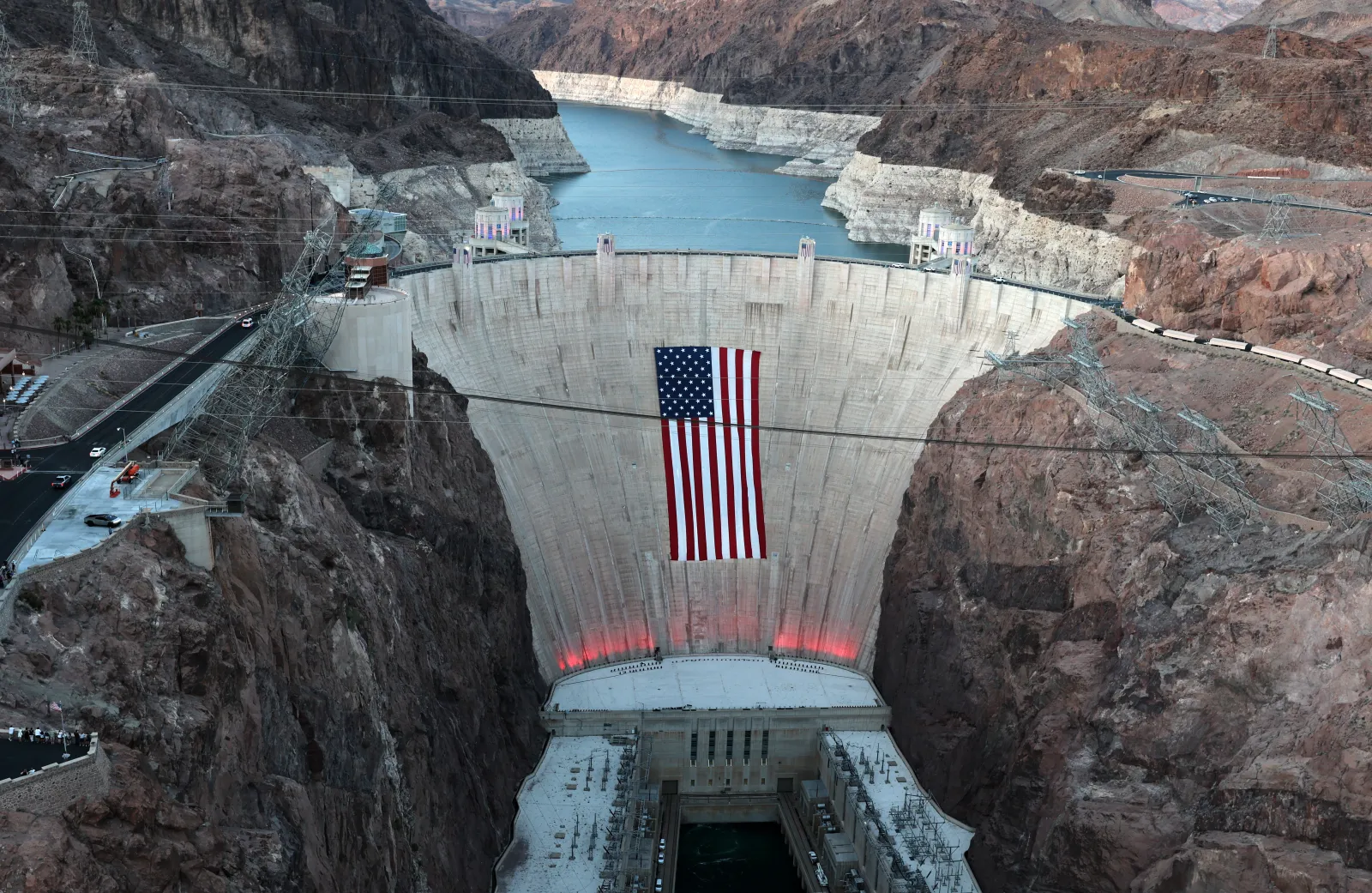
The announcement comes as the Colorado River Basin faces severe water supply challenges. Lake Mead and Lake Powell remain well below historical levels after more than two decades of drought and aridification across the Southwest. According to BOR, the combined contents of the two reservoirs have not been this low since before Glen Canyon Dam began filling Lake Powell in 1963.
The situation has raised continuous concerns for water supplies, hydropower generation and ecosystems throughout the region. The Colorado River provides drinking water to more than 40 million people, supports 5.5 million acres of farmland, supplies 30 tribal nations and delivers water to Mexico under international agreements.
Federal officials report that water demand has consistently exceeded available supplies. Since 2000, total water use has surpassed system inflows in most years. While the Colorado River Compact was based on estimated average annual flows of about 18 million acre-feet during the early 20th century, inflows between 2000 and 2024 averaged just 12.9 million acre-feet.
This year has underscored those persistent challenges. As of July, unregulated inflow into Lake Powell was estimated at only 3.5 million acre-feet.
Flexible Operating Thresholds
Under the preferred alternative, BOR will establish operational "sideboards," or thresholds, to guide future decision-making:
- Releases: Annual releases from Lake Powell will range from 5 million to 12 million acre-feet.
- Shortages: Lower Basin water shortages of up to 3 million acre-feet will be permitted if necessary.
- Conservation Storage: Up to 8 million acre-feet of conserved water could be stored in Lake Powell, while Lake Mead could hold up to 3 million acre-feet.
- Upper Basin Conservation: Voluntary conservation efforts in the Upper Basin will be permitted up to 200,000 acre-feet, depending on hydrologic conditions.
Under the proposal, the burden of future Colorado River water reductions would fall primarily on the three Lower Basin states: Arizona, California and Nevada. Rather than assigning fixed cuts to each state immediately, the plan creates a framework under which the Lower Basin as a whole could be required to reduce water use by as much as 3 million acre-feet through 2036, depending on river conditions and reservoir levels. The Upper Basin states, Colorado, Utah, New Mexico and Wyoming, would not face mandatory cuts under the proposal for now. Federal officials say the approach is intended to give managers flexibility to adjust reductions every two years as drought, runoff and reservoir storage conditions change, while the basin states continue negotiating a longer-term agreement for sharing the river's shrinking water supply.
“Today, the federal government released a broad range of alternatives for how the Colorado River will be managed over the next ten years,” Arizona Governor Katie Hobbs said in a statement sent to Newsweek. “Within that range is the opportunity for the federal government to adopt the commonsense, compromise proposal put forward by Lower Basin States for 2027 and 2028. Our proposal is one of the largest conservation programs in Colorado River history and builds on Arizona’s decades-long commitment to responsible water stewardship."
She added: "While this FEIS still contains unacceptable options that include the federal government forcing Arizona to take the majority of draconian water cutbacks, implementing the Lower Basin agreement would protect Arizona from massive water cuts, distribute reductions more fairly across the Lower Basin States, and provide stability and protection to the water supply that our communities rely upon.”
Nevada Governor Joe Lombardo also wasn't pleased with the FEIS, telling Newsweek in a statement that it "seeks to impose unrealistic reductions on Nevada and our water users.”
“If carried forward, the plan outlined in the FEIS could have devastating economic and environmental impacts on Nevada. Nevada has put forward reasonable compromise proposals to the other states, and I will fight against any outcome that imposes unreasonable impacts to our communities and those living in them,” the governor said.
Newsweek reached out to California Governor Gavin Newsom's press office for comment.
Rather than locking in a single operating strategy for the next decade, the framework establishes a process for issuing operating guidelines at anticipated two-year intervals to adapt to changing weather patterns and runoff forecasts.
“This plan strikes a balance between flexibility and predictability for the Colorado River system that is vital to the 40 million people who rely on it given unprecedented hydrologic conditions and the potential for considerable impacts on water users,” Assistant Secretary for Water and Science Andrea Travnicek said in a statement. “It also allows a new flexibility to respond to changing conditions and potential consensus.”
Shifting Demands and Regional Divides
The operating guidelines are critical as post-2026 rules for the river are renegotiated amid long-running friction between the Upper Basin states and the Lower Basin states, which have frequently clashed over how to share the burden of shortages.
Recent water use data highlights the scale of demand. Between 2020 and 2024, average consumptive use across the basin totaled about 13.1 million acre-feet annually:
- Lower Basin: Roughly 6.5 million acre-feet (49 percent)
- Upper Basin: 3.8 million acre-feet
- Mexico: 1.4 million acre-feet
- Evaporation Losses: 1.4 million acre-feet
What Happens Next
The Final EIS concludes a review process that began in June 2023, which included more than 18,000 public and stakeholder comments following the release of a draft version in January 2026.
Federal officials emphasized that the EIS addresses strictly domestic river operations. A separate binational process concerning water deliveries to Mexico is nearing completion through the International Boundary and Water Commission in coordination with the State Department.
Contact Newsweek editors for this story: Ben Kelly and Anthony Murray.
View 0 Comments
Submit Correction
View Editorial & AI Guidelines