...

By Hollie Silverman
News Editor
0
Share
Newsweek is a Trust Project member
See more of our trusted coverage when you search.Prefer Newsweek on Googleto see more of our trusted coverage when you search.
Federal investigators said New York’s LaGuardia Airport runway alerting system did not issue a warning before an Air Canada Express jet landing Sunday night struck a Port Authority fire truck, killing the two pilots and injuring dozens, as operations partially resumed and a key runway remained closed for days of on‑scene work, according to the National Transportation Safety Board (NTSB) and airport officials.
Jennifer Lynn Homendy, chair of the NTSB, said during a news conference Tuesday that the system in place at LaGuardia, known as ASDE-X or Airport Surface Detection Equipment, Model X, did not alert ahead of the crash.
"ASDE-X did not generate an alert due to the close proximity of vehicles merging and merging near the runway, resulting in the inability to create a track of high confidence," Homendy said during the news conference.
Read More on News
The Context
The collision marked the first fatal accident at LaGuardia in more than three decades and occurred amid broader concerns about runway incursions and air traffic control workload during overnight shifts, drawing scrutiny to ground surveillance technology and tower staffing practices. It also disrupted travel already strained by hours long Transportation Security Administration (TSA) lines tied to a partial government shutdown, affecting thousands of passengers across the region.
...
Video Shows Moment of Impact When Air Canada Plane Crashes at LaGuardia Airport
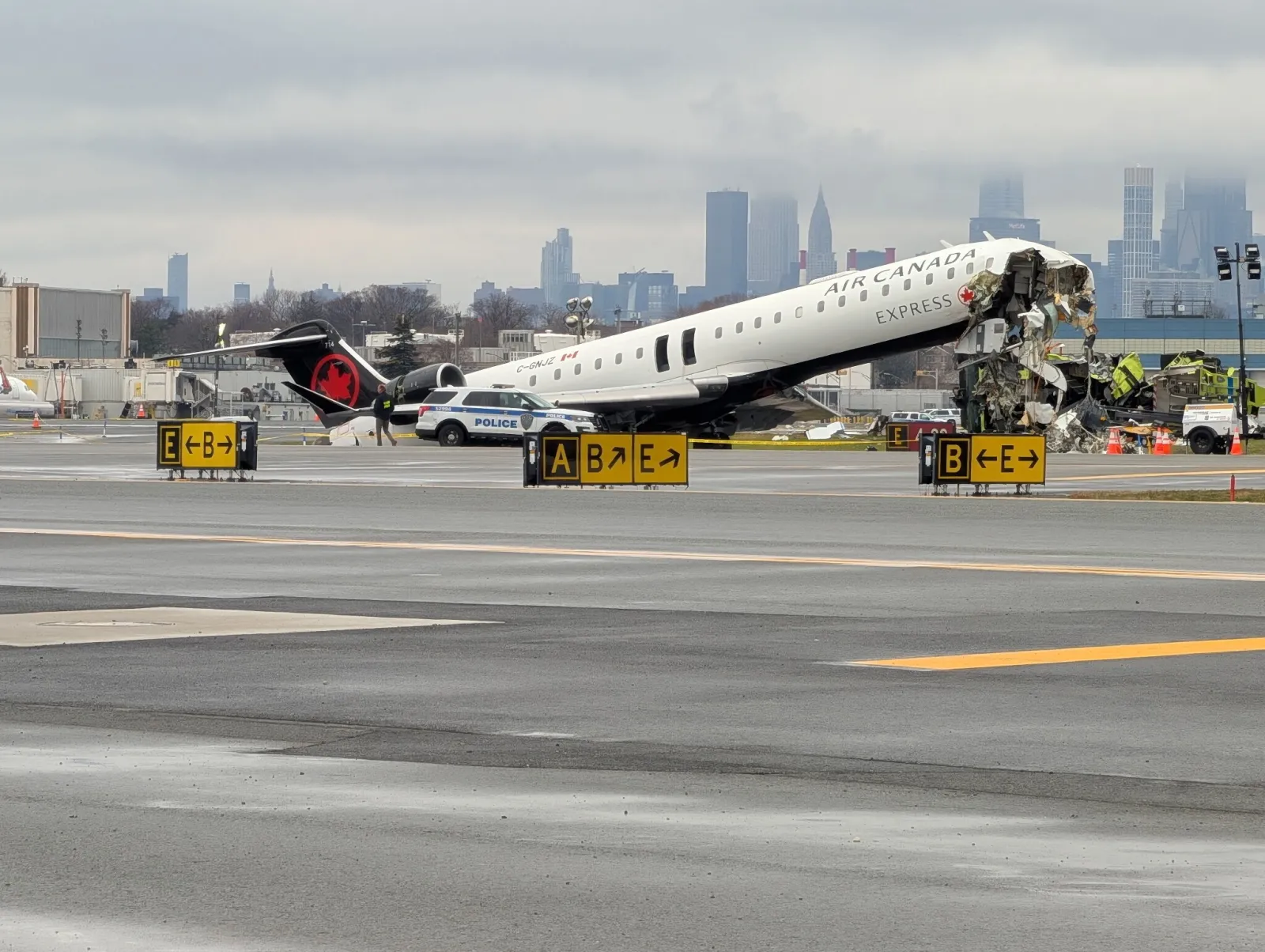
Surveillance video reviewed by the NTSB captured the collision, while passenger video showed evacuations across the wing after the aircraft came to rest with its nose sheared and tail down, according to investigators and contemporaneous media footage.
An air traffic recording captured a controller urgently ordering “Stop, stop, stop, truck one, stop,” seconds before impact during the landing rollout.
LiveATC recordings reviewed by reporters indicated a controller later told a pilot, “I messed up,” following the collision, which occurred minutes after crews responded to a separate United Airlines emergency that had aborted takeoff because of a cabin odor, according to published accounts and federal officials.
NTSB Provides Preliminary Black-Box Findings Recovered From Air Canada Plane
The NTSB said it recovered an ACRON Aviation cockpit voice recorder with over 25 hours of audio and a flight data recorder with roughly eight hours of data and more than 400 parameters.
Preliminary CVR timing showed LaGuardia Tower cleared the jet to land on Runway 4 about 1 minute 52 seconds before the recording ended, with standard callouts at 1,000, 500, 100, 50, 30, 20 and 10 feet preceding touchdown, John Douglas, NTSB Board Member, said during the news conference.
The first officer initially flew the approach and transferred control to the captain six seconds before the recording ended, investigators said.
Audio traffic recorded during the incident showed that the air traffic controller ordered the truck to stop nine and four seconds before the crash, the NTSB said during the news conference.
Homendy said the ASDE‑X “did not generate an alert due to the close proximity of vehicles merging near the runway, resulting in the inability to create a track of high confidence,” and confirmed Truck 1 did not have a transponder.
She added that two controllers were in the tower cab—the local controller and the controller‑in‑charge—performing combined positions typical of the midnight shift, with further interviews scheduled.
LaGuardia Reopens After Plane Crashes Into Firetruck
LaGuardia reopened Monday afternoon, nearly 14 hours after the Air Canada Express CRJ‑900, operating as Flight 8646 from Montreal with 72 passengers and four crew, collided with a Port Authority aircraft rescue and firefighting truck during landing late Sunday, officials said.
The runway where the collision occurred remained closed and was expected to stay shut for days as investigators processed extensive debris. The airport is operated by the Port Authority of New York and New Jersey.
FAA advisories indicated Runway 4 would remain closed through at least Friday morning, while the airport continued reduced operations and carriers canceled or retimed flights in response.
Latest Wait Times at LaGuardia Airport
On Tuesday, roughly one quarter of LaGuardia flights were canceled, and average delays exceeded four hours as the closed runway constrained schedules, according to flight‑tracking and federal advisories.
Passengers also faced hourslong TSA security lines tied to a nationwide staffing shortage during a partial government shutdown, though there is no evidence the shutdown contributed to the collision; air traffic controllers continued to be paid.
Travelers reported rolling updates from airlines as operations restarted, and airport officials warned that disruption would persist while investigators worked the scene and the runway remained closed.
What People Are Saying
Jennifer Homendy, NTSB chair, said in a news conference Tuesday: “ASDE‑X did not generate an alert due to the close proximity of vehicles merging near the runway, resulting in the inability to create a track of high confidence.”
U.S. Transportation Secretary Sean Duffy said Tuesday, as reported by The New York Times: “LaGuardia is a very well‑staffed airport,” though “a couple of controllers short overall.”
Captain Jason Ambrosi, president of Air Line Pilots Association, said in a statement Tuesday: “These pilots dedicated their careers to the safe transport of passengers.”
What Happens Next
NTSB teams planned a cockpit voice recorder group meeting to produce a transcript, continued interviews with tower personnel and firefighters, and further verification of ASDE‑X and runway status light performance.
Investigators said they would map timing from flight data with ground movements, examine visibility and workload in the tower, and assess whether additional ground vehicle transponder requirements or procedural changes could be recommended.
FAA officials said they would support the NTSB investigation and review runway incursion mitigations, while the Port Authority managed a prolonged runway closure and debris removal.
A preliminary report typically publishes within about two weeks; a final probable cause can take a year or more.
Update 3/24/26, 3:24 p.m. ET: This article has been updated with more information.
View 0 Comments
Submit Correction
View Editorial & AI Guidelines