...

By Newsweek Editors
0
Share
Newsweek is a Trust Project member
See more of our trusted coverage when you search.Prefer Newsweek on Googleto see more of our trusted coverage when you search.
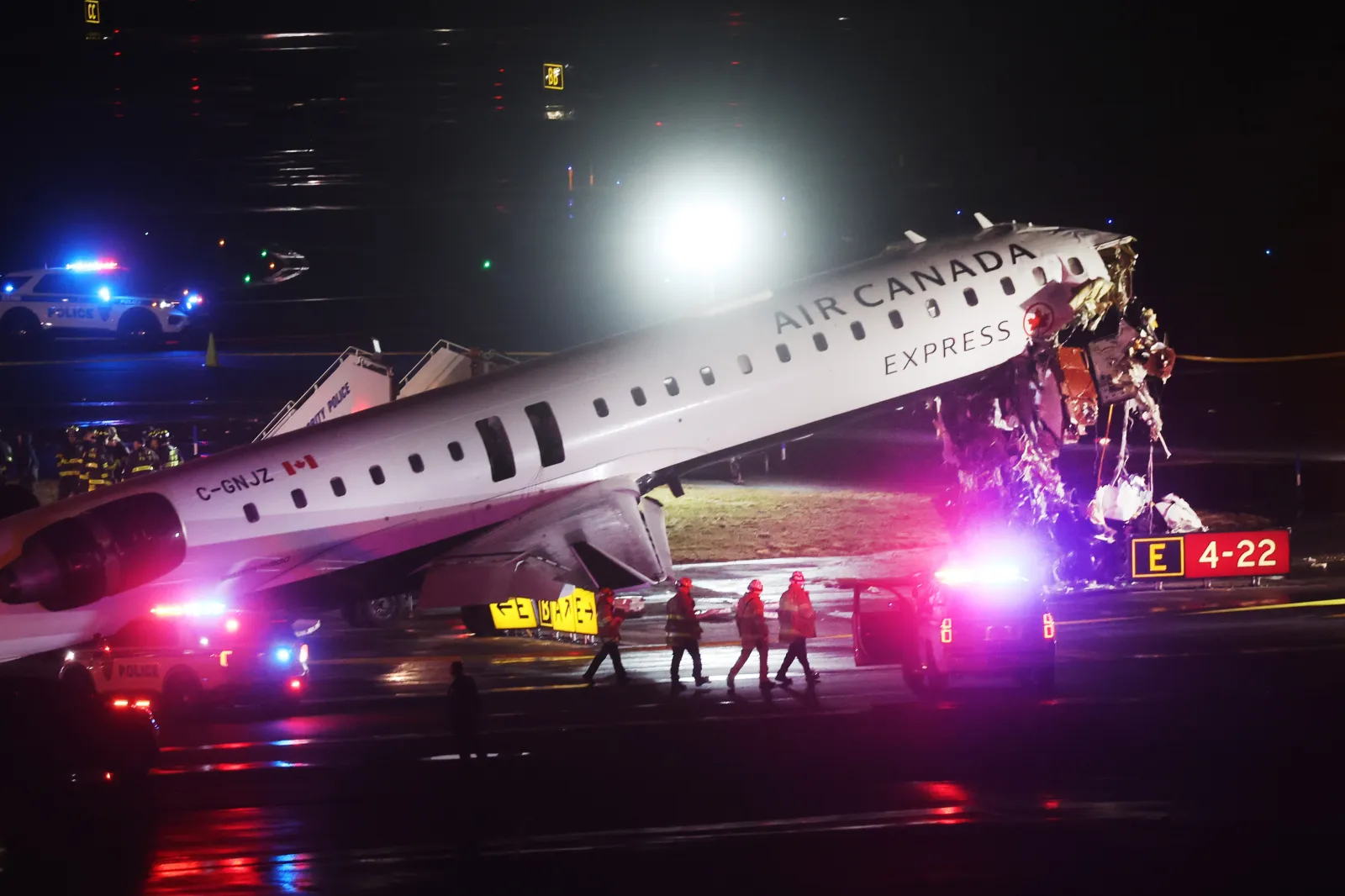
The deadly collision between an Air Canada Express regional jet and a Port Authority fire truck on Runway 4 at LaGuardia in New York late on Sunday night raises urgent questions about safety at one of America’s most constrained airports.
As investigators sift through air traffic control audio and staffing records, three issues stand out immediately.
Why Was a Single Controller Handling Both Runway and Ground Movements?
Initial reports suggest that one controller may have been responsible for both local (runway) and ground (taxiway and vehicle) operations at the time of the incident.
Read More on Analysis
At first glance, the idea that the same controller could clear an aircraft to land while also authorizing a vehicle to cross the same runway may seem unusual.
However, this is permitted under Federal Aviation Administration (FAA) rules, particularly during periods of lower traffic.
FAA Order 7110.65 allows tower positions to be combined when traffic volume permits. Late evening periods are often when such configurations are used, depending on local procedures and staffing.
According to preliminary air traffic control audio, the controller appears to have cleared a fire vehicle to cross Runway 04 at Taxiway D, and then attempted to rescind that clearance shortly afterward as an arriving CRJ-900 was completing its landing rollout.
The precise timing and sequencing of those instructions will be a central focus of the investigation.
Although LaGuardia is a major airport, it typically reduces staffing at night as scheduled arrivals taper off in the late evening hours. The configuration itself, therefore, may not have been unusual.
What remains under scrutiny is whether that setup was appropriate given the operational context, including weather conditions, airport layout, and the presence of an apparent ground emergency.
What Role, if Any, Did Staffing Pressures Play?
Staffing is likely to be one of the most closely examined aspects of the incident.
LaGuardia, like many U.S. airports, operates amid broader system-wide pressures, including air traffic controller shortages and fatigue concerns that have been highlighted by unions and lawmakers.
There is no public evidence at this stage that the controller involved was working excessive hours.
However, a single controller being responsible for coordinating both runway operations and vehicle movements could be significant, particularly as the fire truck was reportedly responding to a separate aircraft emergency involving a rejected takeoff, which, according to CNN, involved an unknown odor in the cockpit that required urgent attention.

...
That scenario, if confirmed, would mean the controller was managing routine arrivals alongside an active emergency response.
Weather conditions may also have played a role.
NBC New York reported heavy rain and reduced visibility in the area Sunday night, which could have increased workload and reduced margins for error in an already constrained runway environment with limited stopping distance.
Investigators will examine whether staffing levels and operational configuration matched the complexity of the situation, which may have exceeded what traffic volume alone would suggest.
Emergencies, by their nature, introduce unpredictability, making coordination, communication, and training critical safeguards.
Was This an Easily Preventable Tragedy?
That is ultimately a question for investigators, and one that the National Transportation Safety Board (NTSB) will address after a full review of the evidence.
The sequence appears to involve a runway crossing clearance that may have been issued and then rescinded as an aircraft was landing. However, it is too early to draw firm conclusions about causality or fault.
Air traffic control audio circulating publicly includes a controller expressing apparent frustration in the aftermath—including saying "I messed up"—though such statements are not, in themselves, determinations of responsibility.
Aviation incidents are rarely the result of a single error. Instead, they tend to reflect a chain of factors that span the operational, environmental, and human.
LaGuardia’s tight layout leaves little margin for delay or misjudgment. Emergency vehicles crossing active runways is a routine but carefully managed operation that depends on precise timing and situational awareness.
Even small timing discrepancies can have serious consequences when an aircraft is still traveling at significant speed after touchdown.
Beyond staffing and configuration, there is also a less visible procedural backdrop shaping how controllers manage arrivals and runway use.
Under FAA Order JO 7110.65, U.S. air traffic rules allow controllers to clear a following aircraft to land if they can ensure that required runway separation will exist when the aircraft crosses the landing threshold, sometimes described as an "anticipatory" clearance.
In other systems, landing clearances are often issued more conservatively, typically based on reasonable assurance of separation and runway occupancy. In practice, that can result in clearances being given later than is common in the United States.
That does not mean the FAA's rule caused this incident. But anticipatory clearances are likely to come under scrutiny in light of the crash.
Ultimately, whether this incident was easily preventable will depend on broader systemic questions.
Should emergency responses involve additional coordination layers? Should major airports default to separate runway and ground controllers even during lower-traffic periods? And should procedures governing runway crossings during arrivals be revisited?
Isolated Error, Faulty Assumptions
The LaGuardia crash may ultimately reflect ordinary procedures operating under challenging conditions.
Combining controller positions is permitted. Runway crossings by emergency vehicles are routine. What investigators must now determine is whether the combination of those factors—along with weather, workload, and airport constraints—created a situation in which the margin for error was too small.
The investigation will seek to establish whether this was an isolated human error or a signal that existing staffing assumptions and operational practices at busy U.S. airports may need to be reassessed.
Similar Incidents
There are at least two high-profile incidents in the public memory that share similarities with the LaGuardia crash.
On November 18, 2022, a LATAM Perú Airbus A320neo operating Flight 2213 struck an airport fire vehicle during its takeoff roll at Lima’s Jorge Chávez International Airport.
The vehicle had driven onto the runway as part of an emergency response drill. Although the crew aborted the takeoff, the aircraft still hit the truck, triggering a fire and causing extensive damage.
All passengers and crew survived, but three firefighters were killed and several people on board were injured.
Decades earlier, on October 31, 1979, a Western Airlines DC-10 crashed at Mexico City International Airport after landing on a runway that had been closed for maintenance in low-visibility conditions.
The aircraft hit construction equipment on the runway and broke apart, killing 72 of the 88 people on board as well as one person on the ground.
Investigators later pointed to a combination of poor visibility, descent below minimums, and failures to identify the correct runway, compounded by inadequate closure markings.
Hey gang, Carlo Versano here. I hope you enjoyed this article. As Newsweek's Director of Politics and Culture and editor of the 1600 newsletter, I'm keen to hear what you think. Now, Newsweek is offering a new service to allow you to communicate directly with me in the form of a text message chat. You can sign up and get a direct line to me, as well as the reporters who work for me. You can shape our coverage.
As a Newsweek member, we're offering this service to you for free. You can sign up below, or read more about how it works here. Let's talk!
View 0 Comments
Submit Correction
View Editorial & AI Guidelines