
...

By Soo Kim
Reporter
0
Share
Newsweek is a Trust Project member
See more of our trusted coverage when you search.Prefer Newsweek on Googleto see more of our trusted coverage when you search.
Maggie Kang, the creator and co-director of KPop Demon Hunters, unveiled some hidden meanings and Easter eggs you may have missed in the smash hit film on Netflix—including a special cameo—in a new interview on South Korean television.
Produced by Sony Pictures Animation, KPop Demon Hunters is Netflix's biggest film of all time, outranking previous Hollywood blockbusters, including Red Notice, Don't Look Up and The Adam Project, on viewership figures, according to the streamer.
Its original soundtrack has topped the rankings across several charts on Billboard, Spotify and others worldwide, including in the United States.
Read More on Entertainment
KPop Demon Hunters, which sees a K-pop girl group fight to keep demons from taking humans from the Earth, marks Kang's debut as a film director, after having worked in animation for around 20 years.
She'd always wanted to see an animation film that showcases the culture of South Korea and was waiting to get involved if one came her way. But when none came along, she thought "Should I try to make one myself?" she revealed this week on You Quiz on the Block, a South Korean television talk show hosted by Korean comedians Yoo Jae-suk and Jo Se-ho.
...
The idea of featuring demons in the film came about quite organically, as Kang felt the "Jeoseung Saja," the Korean Grim Reaper figure, was unfamiliar in the Hollywood landscape, and could be a good cultural element to depict in a film.
"A lot of studios were wanting to do a K-pop film or project, but it had yet to be made. So, I thought 'should I try to make this as well?' and put the idea of K-pop idols and demon hunters together, and it seemed like a good concept," Kang said.
A 'Fun' Idea for KPop Demon Hunters Sequel
Seven years in the making, no one could have predicted the film's runaway success and a KPop Demon Hunters sequel is already reportedly on the cards, just three months since its premiere on June 20. The film's co-director Chris Appelhans told Newsweek last month that he and Kang are "excited to explore what's next" for the budding franchise.
Yoo and Jo also believe a sequel is "a must" for KPop Demon Hunters. While Kang was a bit coy when the hosts spoke of the sequel as a definite go-ahead, she agreed with a resounding "yes" at a possible scene proposed for the sequel.
Jo suggested it "could be fun" to have HUNTR/X, the film's fictional girl band, be "featured as guests on You Quiz on the Block" in the sequel, to which Kang immediately responded, saying: "Ooh, that'd be great. Yes, I like it. That's fun," giving it a thumbs-up with both hands.
A Secret Cameo
The film boasts a star-studded cast, including Squid Game star Lee Byung-hun, but there is one cameo who most viewers may have missed—that being none other than Kang herself.
The director was the voice for three characters, including one in the first scenes of the film—a demon disguised as a flight attendant who waters a flowerpot with a pot of coffee.
Kang was also the voice of a demon K-pop fan who was shown crying in the underworld and the voice for a news announcement that appears in the background when the "Honmoon," a magical barrier in the film that seals the demons away from the Earth, had disappeared.
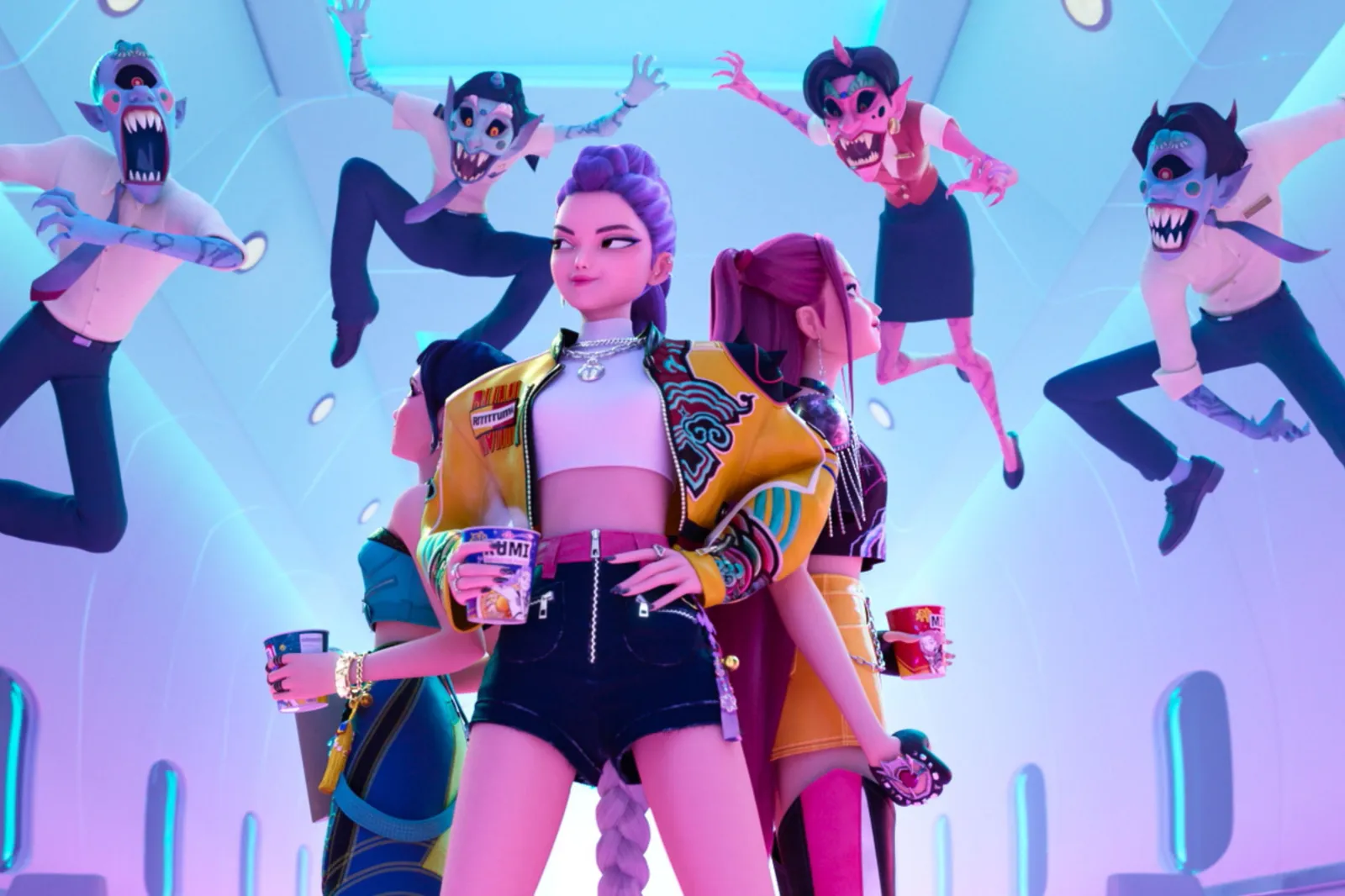
...
Easter Eggs and Hidden Meanings
Beyond the portrayal of K-pop culture, the movie is full of references highlighting different aspects of Korean history, traditions and culture, both old and new, in incredible detail.
Several of these features come with a personal meaning hidden behind them for Kang, such as the public bathhouse setting and the "haneuiwon," a traditional Korean medicine clinic that HUNTR/X visits, both of which Kang remembers frequenting during her early childhood in Korea before moving to Canada, she said on the Korean talk show.
The iconic scene where the Saja Boys, the film's fictional boy band, make their debut performance of "Soda Pop," was set in Myeong-dong, the famed neighborhood and shopping area for tourists.

...
Kang explained: "Typically busking [or music performances like the Saja Boys did in their debut] happens in Hong-dae [a neighborhood in Seoul known for its music scene and nightlife]. But I chose instead to make Myeong-dong the setting for this scene because I was born in Myeong-dong, and my parents met while working in an office there."
"It's sort of a special place to me, so I went with Myeong-dong as the backdrop," Kang said.
Rumi from HUNTR/X, the film's lead female character, is also named after Kang's own daughter, who voices the younger Rumi in the film.

...
The film's showcase of Seoul's attractions and detailed depictions of life in South Korea, from all the Korean food featured to the look of the sun visor-wearing old Korean local ladies, strived to be as accurate as possible—even down to the food table settings, where chopsticks are placed on a napkin.
HUNTR/X are also shown tucking into their snacks while seated on the floor, even though they have a couch, mirroring some typical Korean dining customs.
"These details are not just my own ideas," Kang said, "but a result of the efforts of the many Korean artists from different departments who worked on the film." She recalls her "Korean crew" pointing out that the placement of the rice and the soup bowl on the table was incorrect and needed to be swapped.

...
Beyond the settings, the characters themselves featured many traditional Korean cultural touches, from the "hanbok," the Korean traditional garment, worn by the Saja Boys, to the "norigae," a tassel-like accessory that goes with hanbok and was worn by the members of HUNTR/X, to the different traditional swords carried by each member when fighting demons.
"I watched a lot of like 'sageuk' [Korean period dramas and films]...so I was familiar with a lot of traditional looks," the director said, noting that she really wanted to "show the history of Korea through the story" of KPop Demon Hunters.
Derpy, the enchanting blue tiger belonging to Jinu from the Saja Boys, and its six-eyed magpie sidekick, are both figures featured together in Korean folk art. The look of Derpy, who was designed by Kang's husband, was also inspired by the couple's two "flat-faced" Himalayan cats, the director said.

...
Self-Doubt and 'Finding Your Inner Strength'
Asked how it was to see the film be released after working on it for seven years, Kang said she stayed up to catch the premiere on Netflix and upon seeing it, "I just cried," she said, and was overwhelmed by a flood of tears.
Kang said: "To be honest, while I was making the film, I thought a lot about whether Koreans would be receptive of this film and if I was worthy of making a film like this [that aims to represent South Korea] because I hadn't lived in Korea for very long and lived abroad for many years."
"I'm just so grateful to all the fans for all the love. I never expected this much really," Kang said, noting: "I told my husband that if people don't like this movie, I should probably not make another one because I put so much of my heart into it."
Similar to Kang's own journey with self-doubt, the message of this film is about "overcoming your inner demons—the things that you want to hide about yourself, things that you don't want the world to see," as Rumi does in the film, she explained.
"They will never go away," Kang noted, but "you will always overcome these demons."
She said: "It's not about accepting your inner demons but recognizing that they're there and finding your inner strength within that."
KPop Demon Hunters is available for streaming on Netflix.
View 0 Comments
Submit Correction
View Editorial & AI Guidelines