10
Loading video...

By Khaleda Rahman
National Correspondent
0
Share
Newsweek is a Trust Project member
See more of our trusted coverage when you search.Prefer Newsweek on Googleto see more of our trusted coverage when you search.
For much of his political career, Texas Attorney General Ken Paxton has avoided political debates with his rivals.
That strategy has so far continued, with Paxton having yet to agree to a single debate against his Democratic opponent, James Talarico.
Yet, with just weeks to go until Election Day, the pressure is building in a closely contested race for U.S. Senate in Texas.
Read More on News
A series of recent polls have found Talarico either narrowly ahead of or locked in a statistical dead heat with the scandal-plagued Republican nominee. This has raised concerns that the Democrats, in their bid to win a Senate majority, could triumph in a state that hasn’t elected a Democratic senator since 1988.
Paxton and almost every Republican nominee for a statewide seat in Texas appear to be avoiding debating their opponents this cycle. President Donald Trump’s slipping approval ratings amid the Iran war and rising gas prices have threatened Republicans in almost every state, according to recent national polling averages.
Talarico, a state lawmaker from Austin, has been calling for a debate with Paxton for months. He publicly challenged Paxton in July to three televised debates. He said that Paxton’s "handlers claim he’s willing to debate, but every time a reporter asks a question, he literally runs away." Last month, Talarico invited Paxton to debate him on Fox News.
Paxton’s campaign said in July that he would debate his opponent, but later objected to some proposed moderators. It was later suggested an agreement was imminent, but nothing was announced.

...
Paxton has avoided debating his Democratic opponent during each of his three runs for Texas attorney general in 2014, 2018 and 2022. However, the Senate race is his highest-profile campaign to date.
This time, calls for a debate have also come from Trump and other Republicans. That has fueled speculation that Paxton could eventually step onto a stage against a candidate viewed as one of the Democrats' strongest recruits in a generation.
Newsweek has contacted the Paxton and Talarico campaigns for comment via email and is awaiting responses.
Trump Calls for Debate
When Talarico stopped holding campaign events after falling ill with the flu, Paxton saw an opportunity to attack his opponent.
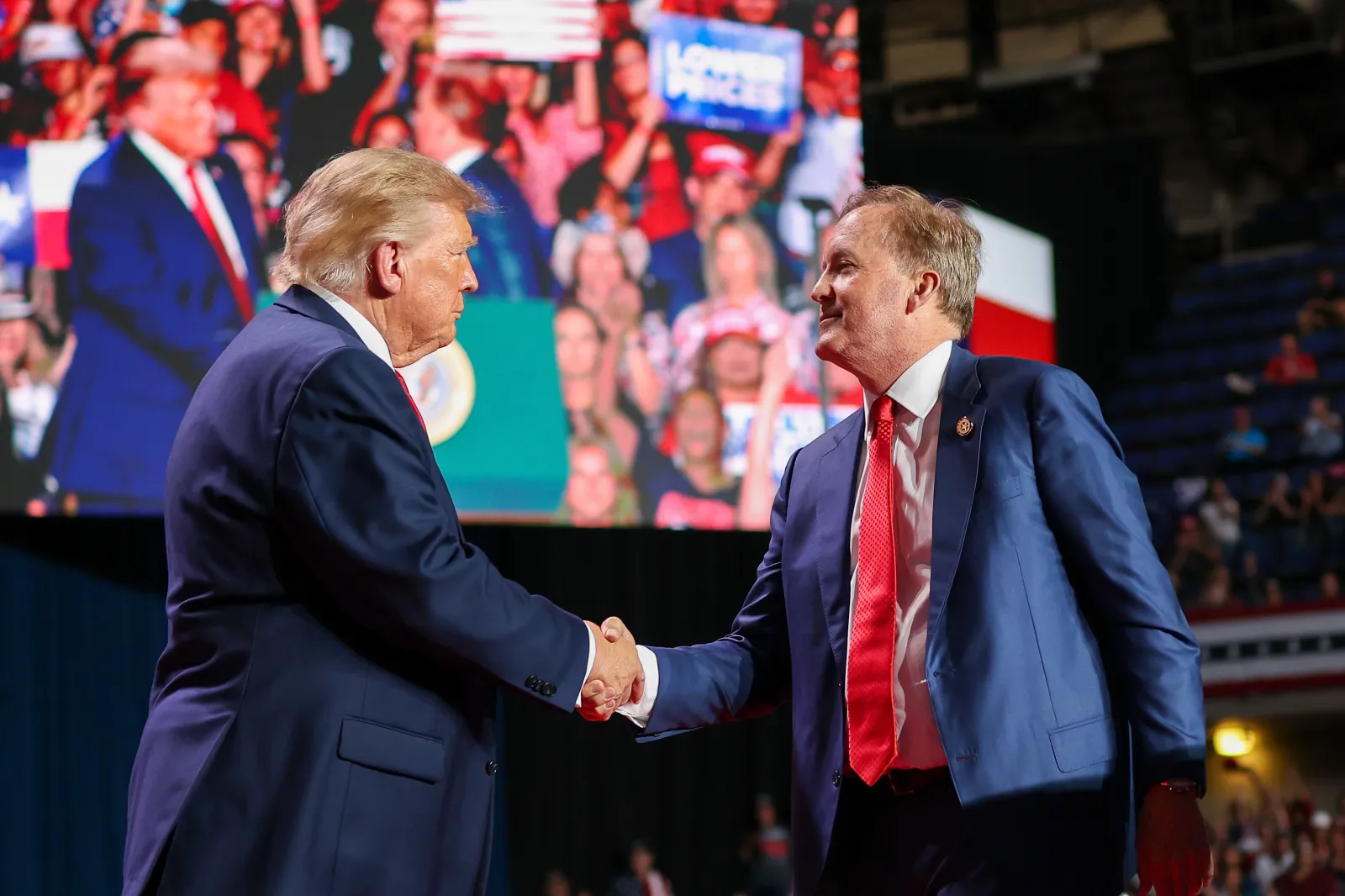
He noted Talarico's absence from the campaign trail at a campaign rally with Trump in San Antonio on Wednesday. "Where is James Talarico?" Paxton said.
Wednesday’s appearance marked Trump's third visit to Texas in less than a month. It was a reflection of how the reliably red state has become an unexpected battleground this election cycle.
That night, while flying back to Washington, Trump attacked Talarico for his absence in a post on his Truth Social platform by calling for the debate that Paxton has avoided.
Talarico "should immediately report to the Debate Stage against Ken Paxton," who is "ready, willing, and able," the president wrote.
Talarico quickly responded, agreeing to debate. "President Trump just said Ken Paxton should debate. I agree. Ball’s in your court @KenPaxtonTX," the Democrat wrote on X.
...
Paxton has yet to publicly respond to the demand for a debate. However, he has continued to troll Talarico for his absence from the campaign trail.
Republican strategist Karl Rove has suggested that refusing to debate Talarico could doom Paxton’s bid for Senate.
"If he doesn’t debate, I think he loses," Rove said during an appearance at The Economic Club of Chicago last week.
Could Paxton Agree to Debate Talarico?
Cal Jillson, a political-science professor at Texas' Southern Methodist University, told Newsweek that he doesn’t believe Paxton will agree to a debate.
"Somewhat surprisingly, Republican candidates, most of them incumbents, in Texas statewide races, continue to refuse to debate their Democrat challengers, even as their polling leads disappear," Jillson said.
"Usually, challengers and/or trailing candidates clamor for debates while incumbents leading in the polls refuse."
Jillson said Paxton is "a peculiarly weak candidate and a poor debater to boot, so it is less surprising that he is declining to debate even as he has fallen behind in the polls.

...
"His bet, or maybe hope, is that the tens of millions of dollars national Republicans are pouring into this race late will pull it out for him. I don't expect him to change his mind."
Grant Davis Reeher, a political-science professor at Syracuse University, told Newsweek that, if both Trump and Rove are calling for Paxton to debate Talarico, it "will start to hurt him" if he doesn’t.
"It’s usually a negative for candidates to be seen avoiding debates—particularly the refusal to participate in just one or two, even though most voters will also tell you that the debates are not that helpful," Reeher said.
"But it creates the impression that the candidates are afraid to defend their positions and their records, and have something to hide."
Costas Panagopoulos, a professor of political science at Northeastern University, said declining to debate could be damaging for Paxton; it suggests he "is unwilling or unable to stand up against his opponent on equal footing."
"If he refuses to debate his opponent in Texas to make a case for his candidacy, voters may wonder what business he has to be in the U.S. Senate, where effective debate is the coin of the realm," Panagopoulos told Newsweek.
"It gives Talarico ammunition to suggest Paxton lacks the confidence and willingness to stand up for his beliefs and positions and subject them to public scrutiny."
But Reeher said that agreeing to a debate could have political downsides for Paxton.
"His history of avoiding them suggests that he is not comfortable with the medium, so he might be playing into his weakness," he said. "Second, if there’s a highly watched debate, and Talarico does not come off like the far-left extremist that Paxton has tried to paint, it could further help undecided voters get more comfortable with him."
Jillson said that, while debates remain symbolically important, there is little evidence that voters punish candidates who refuse.
"Voters expect candidates to debate, whether they actually intend to watch those debates or not, but they don't seem to punish candidates that refuse to debate," he said.
"I think that is the case here too as opinions, most of them negative, on Paxton are set and unlikely to change. The Texas Senate race will turn on attitudes toward Paxton and Talarico, though a fresh face with plenty of money in a good Democrat year will just be the receptacle for the anti-Paxton vote."
Ken Paxton vs. James Talarico: What Latest Polls Show
Talarico holds a three-point lead in Decision Desk HQ's polling average as of Friday. Meanwhile, RealClearPolling's average of polls gives him a 2.8 point lead.
A YouGov poll of 3,625 likely voters, conducted September 28 to October 5, found Talarico with a six-point lead, 50 percent to 44 percent, with 3 percent undecided. That survey had a margin of error of plus or minus 3 percent.
A UMass Lowell/YouGov poll released on Thursday found Talarico and Paxton tied with 45 percent support each and 7 percent of respondents undecided. The survey was conducted among 850 likely Texas voters from September 18 to 28 and has a margin of error of plus or minus 4.5 percent.
A new Guidant Polling & Strategy survey released on Tuesday found Talarico narrowly leading Paxton, 47 percent to 44 percent. The poll surveyed 800 likely Texas voters between September 20 and September 28 and has a margin of error of plus or minus 3.46 percent.
Other recent polling also suggests the race is tight.
A recent New York Times/Siena College survey also showed Talarico with a six-point lead, while a poll by Fox News gave him a two-point lead.
Newsweek’s reporters and editors used Martyn, our AI assistant, to produce this story. Learn more about Martyn here.
Contact Newsweek editors on this story: John Fitzpatrick and James Debens
View 0 Comments
Submit Correction
View Editorial & AI Guidelines