10
Loading video...

By Khaleda Rahman
National Correspondent
0
Share
Newsweek is a Trust Project member
See more of our trusted coverage when you search.Prefer Newsweek on Googleto see more of our trusted coverage when you search.
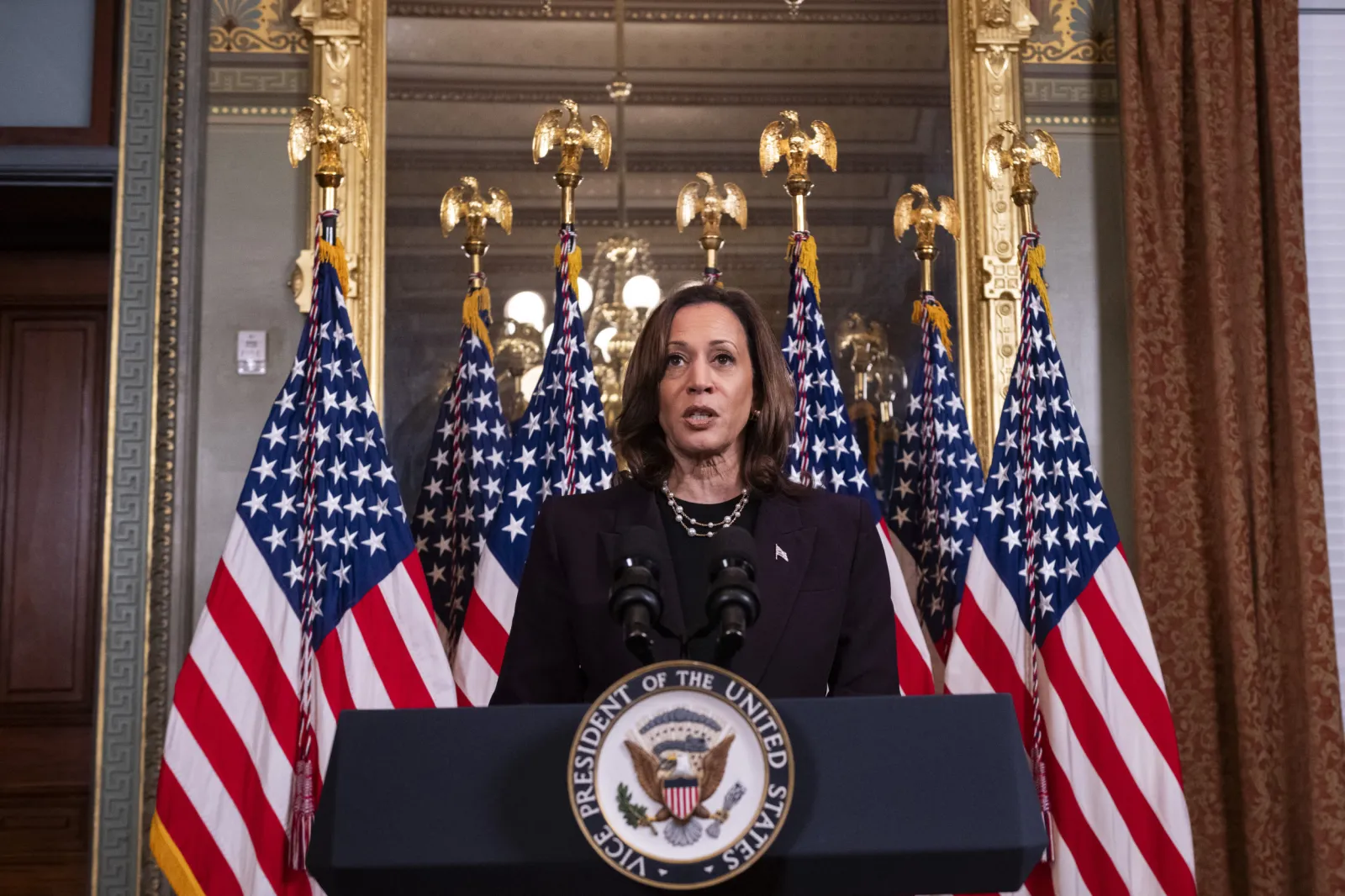
Vice President Kamala Harris' remarks after meeting with Israeli Prime Minister Benjamin Netanyahu on Thursday suggest a shift in the White House's language on Israel's war in Gaza.
Harris, the presumptive Democratic nominee for president after Joe Biden dropped out of the race on Sunday, said she supports Israel's right to defend itself and that she and President Biden are "working every day" to bring home hostages being held in Gaza.
But her remarks also emphasized the widespread suffering of Palestinians in Gaza as she urged Netanyahu to reach a ceasefire deal.
Read More on Politics
"What has happened in Gaza over the past nine months is devastating," she said. "The images of dead children and desperate, hungry people fleeing for safety sometimes displaced for the second, third, or fourth time. We cannot look away in the face of these tragedies. We cannot allow ourselves to become numb to the suffering. And I will not be silent."
Harris' remarks "certainly stand out, and it stands out in contrast to what the president has said," Chuck Freilich, a senior fellow at the Institute for National Security Studies in Tel Aviv and a former Israeli deputy national security adviser, told Newsweek on Friday.
He said he believes past comments from Harris have been more forceful.
"Too many innocent Palestinians have been killed," she said during a visit to Dubai in December last year. "Frankly, the scale of civilian suffering and the images and videos coming from Gaza are devastating."
In March, she said: "People in Gaza are starving. The conditions are inhumane. And our common humanity compels us to act. Given the immense scale of suffering in Gaza, there must be an immediate ceasefire for at least the next six weeks."
...
Freilich said he believes Harris is "trying to set out a more balanced position" now that she is the front-runner to replace Biden at the top of the Democratic ticket and face former President Donald Trump in November.
If she wins the presidency, Harris will "remain fully committed to Israel's basic security, but I think she will be more critical on the Palestinian issue," he said.
There is a "different tone coming from Harris, which I expected," Grant Davis Reeher, a political science professor at Syracuse University, told Newsweek.
Appealing to voters who are angry about the administration's response to the war is likely "one of the goals, and it probably also reflects the vice president's own views more closely," he said. "What she has to watch out for—and this applies to all her messaging, not just regarding the war in Gaza—is that these changes in position can cut both ways. She could lose voters and appeal as well as gain them."
Thomas Gift, an associate professor of political science and director of the Centre on U.S. Politics at University College London, told Newsweek that it is "possible to read too much into the language of one speech by Harris regarding her approach to Gaza."

...
Harris is still a spokesperson for the Biden administration, he said, so she "has to walk a delicate tightrope in articulating the White House's positions and carving out her own.
"The war is a lose-lose situation politically for Harris, and the more her campaign can avoid directly discussing the issue, the less likely it will be to alienate voters who care deeply about the conflict on both sides," Gift said.
An aide to Harris told Newsweek that Biden and Harris "delivered the same message in their private meetings to Prime Minister Netanyahu: it's time to get the ceasefire and hostage deal done. And this is what the vice President said publicly as well."
The aide added that the public comments "tracked with her previous comments on the conflict. She started with underscoring rock-solid support for Israel and then expressed concern about civilian causalities and the humanitarian crisis in Gaza, as she always does. The meeting between Prime Minister Netanyahu and Vice President Harris was serious and collegial."
The nine-month war has killed at least 39,000 Palestinians to date, The Associated Press reported, citing the Gaza Health Ministry. It has created a humanitarian catastrophe, displaced much of the territory's population of 2.3 million, and sparked widespread hunger.
The war erupted after the Palestinian militant group Hamas launched an attack on Israel that killed 1,200 people. Dozens of hostages taken during the attack remain in Hamas captivity.
Zara Rahim, a former Barack Obama staffer, said on social media that it may have been the first time the White House has explicitly referred to "dead children" when speaking about the Palestinian civilians killed in Gaza.
"They famously love to say obtuse things like 'loss of life'... The linguistic gymnastics employed to sterilize the very basic reality that thousands of children are dead and under the rubble. This is not an 'improvement', but it is the truth," Rahim wrote on X, formerly Twitter.
Biden earlier this year acknowledged that Palestinian civilians have been killed using bombs sent by the United States to Israel, but he has not spoken explicitly about children killed in Gaza.
Speaking about Hamas' October 7 attack while expressing support for Israel's war, he had claimed he had seen pictures of "terrorists beheading children." The White House later clarified that Biden and U.S. officials had not actually seen pictures or independently confirmed the reports.
Others on social media also suggested Harris' latest remarks marked a change in the White House's tone.
"A welcomed shift," actor Mark Ruffalo, who has repeatedly decried Israel's actions in Gaza and called for a ceasefire, wrote on X. "What a breath of fresh air to hear some humanity, compassion, and thoughtfulness brought into this conversation."
Biden's steadfast support for Israel despite the increasing death toll in Gaza was among his major vulnerabilities ahead of November's election, with some critics dubbing him "Genocide Joe."
That anger was seen during the Democratic primary in battleground state Michigan, which has a large Arab American community, when more than 100,000 people cast "uncommitted" ballots in protest.
In her latest remarks, Harris did not suggest any deviation from the Biden administration's policy on Israel or mention cutting military aid. But she addressed those who the ongoing bloodshed has angered.
"To everyone who has been calling for a ceasefire and to everyone who yearns for peace, I see you, and I hear you," she said.
Earlier on Thursday, she issued a statement condemning the burning of the American flag and other actions by protesters demonstrating against Netanyahu's visit.
"Pro-Hamas graffiti and rhetoric is abhorrent, and we must not tolerate it in our nation," she said. "I condemn the burning of the American flag. That flag is a symbol of our highest ideals as a nation and represents the promise of America. It should never be desecrated in that way."
She added: "I support the right to peacefully protest, but let's be clear: Antisemitism, hate and violence of any kind have no place in our nation."
Update 7/26/24, 9:30 a.m. ET: This article has been updated to add comments from an aide to the vice president and Grant Davis Reeher.
View 0 Comments
Submit Correction
View Editorial & AI Guidelines