10
Loading video...

By Andrew Stanton
Reporter
0
Share
Newsweek is a Trust Project member
See more of our trusted coverage when you search.Prefer Newsweek on Googleto see more of our trusted coverage when you search.
A new Emerson College poll revealed which Democrats have the strongest lead over Vice President JD Vance and Secretary of State Marco Rubio in a 2028 presidential election matchup.
The presidential field could soon start to take shape. Candidates typically begin announcing their runs after the midterms, though it’s not unprecedented for candidates to jump in even before those elections. Prospective candidates are already testing their messages and heading to key primary states to build their name recognition and make inroads with voters.
Although the first votes won’t be cast for more than a year, polls can signal which candidates have early momentum among the electorate.
Read More on Politics
Donors and voters can use these early signals to gauge a candidate’s viability, and the numbers matter to a candidate's ability to fundraise and garner media attention. They generally measure initial name recognition among potential candidates and can change once the primary season kicks off.
The Democratic field is expected to be competitive and crowded, with individuals like former Vice President Kamala Harris, California Governor Gavin Newsom, New York Representative Alexandria Ocasio-Cortez, Georgia Senator Jon Ossoff and former Transportation Secretary Pete Buttigieg being named as potential candidates.
On the Republican side, Vance and Rubio are viewed as leading contenders if they choose to run.
...
Which Democrats Perform Best Against Vance and Rubio?
The new poll tested potential matchups of the 2028 general election. It surveyed 1,000 likely voters from August 16-17, 2026, and had a margin of error of ±3 percentage points. It was conducted in partnership with The Hill.
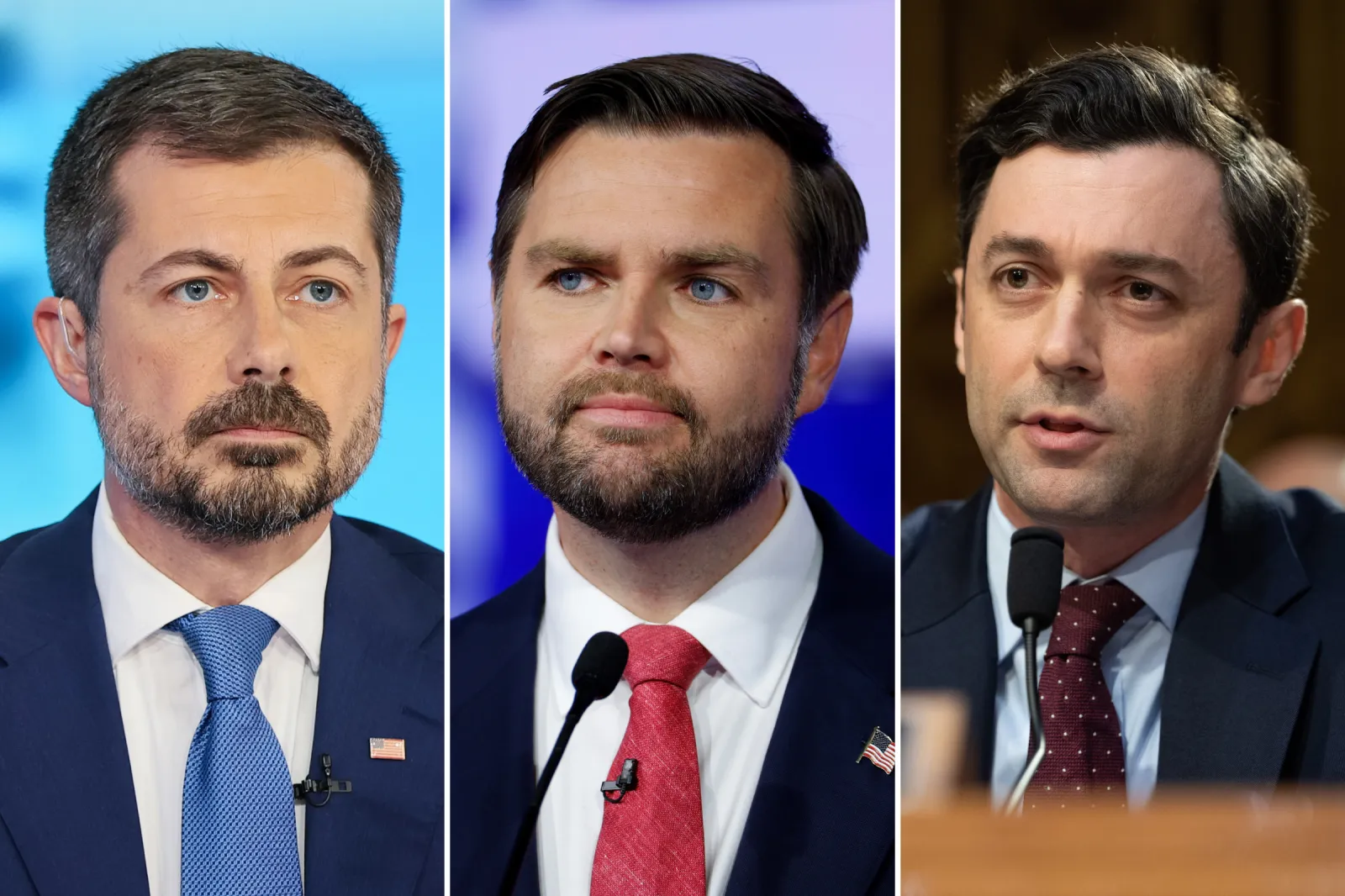
Buttigieg held 5-point leads against both Vance and Rubio, leading each Republican 49 percent to 44 percent, according to the poll.
Ossoff led Vance by 5 points as well, 49 percent to 44 percent, while he led Rubio by 3 points, 47 percent to 44 percent.
Newsom led Vance by 5 points, 49 percent to 44 percent and Rubio by 2 points, 48 percent to 46 percent, according to the poll.
Harris led Vance by 4 points, 49 percent to 45 percent. However, Rubio held a 5-point lead against Harris, 48 percent to 43 percent.
Meanwhile, both Republicans led Ocasio-Cortez, a favorite among progressives ahead of the primary. Vance led Ocasio-Cortez by 2 points, 46 percent to 44 percent, while Rubio held a 5-point lead, 48 percent to 43 percent.
Newsweek reached out to representatives for Buttigieg, Harris, Newsom, Ocasio-Cortez, Ossoff, Rubio and Vance for comment via email.
Who Is Leading Democratic Primary in the Polls?
The latest polls of the Democratic primary suggest the field remains splintered, though Harris, who is well-known across the electorate, has maintained a lead in recent surveys.
A Saint Anselm College Survey Center poll released this week shows Buttigieg in the lead with 25 percent, Ocasio-Cortez with 17 percent, Ossoff and Arizona Senator Mark Kelly tied at 12 percent, Newsom with 7 percent, Harris with 3 percent and other potential candidates with 2 percent or less.
The poll surveyed 1,411 New Hampshire likely voters overall on August 17 and August 18 and has a margin of error of 2.6 percent. The question regarding the Democratic primary surveyed 733 Democratic voters, with a 3.6 percent margin of error.
An Echelon Insights poll recently found Harris leading with 18 percent, followed by Buttigieg (13 percent), Newsom (12 percent), Ocasio-Cortez (11 percent), Kelly (7 percent), Pennsylvania Governor Josh Shapiro (6 percent) and Ossoff (5 percent). Several other candidates received less than 5 percent in the poll.
It surveyed 1,002 likely voters from August 13 to 17, 2026 and had a margin of error of ±3.4 percentage points.
A recent Emerson College poll found Buttigieg leading with 19 percent, followed by Newsom (17 percent), Ossoff (13 percent), Ocasio-Cortez (13 percent), Harris (8 percent), Kentucky Governor Andy Beshear (7 percent), and Shapiro (5 percent), with other candidates polling in the lower single digits.
The poll surveyed 1,110 likely voters from July 19 to 20, 2026, with a margin of error of ±2.9 percentage points.
Who Is Leading the Republican Primary in the Polls?
On the Republican side, a handful of potential candidates have been leading recent polling, though several others could also end up running.
The Echelon poll found Vance up with 39 percent, followed by Rubio (22 percent), Florida Governor Ron DeSantis (10 percent) and Donald Trump Jr. (8 percent). The Emerson College poll found Vance leading with 39 percent, closely followed by Rubio at 38 percent. DeSantis received 5 percent support.
The Saint Anselm College Survey Center poll found Vance leading with 38 percent compared to Rubio's 36 percent. DeSantis came in third with 5 percent and all other potential candidates landed 2 percent and below.
The question regarding the Republican primary surveyed 678 GOP voters, with a margin of error of 3.8 percent.
What Do Prediction Markets Show?
Prediction markets favored Democrats to win the presidency as of Thursday.
On Kalshi, Democrats had a 58 percent chance of winning the White House, up from 54 percent at the start of 2026 and 50 percent in January 2025. Meanwhile, Polymarket gave Democrats a 59 percent chance of flipping the White House in two years, up from 53 percent at the start of 2026 and 54 percent one year earlier.
Prediction markets let traders buy and sell contracts tied to political outcomes and current events, aggregating real-money wagers into probability estimates. Prices fluctuate as traders react to polling, fundraising, candidate developments and broader political trends. They measure trader sentiment at a given moment but do not always accurately predict the future.
What Have Potential Candidates Said About Running?
Vance
In June, Vance told CBS News he would discuss plans to run in 2028 after the midterms.
"I have no doubt that the president of the United States is going to be very supportive of anything that I ultimately decide to do," Vance told the news station. "But we really just haven't talked about what that thing will be."
Harris
Harris, who has traveled to states like Michigan and South Carolina in recent months, has suggested she could run again.
“I might. I am thinking about it,” she told the Reverend Al Sharpton in April after he asked during the National Action Network’s annual convention if she planned to run for president in 2028. Harris noted that she “served for four years being a heartbeat away from the presidency of the United States.”
“I spent countless hours in my West Wing office footsteps away from the Oval Office," she said. "I spent countless hours in the Oval Office and the Situation Room. I know what the job is, and I know what it requires.”
Newsom
Newsom discussed the possibility of running in a June 2025 interview with The Wall Street Journal.
“I'm not thinking about running, but it's a path that I could see unfold,” he said.
Newsom also told reporters in July that whether he joins the race would be determined by “fate.”
“I really believe it’s fate,” he said. “You meet the moment, you represent something where you can uniquely and distinctively make the case that your voice matters in a competitive field where there will be stadiums full of Democrats. Every conceivable stripe of Democrat will be on display.”
Ocasio-Cortez
Ocasio-Cortez addressed presidential speculation in May in a conversation with David Axelrod, a former adviser to former President Barack Obama.
"My ambition is to change this country,” she said. “Presidents come and go. Senate, House seats, elected officials come and go. But single-payer healthcare is forever. A living wage is forever, workers' rights are forever, women's rights, all of that, and so anyways...to a finer point to your question is that when you aren't attached, when you haven't been like fantasizing about being this or that since the time you were 7 years old, it is tremendously liberating."
Ossoff
Ossoff has said he does not plan to run.
“I have zero interest in running for president in 2028, and frankly zero interest in the 2028 fantasy football right now,” he said on MS Now.
What Happens Next
While there is no immediate deadline for a prospective 2028 presidential candidate to enter the race, political observers are likely to focus first on the outcome of the 2026 midterm elections on November 3. The results are expected to provide an early indication of the issues, voter coalitions and political figures that could shape the next presidential contest.
Following the midterms, potential White House hopefuls are expected to ramp up fundraising, travel to early-voting states and build campaign organizations ahead of what could become a crowded 2028 field. Primary calendars and candidate filing deadlines are not yet finalized, but the race is expected to accelerate significantly once the 2026 elections conclude.
Contact Newsweek editors on this story: Jason Lemon, Gray R. Thomas, Sam Wilson, Anna Commander
View 0 Comments
Submit Correction
View Editorial & AI Guidelines